
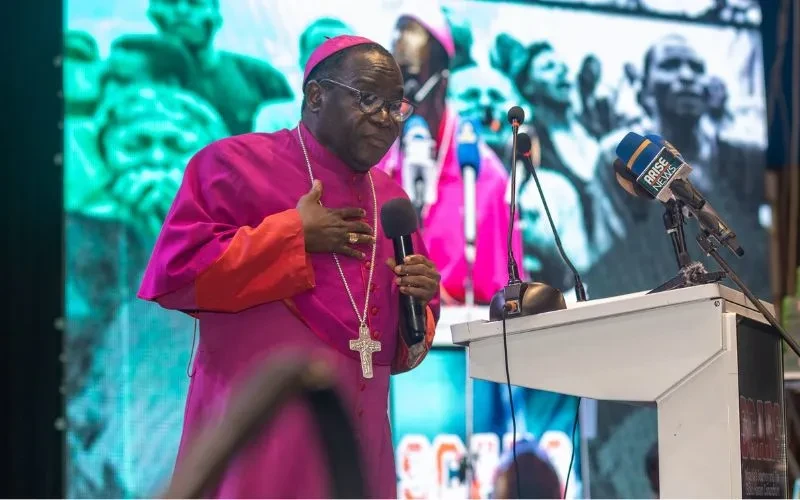
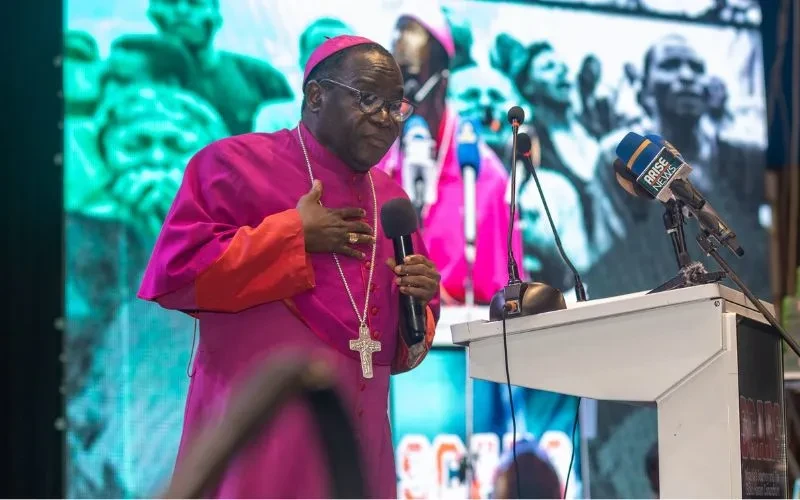
Bishop Matthew Hassan Kukah of the Catholic Diocese of Sokoto is the founder of The Kukah Centre, a Nigeria-based public policy institute. / Credit: The Kukah Centre
ACI Africa, Dec 3, 2025 / 10:00 am (CNA).
The Kukah Centre (TKC), a Nigeria-based public policy institute, has responded to what it describes as a “mischaracterization” of the remarks of its founder, Bishop Matthew Hassan Kukah, about the alleged genocide of Christians in the West African nation.
In a press release on Tuesday, the executive director of TKC, Father Atta Barkindo, blamed the media for its inadequate reporting of Kukah’s remarks, which he made during the launch of the 2025 World Report on Religious Freedom at the Vatican on Oct. 21, and in his subsequent address to the 46th Supreme Convention of the Knights of St. Mulumba (KSM) in Kaduna on Friday, Nov. 28.
Barkindo said what the media are reporting reflect neither Kukah’s remarks nor the context of his work spanning half a century.
“TKC has followed with humility and keen attention recent reports about remarks attributed to our founder, His Lordship Bishop Matthew Hassan Kukah, concerning the very current issue of the protection — or lack thereof — of the right to freedom of conscience, religion, and worship in Nigeria, particularly as it affects adherents of the Christian faith in northern Nigeria and related concerns about persecution of Christians,” Barkindo said.
He added that the foundation is “heartened by the heightened public interest in both the subject matter of religious freedom in Nigeria and in the views of our founder on the subject.”
At a gathering of KSM in Kaduna on Nov. 28, Kukah reportedly reaffirmed his view that current claims of a genocide or systematic persecution of Christians in Nigeria are not supported by credible data. He reportedly argued that the claim “1,200 churches are burned every year in Nigeria” lacks verification.
He asked: “In which Nigeria?”, pointing out that no one had checked with the Catholic Church to confirm such numbers.
The bishop emphasized that “genocide” is defined not by the number of deaths or attacks alone but by intent, a deliberate plan to eliminate a group. “You can kill 10 million people, and it still won’t amount to genocide,” he said. “What matters is intent.”
He also challenged the use of terms such as “martyrdom,” pointing out that some violence might be criminal or opportunistic rather than motivated by religious hatred.
Various religious organizations and Christian advocacy groups in Nigeria have shared divergent opinions.
The Christian Association of Nigeria publicly stated that ongoing violence against Christians across Nigeria amounts to a “Christian genocide.” It has claimed that many attacks are clearly targeted at Christian communities.
Critics argue that focusing only on “intent” or official data overlooks reality on the ground. Many Christians who have lost family or property feel vulnerable and unsafe, even if there is no verified nationwide data.
Still others worry that Kukah’s stance may dampen international awareness or pressure that could help protect vulnerable communities.
In the Dec. 1 press release, Barkindo said: “For the avoidance of doubt, at no point has His Lordship diminished the seriousness of the crisis of faith-based persecution in parts of Nigeria nor has he failed to identify with the very real sufferings caused by it.”
Referring to Kukah’s remarks at the Vatican event on Oct. 21, Barkindo said the bishop acknowledged that there is a problem in Nigeria.
At the Vatican, Kukah said: “By whatever names we choose, the fact is that Nigerians are dying unacceptable deaths across the country. In many cases, they are targeted because of their beliefs but also because of their ethnicity.”
Barkindo maintained that TKC continues to urge zero tolerance for religious persecution, solidarity with the victims and affected communities, and accountability for the perpetrators.
This story was first published by ACI Africa, CNA’s news partner in Africa, and has been adapted by CNA.