


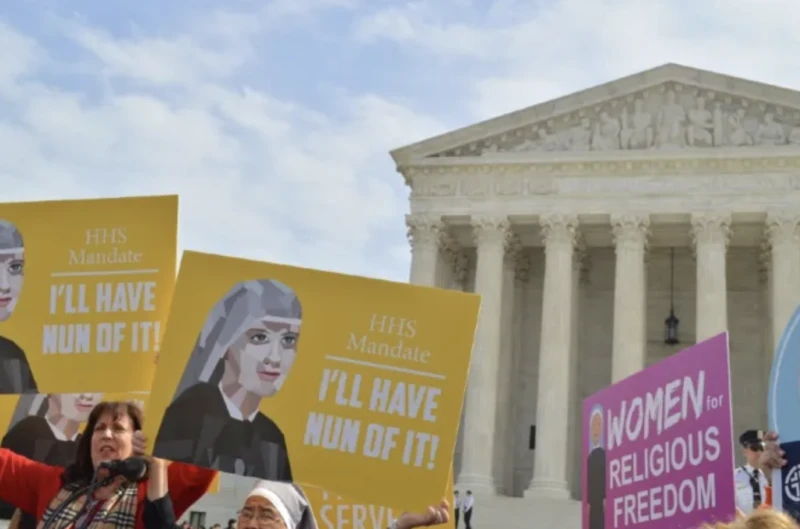
Religious sisters show their support for the Little Sisters of the Poor outside the Supreme Court, where oral arguments were heard on March 23, 2016, in the Zubik v. Burwell case against the HHS mandate. / Credit: CNA
Washington, D.C. Newsroom, Dec 15, 2025 / 18:06 pm (CNA).
The 14-year legal battle against federal contraceptive mandates will continue, with Little Sisters of the Poor and the federal government seeking to reinstate moral and religious exemptions that were established in 2017.
Little Sisters of the Poor have already won religious freedom cases on this subject twice at the Supreme Court level. The high court ruled in 2016 that the federal government must protect religious freedoms for those who oppose the contraceptives and in 2020 ruled that the federal government had the legal authority to adopt the broad exemptions established in 2017.
Those exemptions fully covered employers that had religious or moral objections to providing the contraceptives, some of which can be abortifacient. Under the rules, those employers were not required to include any contraceptive coverage in their insurance plans for employees.
In spite of the prior Supreme Court wins, a federal court in August 2025 struck down the 2017 exemptions on grounds that the Supreme Court had not yet ruled on.
Because the Supreme Court left some questions open, the attorneys general in two states that disapprove of the exemptions — Pennsylvania and New Jersey — continued their legal battle on different grounds. Those legal arguments allege that the adoption of the rules did not comply with the Administrative Procedure Act (APA), which the Supreme Court had not ruled on.
In the August ruling, Judge Wendy Beetlestone found that the rules did not comply with the APA, ruling instead that the rules are arbitrary and capricious.
“The agencies’ actions in promulgating the rule were arbitrary and capricious — in that they failed to ‘articulate a satisfactory explanation for [their] action[s] including a ‘rational connection between the facts found and the choices made,’” Beetlestone wrote in her opinion.
Little Sisters of the Poor are represented by the Becket Fund for Religious Liberty, whose lawyers say the appellate court should overturn that decision and bring the legal dispute to an end.
“The 14-year legal crusade against the Little Sisters has been needless, grotesque, and un-American,” Mark Rienzi, president of Becket and lead attorney for the sisters, said in a statement.
“The states have no business trying to take away the Little Sisters’ federal civil rights. The 3rd Circuit should toss the states’ lawsuit into the dustbin of history and uphold the protection the Little Sisters already won at the Supreme Court … twice,” he said.
In the appeal, the lawyers cite the legal precedent from the 2016 and 2020 cases that required religious exemptions and upheld the rules. They warn that the August 2025 ruling could create a “constitutional conflict” because the original mandate cannot legally be reimposed.
“The appellee states maintain that state governments somehow have an interest in forcing the federal government to force religious objectors to comply with the federal contraceptive mandate — even though the federal government need not have any contraceptive mandate at all, and even though the states themselves have chosen not to have such mandates of their own,” the lawsuit notes.