
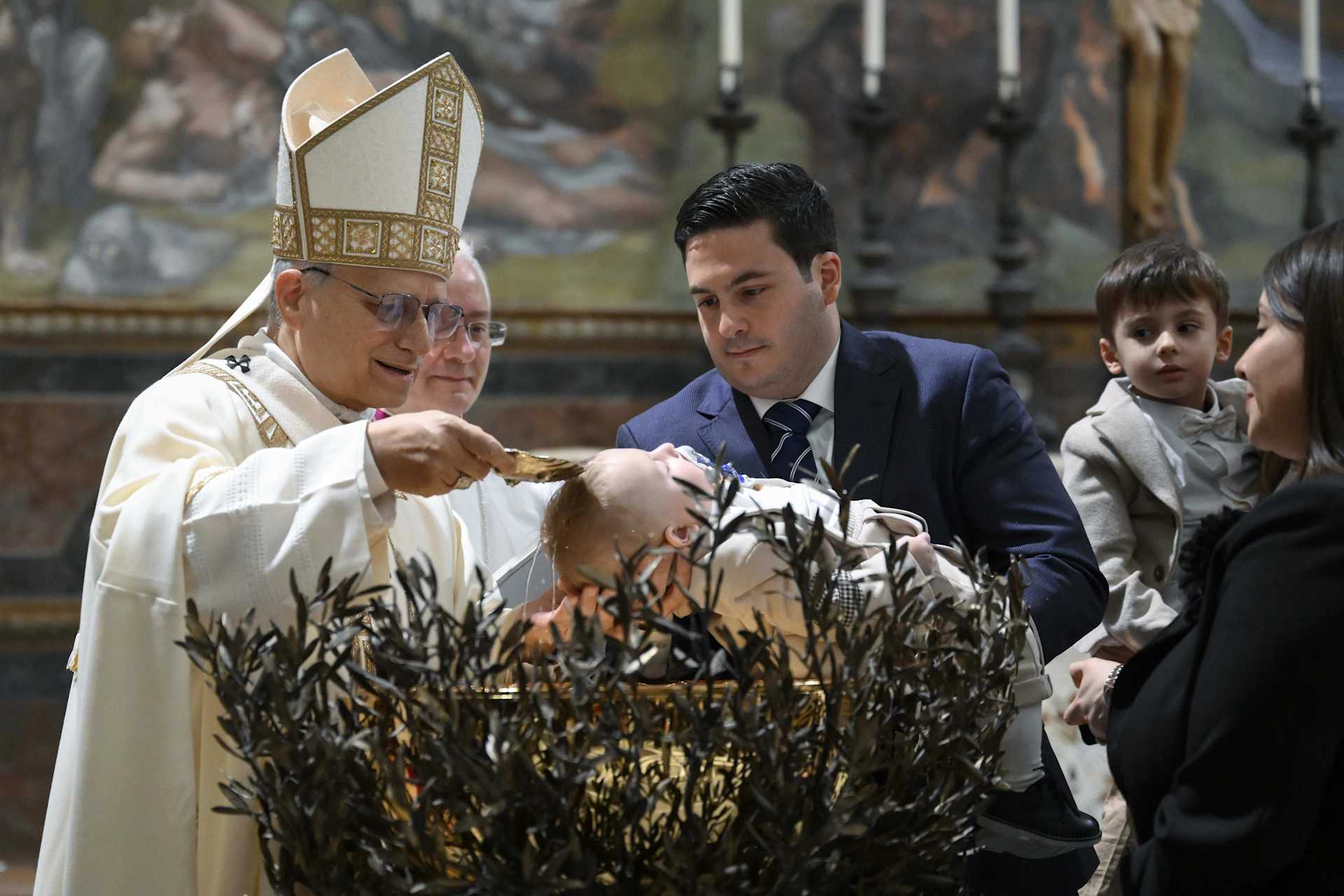
Pope Leo XIV baptizes a child in the Sistine Chapel at the Vatican on the feast of the Baptism of the Lord, Jan. 11, 2026. | Credit: Vatican Media
Jan 21, 2026 / 07:00 am (CNA).
Former president of Ireland Mary McAleese, a lawyer and canon lawyer, recently said in an op-ed in the Irish Times that infant baptism denies children their human rights and is an act of control on the part of the Church.
Catholic clergy and laity in Ireland have pushed back on her claims, viewing it as an opportunity to share what baptism is really about.
Bishop Alphonsus Cullinan, bishop of Waterford and Lismore, explained to EWTN News that infant baptism is commonplace in most Christian denominations and has been practiced in the Church since the first century.
“Jesus gives us a command to go and baptize. So the Church baptizes in obedience to an express command that is supported by the Bible. So to baptize infants into the body of Christ is something very good,” he said.
“If we were to say we will wait until a child is an adult to make such a decision, well, then, what other decisions would we deny taking for our children? Would we, for example, not give them good food? Will we show them the beauty of exercise and would we not give them good medical care? Would we wait until they could make their own decisions?”
Cullinan added: “One of the first things that the Catholic parent does to their child is to take his little hand or her little hand and make the sign of the cross. What a beautiful thing. Why do parents do it? Because they want their child to have a relationship with a living God throughout their life and lead them into eternal life.”
Father Owen Gorman, a parish priest in the Clogher Diocese, said the Church “encourages infant baptism out of love for souls, and so that the babies of Catholic parents would receive the best start in life, that they would be plunged into the mystery of Christ and that they would be filled with God’s life.”
He continued: “And that is a great good, and it is a great good that should not be postponed. The Church wants children to experience that immersion in Christ to be part of his body, so that they may have life and have it to the full.”
In her article, McAleese stated that baptismal promises made and renewed at confirmation are “fictitious” and that infant baptism ignores children’s later rights to freely decide for themselves their religious identity, to accept and embrace Church membership, or to change religion if that is their choice.
Mahon McCann is a doctoral student in ethics who was baptized into the Catholic faith on Easter Saturday 2025. He was raised as an atheist by parents who were baptized Catholic. He told EWTN News that it should be the choice of parents whether to baptize their children and continue the tradition they inherited.
“Infant baptism does not require an ‘opt-out’ unless you truly believe you were opted into something real in the first place,” he said. “To want some kind of formal procedure to ‘opt out’ is to implicitly accept the Church’s moral authority in the first place.”
Rather than doing this as an act of power and control as McAleese asserts, Gorman said the Church does it “as an act of love.”
“As a mother, she is loving her children, and she is wise in directing parents to bring the children to the grace of God and the saving waters of baptism from a young age. It is about providing that which is best for them, so it enables them to have the best life possible, as part of the body of Christ, the Church. So the Church desires it not out of a sense of wanting to control people or exert power over them but to give as a wise and provident mother,” he said.
McCann agreed and pointed to his own experience. “My parents simply ‘canceled their subscription to the Resurrection’ in their own minds and stopped going to Mass, etc., like many Catholics today. The Church can do nothing to legally compel you to pursue holiness.”
In her article, McAleese wrote that baptism “restricts children’s rights as set out in the Universal Declaration of Human Rights (UDHR) in 1948 and United Nations Convention on the Rights of the Child (UNCRC) in 1989, to which both Ireland and the Holy See — which governs the Catholic Church and is effectively the author of canon law — are state parties.”
McCann told EWTN News that rather than evaluating infant baptism through the lens of “rights,” we should ask: “Are human rights the proper ethical standard [by which] to evaluate Catholic moral theology?”
“The answer would be no,” he said. “Catholic moral theology is teleological, aims at the holiness of the person, and therefore whatever brings one to holiness is ‘good’ and whatever takes one away from holiness is ‘bad.’ Human rights ethics are not concerned with achieving holiness and therefore are not the right ethical framework to evaluate Catholic sacraments or practices.”
McCann explained that he didn’t fully understand infant baptism before becoming a Catholic but disagrees with the idea that it is like a legal contract between two parties.
“That is a very superficial modern understanding of the rite of baptism and really of tradition as such, he said.
“A tradition, by definition, is intergenerational — a tradition that isn’t passed on from one generation to another isn’t a tradition,” McCann said. “Infant baptism is primarily a decision of the parents, who are gifting their offspring membership into the life of the Church and the traditional Catholic way of life that leads to their salvation,” he said.
“The idea that babies and children should ‘consent’ to be part of a particular tradition is as ridiculous as saying that they should choose what language they are going to speak,” McCann said.