
Former Miss California Carrie Prejean Boller, a member of President Donald Trump’s Religious Liberty Commission, said she doesn’t embrace Zionism because of her Catholic faith, despite Catholic teaching that does not oppose Israel as a nation or the Jewish people.
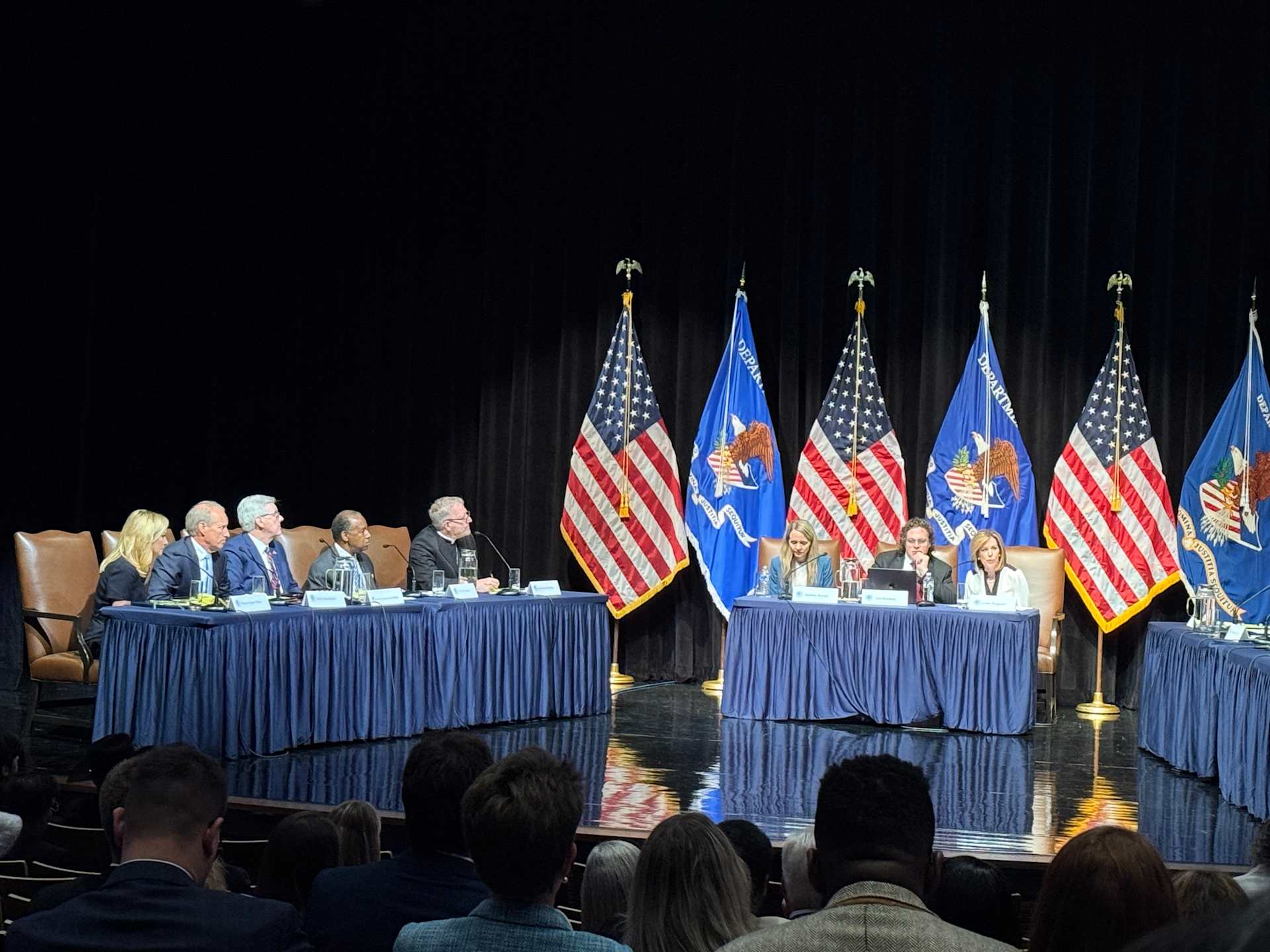
“I am a Catholic, and Catholics don’t embrace Zionism,” Boller said at the fifth hearing of the Trump-appointed Religious Liberty Commission focusing on the topic of antisemitism in Washington, D.C., on Feb. 9.
Catholic teaching does not explicitly oppose Zionism, the movement supporting Jewish self‑determination in a homeland in Israel. Israel is seen as God’s chosen people through whom God revealed himself and prepared the way for the coming of Jesus Christ. The Catholic Church universally condemns antisemitism. The Church recognizes Israel’s fundamental right to exist.
Boller issued several social media posts after the hearing. She wrote: “Forcing people to affirm Zionism on a ‘Religious Liberty’ Commission is the opposite of religious freedom. I will not resign, and I will not be bullied for following my Catholic conscience.”
The commission and the White House did not immediately respond to requests for comment.
Yeshiva University President Rabbi Ari Berman said at the hearing that while one does not have to support the policies of the Israeli government, “by denying the rights of Jews to have their own state while not saying the same for any other people, that is a double standard hypocrisy and antisemitism.”
Both Berman and Yitzchok Frankel, a law student and former defendant in a case against Regents of the University of California over anti-Jewish protests that took place in wake of the Oct. 7, 2023, attacks, said “anti-Zionism is antisemitism.”
Boller, author of “Still Standing: The Untold Truth of My Fight Against Gossip, Hate, and Political Attacks,” countered that “as a Catholic,” she disagrees with the notion that “the new modern state of Israel has any biblical prophecy meaning at all.” She repeatedly pressed the Jewish panelists on whether her views made her an antisemite before the commission’s chair, Texas Lt. Gov. Dan Patrick, halted the exchange.
Boller told EWTN News that members of the commission asked her to resign a few months ago but that she refused. She also said several members asked to meet with her before the hearing to discourage her from making her planned remarks. “They were seeing what I was going to say in the hearing, trying to silence me,” she said. “I told them I won’t be silenced.”
Response from other Catholic members
Later in the hearing, panelist Ryan Anderson, president of the Ethics and Public Policy Center, joined the dialogue on Catholic teaching regarding the Jewish people and read passages from both Nostra Aetate and the writings of Pope Benedict XVI.
Anderson cited the following passage, which states that while “the Jewish authorities and those who followed their lead pressed for the death of Christ,” it is the case that “what happened in his passion cannot be charged against all the Jews, without distinction, then alive, nor against the Jews of today.” The paragraph further states that the Jewish people should not be regarded as rejected by God “as if this followed from the Holy Scriptures.”
Anderson called on Father Thomas Ferguson of Good Shepherd Catholic Church in Alexandria, Virginia, who sits on the panel’s advisory board of religious leaders, to provide further analysis on the Catholic Church’s position on Jewish-Catholic relations.
“About the responsibility for the death of Jesus,” Ferguson said, “he’s not dead. He’s alive, he is risen.”
The pastor emphasized the Church’s view that Jesus gave up his life freely and sacrificially. He also noted that, in alignment with the passage cited by Anderson from Nostra Aetate, Jesus “made an atonement as an offering for the forgiveness of the sins of every person, every time and place.”
“That’s how Catholics understand who is responsible for the death of Jesus on the cross: It’s all of us,” Ferguson said.
Ferguson said: “If you are seeking to know God through the Scriptures of the Old Testament and the New Testament,” it is not possible to be Christian and antisemitic, “because we have the same father and faith.” The more Catholics embrace their responsibility to know God through the Scriptures, he said, “the more we will know our common patrimony.”
Catholic reaction
“Carrie Prejean Boller does not speak for the Catholic Church,” Simone Rizkallah, director of the Coalition of Catholics Against Antisemitism and host of the “Beyond Rome” podcast, which seeks to reconnect Catholics to their roots in the Near East, told EWTN. “Her claim that Catholics do not embrace Zionism is not merely mistaken — it is reckless, historically uninformed, and deeply misleading to both Catholics and the wider public.”
Rizkallah pointed out that the recognition of Israel’s right to exist fundamentally amounts to “precisely what Zionism means,” though Catholics themselves may not always be accustomed to using the word formally.
“Catholics who affirm Israel’s right to exist and to self-determination — whether or not they personally use the label — are, in essence, affirming that same principle,” she said. “The Church is therefore neither anti-Zionist nor, certainly, antisemitic; she explicitly condemns antisemitism and calls the faithful to reject it in all its forms.”
At the same time, Rizkallah emphasized that the Catholic Church does not define Zionism using the same “theological frameworks found in some strands of Protestant Christian Zionism.” Namely, she said, “Catholic theology does not teach that the modern state of Israel represents the direct fulfillment of biblical prophecy or a predetermined eschatological event.”
Rizkallah described the Church’s position as “both clear and nuanced,” recognizing the modern state of Israel’s political legitimacy, but not grounding it in prophetic claims.
Ultimately, she concluded, “precision matters. When public figures speak carelessly about the Church’s teaching, they do not merely express a personal opinion — they create confusion, distort Catholic doctrine, and undermine serious efforts at Catholic-Jewish understanding. Catholics deserve better than slogans masquerading as theology.”
The Religious Liberty Commission has had four previous hearings on protecting religious freedom in the U.S., religious freedom in education, and religious freedom in the military.