
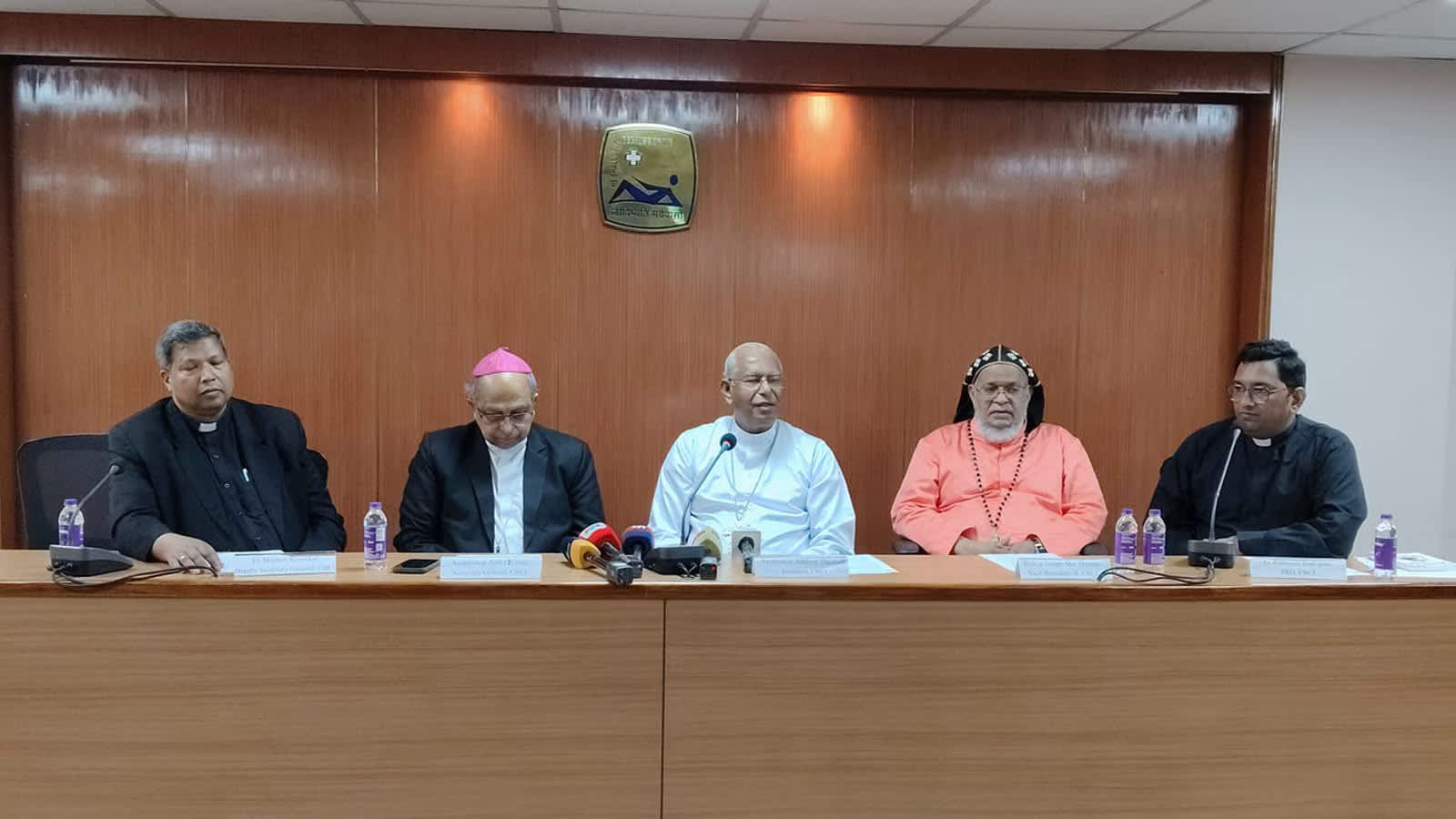
Cardinal Anthony Poola has been elected president of the Catholic Bishops’ Conference of India (CBCI), becoming the first Dalit — a member of India’s historically marginalized “untouchable” castes — to lead the nation’s bishops.
The election took place during the CBCI’s General Body Meeting, held Feb. 4–10 at St. John’s National Academy of Health Sciences in Bangalore, according to a Feb. 10 press release from the bishops’ conference.
In a statement issued at the conclusion of the meeting, the bishops called for the repeal of anti-conversion legislation that several Indian states have enacted to criminalize religious conversions allegedly accomplished through force, fraud, or inducement.
The bishops assert that such laws violate India’s constitution and lead to false arrests of Christians.
“Innocent people face arrest due to false allegations of forced conversion,” the bishops said, demanding “the repeal of all legislation undermining religious freedom and privacy.”
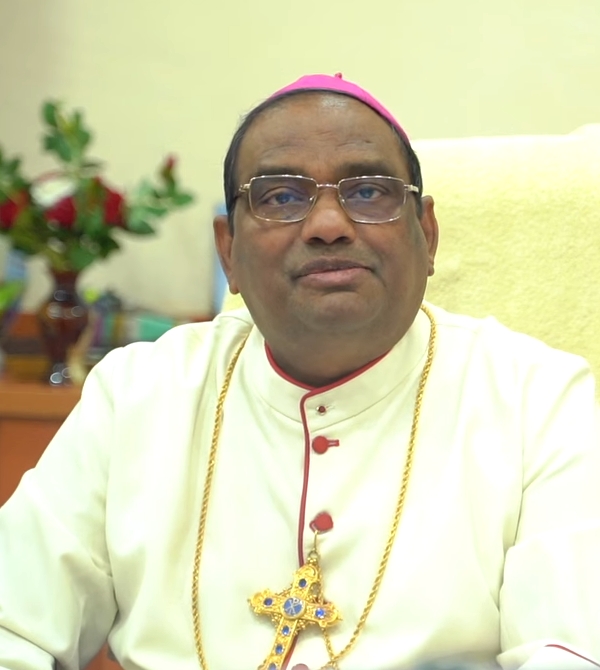
Poola’s election represents a historic moment in a nation where caste discrimination remains deeply rooted despite constitutional protections. The 64-year-old archbishop of Hyderabad was created cardinal by Pope Francis in August 2022, becoming the first Dalit elevated to the College of Cardinals.
Dalits, whose name literally means “trampled upon,” have historically been treated as “untouchables” in India’s caste system and traditionally relegated to menial work. A significant majority of India’s Catholics are from Dalit backgrounds.
Archbishop Anil Joseph Couto of Delhi was elected secretary-general of the CBCI, according to the press release. Archbishop Thomas Mar Koorilos of Tiruvalla and Archbishop Mathew Moolakkatt of Kottayam were elected vice presidents.
In his first message as CBCI president, Poola thanked God “for the confidence” of his “brother bishops” and “the people of God for their prayer, goodwill, and confidence in my leadership.”
He said he receives the role “with humility, conscious that leadership in the Church is a service rooted in listening, prayer, and shared discernment,” and committed to working “for the unity of the Churches in India, the unity of Christians, and a deeper unity with the people of our nation.”
In a time “marked by division, violence, and growing social tensions,” Poola said, the Church “is called to be a sign of reconciliation, dialogue, and hope.”
Constitutional rights under threat
The bishops’ statement emphasized that “at a time when freedom and human rights are increasingly disregarded, we reaffirm our faith in the constitution of India,” which envisions the country as “a sovereign socialist secular democratic republic” securing justice, liberty, equality, and fraternity for all citizens.
Article 25 of the India Constitution guarantees that “all persons are equally entitled to freedom of conscience and the right to freely profess, practice, and propagate religion.”
However, several Indian states have enacted anti-conversion laws in recent years that require individuals to obtain government permission before changing their religious affiliation. The laws impose penalties including imprisonment for those accused of facilitating conversions.
Hindu nationalist groups and vigilante organizations frequently use these laws to accuse Christians of using deceptive tactics to convert people, charges Christians deny.
The same groups frequently carry out violence against religious minorities, with critics saying arrests of those accused of conversions often proceed without due process of law. Vigilantes have stormed prayer meetings and church gatherings where Christians are sometimes forced to perform Hindu rituals.
Such attacks form part of what activists describe as a broader agenda of “saffronization” — an effort to impose Hindu values and identity while restricting other religions.
Couto told EWTN News that the federal government led by Prime Minister Narendra Modi has a duty to protect all religious minorities in adherence to the constitution. No religious minority community should ever feel discriminated against based on religion, he said.
Before the assembly, Archbishop Andrews Thazhath, outgoing CBCI president, urged Modi on Feb. 3 to condemn attacks on Christians and said the government has a duty to protect the rights of religious minorities.
“We have been approaching government authorities whenever there is an attack,” Thazhath said. “We don’t counterattack. We have personally raised the issue with Modi. The latest was when he joined us for Christmas celebrations. Protecting the rights of minorities and Christians is the duty of the government.”
“Whenever we go to the authorities, they say they [the attackers] are fringe groups,” he added. “But take control of those fringe groups.”
Discrimination against Dalit Christians
The bishops expressed particular concern about how Dalit Christians and Muslims are denied government welfare benefits in education and employment, facing discrimination based on religion.
“The denial of rights to Dalit Christians has continued for decades as an indirect form of discrimination, despite numerous appeals for equality and justice,” the CBCI statement said. “We express our concerns about the denial of rights to the minorities, as such acts weaken the democratic fabric of our society.”
In 1950, the federal government enacted legislation listing Hindu Dalits as “Scheduled Caste,” making them eligible for free education and a 15% quota in government jobs and legislatures to improve their social status. The “Scheduled Caste” privileges were extended to Sikh Dalits in 1956 and Buddhist Dalits in 1990 but have been denied to Muslim and Christian Dalits.
“While maintaining our commitment to eliminate any type of discrimination existing in the ecclesial communities based on caste or language, we urge the government to ensure that no citizen is denied the fundamental rights of equality and freedom,” the bishops said.
John Dayal, a senior Catholic lay leader and human rights activist, said that in a climate of growing anti-Christian violence, bishops and others have a crucial role in easing communal tensions and reinforcing advocacy for religious freedom and minority rights.
Safeguarding constitutional values
The bishops stressed that “protecting basic rights for everyone — regardless of caste, creed, or language — is essential in this situation.”
“Genuine Christian living inspires us to be law-abiding citizens who promote peace and defend human rights,” they said. “Fidelity to the Constitution of India flows from our Christian faith and our commitment to the common good, freedom of conscience, the dignity of every person, and the protection of India’s plural, secular, and democratic character.”
The Church’s socially uplifting initiatives for the poor spring from its deep-rootedness in Christ and faithfulness to constitutional values, the bishops added.
“We encourage all the faithful to continue participating actively in nation-building, guided by truth, compassion, and moral courage,” they said.
The Church remains committed to fostering dialogue, reconciliation, and fraternity amid polarization and mistrust, the bishops said. Inspired by Christian faith, its members seek the way of forgiveness when deprived of human dignity and rights.
“We take upon sustained interreligious dialogue and civil-society engagement, standing in solidarity with all those who face injustice or exclusion, and working together for peace, social harmony, and the protection of human dignity,” the bishops said.
Founded in 1944, the CBCI comprises the Latin rite and two Eastern Catholic Churches — the Syro-Malabar and Syro-Malankara Churches. Christians constitute 2.3% of India’s 1.4 billion population, while Muslims represent 15% and Hindus nearly 80%.