
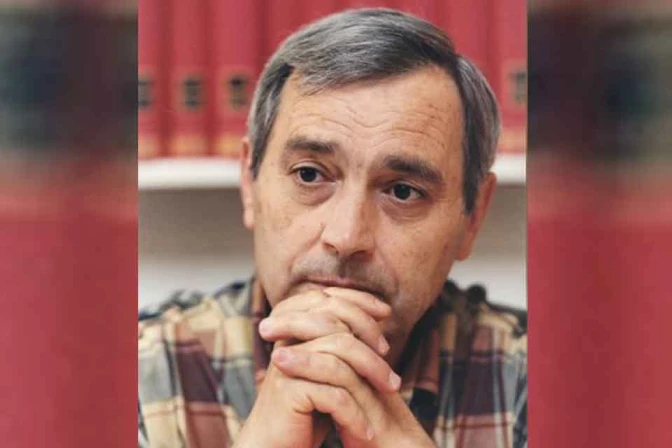
The Spanish-language editor of the Italian writer and apologist Vittorio Messori, who passed away this past Good Friday, revealed the keys to the Italian writerʼs literary success and the secret behind a heroic life lived out of love for the Church.
The relationship between editor Álex del Rosal and Messori, one of the most successful Catholic writers of the last half-century, began in 1993, when the publishing house Planeta embraced del Rosalʼs idea to launch “Planeta Testimonio.”
The idea was to collect Catholic books that offered “engaging themes and authors that would consistently appeal to everyone from the student to the shopkeeper to the taxi driver,” del Rosal said in an interview with ACI Prensa, the Spanish-language sister service of EWTN News.
With this goal in mind, del Rosal contacted Messori and proposed compiling his articles from the “Vivaio” column in the newspaper Avvenire into a book. In that column, Messori often defended the Catholic Church. The result was the bestseller “Black Legends of the Church.”
Other titles followed, and in 1984, when Cardinal Joseph Ratzinger was still prefect of the Congregation for the Doctrine of the Faith, Messori conducted a lengthy and candid interview with the future Pope Benedict XVI. Published in 1985 as “The Ratzinger Report,” the book became an international bestseller. The two men remained friends over the years.
Messori achieved another historic milestone in 1994 with “Crossing the Threshold of Hope,” a book-length interview with St. John Paul II. He was the only journalist ever commissioned to prepare questions for such a project with the pontiff. John Paul II personally wrote detailed written responses to Messori’s questions, and the resulting volume became one of the most successful papal bestsellers in history.
Del Rosal, who described Messori as “extraordinary and deeply human,” maintained a friendship with the Italian writer that spanned more than three decades and lasted till his death on April 3.
The Spanish editor shared in an interview with ACI Prensa some key insights into Messoriʼs work and life.
The secret behind his heroic life
Beyond Messoriʼs public image as a friend of popes and a world-renowned author, del Rosal revealed a little-known aspect of the writerʼs life that, in many ways, defined him even more profoundly as a son of the Church. “It was the great cross that Vittorio bore in profound silence,” the editor remarked.
While he was still an agnostic, Messori entered into a canonical marriage with a young woman. Shortly thereafter, they separated, and he initiated the process to have the marriage declared null — a process that lasted two decades.
In that time, the writer met the woman who would remain his wife until his death: Rosanna Brichetti. The two met within the circles of Pro Civitate Christiana, a group founded in Assisi in 1939 by Father Giovanni Rossi, characterized by a great openness toward the secular world.
Messori disclosed his canonical situation to Brichetti with complete candor. “For 20 years,” del Rosal said, “he lived with Rosanna in chastity — together, like brother and sister — in a truly heroic manner, precisely because he was so serious about living out his faith.”
The annulment process lasted from 1975 to 1995. The first ruling, which affirmed the validity of the marriage, came in Turin; the second, in Milan. It was only after his appeal to Rome that he finally received the response he had been hoping for from the Church: His first marriage was declared null.
During one of his visits to Messori, del Rosal discussed this matter with the writer: “He would say to me with great pain: ‘I am convinced. First, my conscience tells me that that first marriage is null and void. Second, I am almost certain that my success has slowed down this proceeding and made things more difficult for me.’”
“Thirdly — I, who am friends with Cardinal Ratzinger, the prefect of the Congregation for the Doctrine of the Faith who oversees these matters, and with the pope [St. John Paul II], who is ultimately the one who can also make the decision — nevertheless, I do not wish to use my friendship for a matter of this nature,” the editor recalled.
“Vittorio’s greatest attribute is not his literary success, nor his apologetic work, nor even how formidable he was in his defense of the Church; rather, it is the immense heroism he displayed in loving the Church despite — one might say — having been mistreated,” del Rosal said.
‘A writer’s master is his readers’
Messori was one of the most successful Catholic authors in recent decades, selling “somewhere between 30 and 40 million copies of his various works worldwide,” del Rosal noted.
Part of this success was based on a maxim he upheld not merely in theory, but through great personal effort: “He was the writer who most earnestly lived out his own words: ‘A writer’s master is his readers. Therefore, one must always answer them,’” del Rosal recalled.
With the help of his wife, Rosanna, Messori replied to every one of the more than 100 letters that arrived in his mailbox each week, until the use of email became widespread.
Speak to the seeker, not the convinced
Another of Messori’s strengths was that he addressed himself “not to the convinced Catholic, but to the seeker, to the one asking questions, even if they were at the opposite ends of ideological or doctrinal positions.” Messori himself was raised in a communist and deeply anticlerical family. It is not without reason that his mother, upon learning of his conversion, “wanted to send him to a psychiatrist,” the editor added.
This approach was evident in the publication of his first book, “Hypothesis About Jesus,” for which he asked prominent Italian Communist Party member Lucio Lombardo Radice, an agnostic, to write the prologue.
“He didn’t write or speak for a closed circle within the Catholic Church; rather, he sought to address every type of audience,” del Rosal emphasized.
Every morning in the small Italian town on the shores of Lake Garda, Desenzano del Garda, Messoriʼs work routine involved visiting what he called the “center of the town’s opinion,“ a bar where ”the television was on and people chatted about this and that. While having breakfast and reading the newspaper, he would listen to the people’s conversations. This gave him a great deal of inspiration for taking the pulse of public opinion,” del Rosal said.
The balance between reason and the Holy Spirit
Messori’s manner of expression “maintained a balance between the two lungs of the Church: the Spirit and reason,” according to the editor.
Messori really disliked “the terminology of the Vaticanologist” and rejected that label, despite having interviewed two pontiffs. To him, the Vaticanologist “is incapable of moving beyond merely gazing at the exterior of the vessel containing the deposit of faith” and concerns himself solely “with superficial or flashy matters.”
“He always approached apologetics from the standpoint of reasoned faith, not morality. He argued that when morality is proclaimed without first having presented the faith, the result is not acceptance, but rejection,” del Rosal explained.
This story was first published by ACI Prensa, the Spanish-language sister service of EWTN News. It has been translated and adapted by EWTN News English.