
THRISSUR, India — People from all walks of life paid tribute to Father Francis Alappatt, the priest-physician who galvanized public support for medical service to the poor, at a memorial gathering in Thrissur in the southern Indian state of Kerala on April 13.
“It was Father Francis who recommended that all the charitable and welfare programs of the archdiocese be named under ‘Sathwanam’ (Compassion). His aim was to provide the best treatment with the least expense, and he worked hard for that,” said Archbishop Andrews Thazhath of Thrissur, inaugurating the memorial at the Jubilee Mission Medical College (JMMC) that Alappatt established at the archdiocesan hospital in the heart of Thrissur.
Alappatt, who died of complications from diabetes at the age of 72 on April 8, was a singular figure in the Catholic Church in India: He was ordained in 1995 at the age of 41 after joining the seminary to fulfill a childhood dream, having already earned a medical degree from Kozhikode Medical College.
‘Half priest’
“Even when he was a medical student, he was called ‘padi achan’ (half priest) for his lifestyle, and I was also touched by him,” recounted Dr. Susheela Jacob, who was a professor at Kozhikode Medical College when Alappatt was a medical student in the 1980s, during the memorial.
“Scenes of trade in blood around the hospital prompted him to launch a blood donation campaign with batchmates [classmates], and he founded the Kerala Blood Donors Forum as a medical student,” Jacob recalled.
“I was regularly in touch with him, and when he started the medical college, he invited me, and I gladly joined in 2005,” said Jacob, a pathologist who is presently lab director at the JMMC Hospital. She spoke to EWTN News on April 14.
After his ordination, Alappatt transformed even remote parishes into centers of blood donation awareness and paved the way for the Kerala state government to record the blood group of each student in school certificates.

As director of Jubilee Mission Hospital, he expanded it into a medical college — approved by the central government — in 2004 and doubled the hospitalʼs beds to more than 1,500, making it one of the largest hospitals in Kerala. The facility is known for subsidized treatment for the poor and free medicines for snakebite victims.
Interreligious tributes
“Father Alappatt had a special doctorate in human relations. He knew how to move people,” said K. Rajan, a Hindu and minister in the Kerala state government, at the memorial. “Whenever he invited me for a program, I could not decline.”
“Father Francis was my classmate in school and surprised me [in the late] 1990s coming back to me as a priest. Then he turned my guru (teacher) in life,” said T.S. Pattabhiraman, a leading Hindu businessman of Thrissur.
“He became a family friend and had a unique marketing strategy [to get financial support]. Whenever I went to invite him for a family marriage or other functions, he would seek support for his free dialysis, treatment for snakebite victims. Whenever he needed help, he would call me. I could never say ‘no’ to him,” recalled Pattabhiraman, who is one of the trustees of the interreligious forum Alappatt founded to promote religious harmony.
Popular for his pioneering blood donation movement in Kerala — as well as his interreligious and health awareness programs, in addition to his role as founding director of the Catholic medical college — Alappatt was named chairman of the Indian Red Cross Society.
“In honor of Father Alappattʼs compassion for those affected by kidney disease, I am happy to announce today that Jubilee Mission has decided to set up a renal transplant center, and it will be called the Father Francis Alappatt Memorial Renal Transplant Centre,” announced Auxiliary Bishop Tony Neelankavil at the memorial, evoking thunderous applause.
Free dialysis and parish support
“Father Alappatt introduced and motivated parishes and families to support free dialysis as part of parish feasts and family celebrations like marriage or baptism. We got support for more than 12,000 free dialysis [treatments] in 2025,” Father Reny Mundankurian, the JMMC Hospital director, told EWTN News.
After leaving Jubilee Hospital in 2010, Alappatt served as vicar general of the Archdiocese of Thrissur and also helped improve smaller diocesan hospitals and health care initiatives in the archdiocese.
A prolific writer, he authored 50 books on health, social harmony, the environment, and human relations. A dozen of these were written after he became seriously ill, restricting his movement.
‘He showed God to the world’
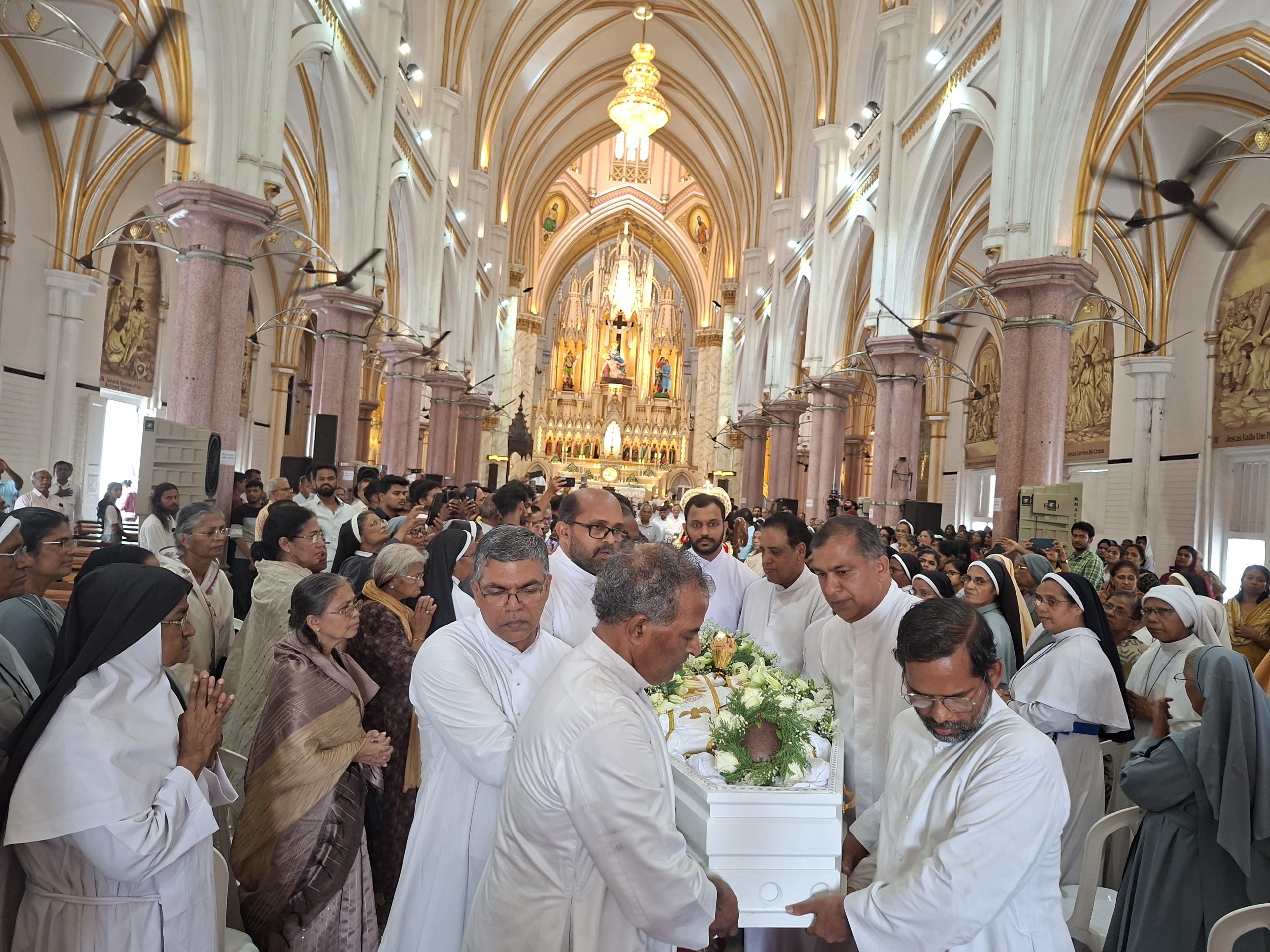
“Father Alappatt showed God to the world through his loving service,” said Major Archbishop Raphael Thattil, head of the Syro-Malabar Catholic Church, in his homily during the April 10 funeral service at the Basilica of Our Lady of Dolours parish in the heart of Thrissur.
“He never worked in mission centers, but he showed with his life how life can be turned into missionary work,” said Thattil about his fellow parishioner, as both of them hail from the Dolours Basilica parish, which is celebrating its centenary year.
True to his commitment to health care, Alappatt donated his eyes, and after the funeral service — attended by half a dozen bishops — his body was not taken to the cemetery but placed in the JMMC mobile ambulance to be transported to the hospitalʼs anatomy department.