

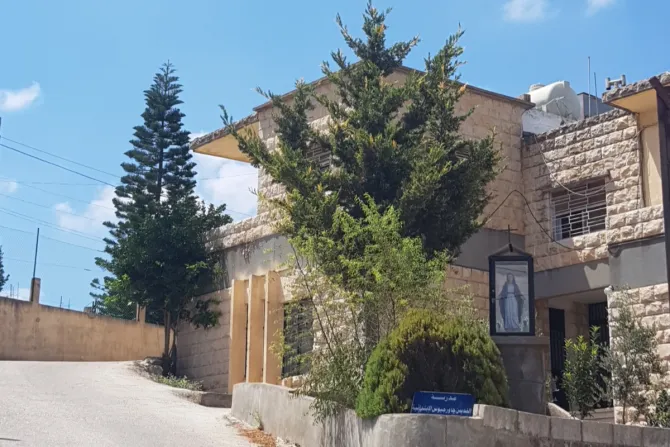
In southern Lebanon, the village of Yaroun has drawn widespread attention after images and video circulated showing the demolition, allegedly by Israeli forces, of a monastery and Catholic school belonging to the Salvatorian Sisters.
Yarounʼs mayor, Adib Ajaka, rejected claims by the Israeli army that it did not know the buildings were religious places, and the Council of Melkite Greek Catholic Bishops in Lebanon urged the Lebanese government and the United Nations “to protect the property of civilians and religious institutions, citing in particular the village of Yaroun,” according to the Associated Press.
Speaking to ACI MENA, the Arabic-language sister service of EWTN News, Ajaka clarified that some media outlets have been recirculating images of a destroyed church as if they were from the latest incident, but the church itself had already been targeted multiple times since 2024. He stressed that the most recent incident concerns the demolition of the monastery and the school.
Responding to the Israeli army’s claim that “there were no indications that it was a religious building,” Ajaqa rejected the statement as unconvincing, noting that the site was clearly identifiable, bearing a cross and a statue of the Virgin Mary.
He also pointed out that the church had been targeted previously and that footage from 2024 showed the deliberate destruction of a statue of St. George.

Ajaka said images published by Israel showing the diocese and a nearby clinic were used to suggest that the monastery had not been destroyed, but in reality they referred to a separate building housing a clinic run by the Order of Malta. He suggested that the presence of the organization’s flag may have contributed to it being spared so far.
According to Ajaka, the bulldozing operations took place after the ceasefire came into effect. At first, residents did not grasp the scale of what was happening, as they remained in contact with nearby towns such as Rmeish and Ain Ebel, where no strikes or shelling had been reported from Yaroun. This created the impression that the village had not been directly targeted. It later became clear, however, that what had taken place was not bombardment but the widespread bulldozing of homes.
Yaroun is home to about 60 Melkite Catholic families — all of whom fled at the outbreak of the war in 2024. Seventeen families returned during the initial ceasefire period, but many others were unable to do so due to the destruction of their homes. Today, residents remain unable to return, scattered between rented accommodations, monasteries, and relatives’ homes, while some have relocated to nearby Christian villages in the south.
Ajaka noted that assistance to residents has so far been limited, emphasizing that the most urgent need is direct financial support to help cover rent. At the same time, he expressed gratitude for the support provided by the Vatican and for the continued efforts of the apostolic nuncio through regular visits and follow-up on the situation of displaced families.

He also recalled that during the pope’s visit to Lebanon in December 2025, a historic stone from the village church dating back to 1872, engraved with an image of St. George, was presented to him in the hope of drawing attention to Yaroun and its people.
Today, the fate of this stone remains unknown, as the church has been destroyed and residents are unable to return to see what remains. Ajaka stressed that the destroyed homes of the Catholic families there are over a century old and are purely civilian properties.
Church vandalism across Lebanon
The alleged demolitions in Yaroun come amid recent and varied incidents of church vandalism in Lebanon, with multiple places of worship targeted and their contents deliberately damaged.
Among them, the Church of Mar Shalita in Qobeiyat was stormed and vandalized. And in Ajaltoun, the Church of Our Lady was targeted, with intruders stealing items, destroying furniture, and leaving bullets scattered on the floor.
Taken together, these incidents reflect a broader climate in which Lebanese Christians increasingly feel under pressure, facing different forms of intimidation and attack from multiple actors.
This story was first published by ACI MENA, the Arabic-language sister service of EWTN News, and has been adapted by EWTN News English.