
Every Sunday, the police arrive to photograph him. He must report to authorities every time he leaves his parish and about every liturgical service in which he participates. If he speaks of any social issue during a homily, he risks one of two things: imprisonment or exile.
Speaking anonymously to ACI Prensa, the Spanish-language sister service of EWTN News, a priest in active service in Nicaragua revealed the exact mechanisms by which the dictatorship of President Daniel Ortega and his wife and vice president, Rosario Murillo, control, surveil, and silence the Catholic Church in the country.
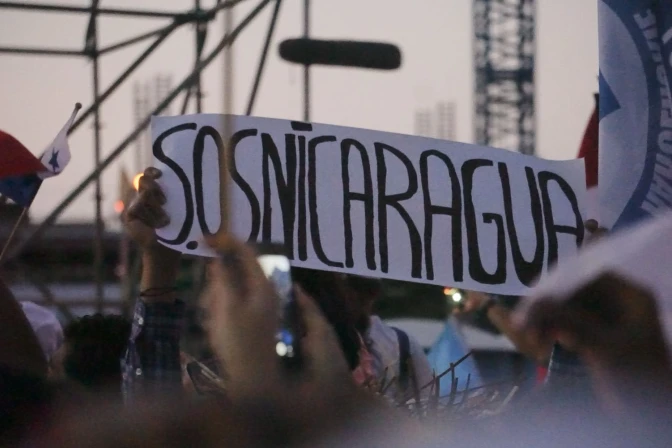
The Nicaraguan dictatorship intensified its persecution of the Church in 2018 after bishops and priests offered to mediate between the regime and civil society in the wake of popular protests. Documented attacks against Catholics in the country now total over 1,030, and 149 priests have been expelled or exiled.
The priest said the population “has grown accustomed to the situation and no longer says anything. I sense a calm atmosphere, yet the restrictions, which are always present, persist, because there is no freedom.”
Every Sunday, ‘the police arrive to take my photograph’
Speaking about how the police monitor priests and bishops, the priest recounted: “Whenever there are liturgical services, we have to report what they are and where they are being held; we have to report when we leave our parish boundaries, and we have to state how long we intend to remain at any location outside of it.”
“And the police arrive to take my photograph, always, every Sunday. It’s a way of verifying that we are where we said we would be. Police superiors require their officers to provide evidence of the visits they conduct, and thatʼs how they maintain control,” he added.
“If you fail to give notice,” the priest continued, “sometimes nothing happens; but other times when they realize that youʼre outside the parish and didn’t give prior notice, they make a call. There have been times when it simply slipped my mind to let them know.”
Regarding the bishops, he said he believes that “yes, they are monitored, they are kept under surveillance. And the police are constantly asking about this or that meeting: where it’s going to take place and whether the bishop will be there.” It also appears the police do in fact “have some person along with his vehicle assigned to” follow the bishops.
Political or social issues avoided in homilies
The priest explained that no priest can speak about social or political topics; otherwise, he risks being considered an opponent to the regime and it could cost him one of two things: “imprisonment or exile.”
“If we speak about a social problem or something currently taking place, they may view us as opponents, as if we were delivering a speech inciting rebellion. And so, they keep watch. They listen whether in person or via broadcasts, and they record us and file reports,” he said.
Any criticism of the dictatorship, he added, “they interpret as political discourse or an act of insurrection. And so that can have consequences.”
The priest recounted that whenever he learns of a fellow priest being imprisoned, there is “total silence. You can’t visit them; you can’t speak with them.”
Pressure on the bishops
ACI Prensa asked the priest why the bishops of Nicaragua do not typically speak about the situation in the country or criticize the dictatorship.
“First, perhaps, out of fear of being expelled. I believe thatʼs the primary factor. And there is the fear of leaving a large population of believers [without a bishop] as happened in Matagalpa, Estelí, or Jinotega” where the bishops are in exile, the priest noted.
The four dioceses currently without a bishop present in the country are Jinotega, whose bishop, Carlos Herrera, serves as president of the bishops’ conference; Siuna, Matagalpa, and Estelí. The latter two are headed by Bishop Rolando Álvarez, who was exiled to Rome in January 2024.
The priest noted that “in the dioceses where the bishops are absent, there are no priestly ordinations, primarily because the bishops are not there.”
“They [the police] are specifically keeping those dioceses under surveillance,” he added, explaining that a bishop from another diocese is also not permitted to ordain priests who fall outside his own jurisdiction.
In a diocese where the bishop is still present, he continued, “ordinations do take place, but they are conducted with great prudence and caution; they are not given much publicity or promoted in the media, so as to avoid any difficulties.”
The priest noted that there has been a decline in the number of priests due to expulsions, and that the most affected diocese is Matagalpa, with nearly half of its clergy now outside the country — a reprisal against Álvarez, who “in his homilies never sugarcoated” the situation in Nicaragua.
Processions banned in Nicaragua
The priest said that while most processions are banned, “there are some, traditionally massive in scale, that have been permitted,” such as those for St. Jerome or the Virgin of Mercy; “but more for their cultural and tourism value and not because it might be an opening toward the faith which they [the police] have otherwise closed.”
The priest recalled when he requested permission from the police to hold a procession and an officer told him that they could imprison him if he proceeded with it.
How does the Church get by day to day?
In 2023, the dictatorship banned the inflow of foreign funds to the Catholic Church after accusing it of “money laundering,” an accusation deemed “ridiculous” at the time by Félix Maradiaga, president of the Freedom for Nicaragua Foundation, while simultaneously freezing the bank accounts of the country’s parishes and dioceses in an attempt to further curtail their activities.
“There are no [parish] vehicles, and it’s impossible to purchase them using the offertory funds because the people are poor. So I have to go around asking people to give me a ride,” he recounted.
Among the many institutions whose legal status was revoked by the Ortega-Murillo dictatorship — meaning they cease to function and their assets are transferred to the regime — is Caritas Nicaragua, the charitable arm of the Catholic Church, which was dissolved by the dictatorship in March 2023.
“We no longer have access to Caritas or foreign aid, because all of that has been banned. Consequently, here, assistance is provided by the population itself amid their poverty,” the priest emphasized.
Without the assistance of Caritas, “it’s the community itself that takes it upon itself to help us. We rely on divine providence, and thatʼs how we carry on.”
“If we survive, it’s because of the help of the people themselves. The people pay for the electricity and the water. These costs are not paid with the collection or offerings. The same goes for food; the people pitch in to help me. Without that, it would not be sustainable,” he explained.
“We collaborate with the people; we help, we deliver food, provisions to certain people. I haven’t had any issues with the police in that regard, but I do it publicly; I don’t do it in secret,” he explained.
According to an April World Bank report, 2.8 million people in Nicaragua live in poverty.
Are there vocations in Nicaragua?
The Nicaraguan priest highlighted that, despite everything, there still are vocations. “It’s true that there was a decline in vocations after 2018. There was significant attrition and a decrease in numbers, and many young people left the country; however, vocations are currently on the rise.”
The year 2018 marked a turning point in the persecution against the Church. Protests against the dictatorship prompted the regime to intensify its multifaceted attacks against Catholics. Nicaraguan lawyer and activist Martha Patricia Molina, author of the report ”Nicaragua: A Persecuted Church,” provides a detailed account of these attacks.
“Today, vocations are once again beginning to resurge in the seminaries. Before last year there were few, but today the number of seminarians has already risen,” the priest added.
Despite the tribulations, the Church in Nicaragua ‘walks with hope’
The priest said “a characteristic of Nicaraguans is their love for the pope, because he [represents human] dignity and the Church, it’s something that characterizes the Nicaraguan Catholic.”
Bolstered by the pope’s encouragement expressed to the exiled Nicaraguan bishops in August 2025 and despite all the difficulties facing Nicaragua, the priest said there are reasons for hope, such as those newly baptized at Easter.
“I believe that the Church in Nicaragua is a suffering Church; yet, above all that suffering, we press onward. We are spurred on and find hope in the knowledge of what Easter has given us: the resurrection of Christ, that Christ is alive, that Christ is with us, and that he walks in our midst,” he said.
“Even amid these tribulations,” he affirmed, “the Church in Nicaragua moves forward with confidence; it moves forward with hope. We’re not sorrowful; we are joyful. We simply hope to receive the solidarity and attention of the world, and that, one day, we may be able to live out our faith in complete freedom.”
This story was first published by ACI Prensa, the Spanish-language sister service of EWTN News. It has been translated and adapted by EWTN News English.