
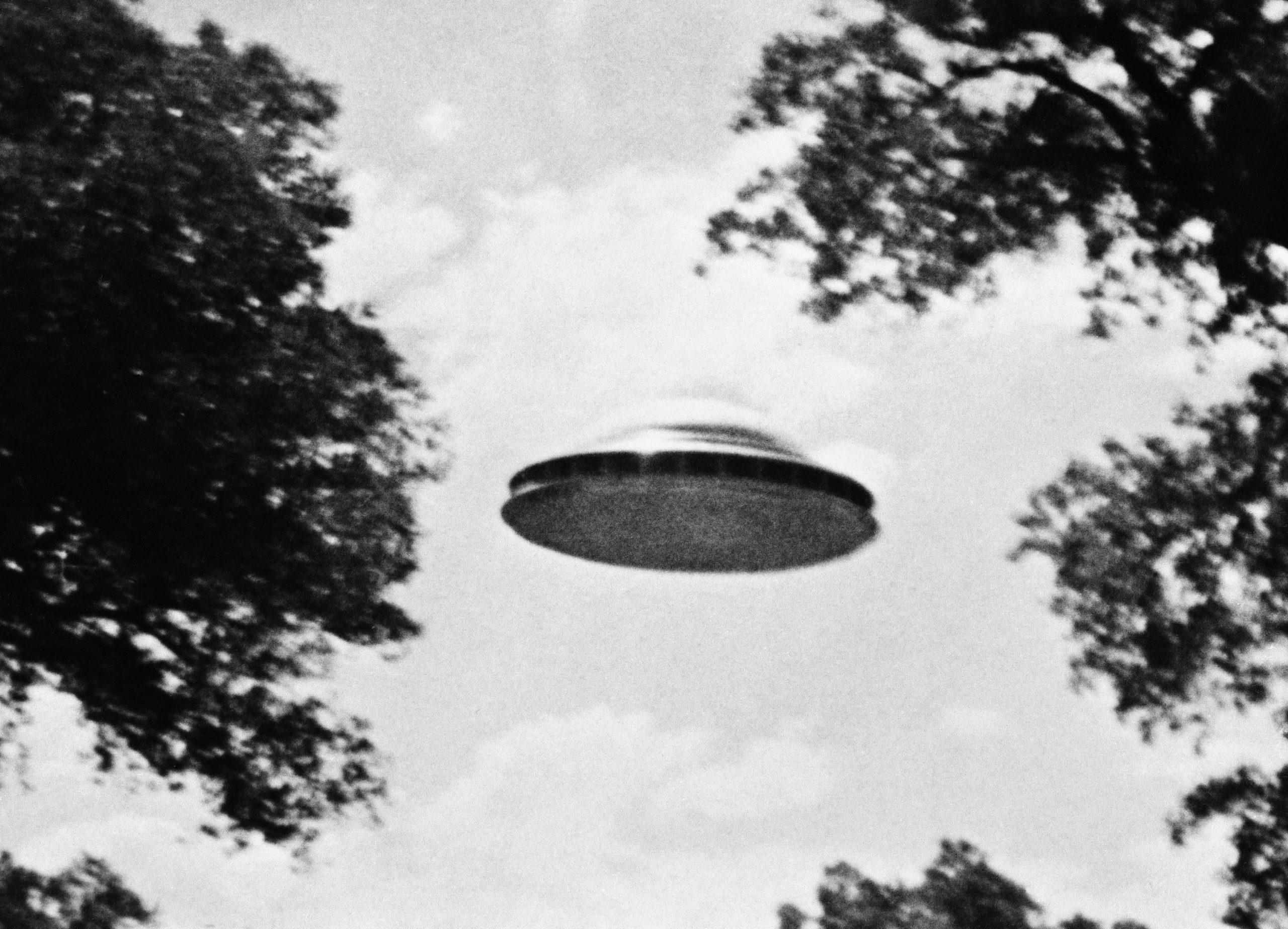
The U.S. government on May 8 began releasing files related to unidentified anomalous phenomena (UAP) — previously referred to as unidentified flying objects (UFOs) — generating nationwide speculation regarding government evidence of extraterrestrial life and nonhuman intelligence. But what does the Catholic Church have to say about it?
There is “no dogma or formal teaching” promulgated by the Church on the question of extraterrestrial life, according to experts, but prominent Catholic scholars and philosophers have contributed to the discussion around the centuries-old question, one that remains unresolved amid intense public interest.
For decades “contactees” have claimed to have encountered alien life either in the form of purported alien spacecraft or direct contact with extraterrestrials themselves. But such sightings and experiences have never been “proven” or confirmed by scientific bodies or governments.
Perhaps unsurprisingly for a topic that in more recent decades has been viewed as little more than an esoteric fad, the Church has never pronounced definitively on the topic of UAP and alien phenomena in general.
But Luke Togni, a professor of religious studies at Saint Maryʼs University in Nova Scotia, Canada, said the Churchʼs official silence on the matter is arguably a statement in and of itself.
“You might say that the Church hasn’t pronounced on it through a kind of silence around the topic,” he said. “But it has permitted speculation.”
There are some rare instances in Church history where leaders have briefly touched on the question, Togni said.
He pointed to the Medieval-era Pope Zacharyʼs condemnation of a theory that there could be human life on “another orb,” although Togni said the popeʼs remarks “probably had more to do with a race of humans not descending from Adam” than dispute over alien life in general.
He also noted the 15th-century Pope Pius IIʼs condemnation of a similar theory regarding other humans on “other worlds,” though the dispute again seemed to stem from whether or not the biblical Adam was to be considered the first human being.
Still, the overall debate, particularly in modern times, has never been deemed illicit by the Church, Togni said. “Into the Renaissance and more recent modernity there is a proliferation of speculation about alien life,” he said. “That’s never been condemned.”
The issue is increasingly drawing attention and commentary from Catholic philosophers and experts.
Catholic theologian Paul Thigpen, who passed away in February and who wrote the book “Extraterrestrial Intelligence and the Catholic Faith: Are We Alone in the Universe with God and the Angels?“, told the National Catholic Register in 2022 that he was “convinced” after years of study that a belief in extraterrestrial intelligence was compatible with the Catholic faith.
“Some Christian theologians of the past have asserted that there can be no intelligent species other than humanity and the angels (fallen and unfallen),” he told the Register.
“But their reasoning was most often flawed by a reliance on certain philosophical or scientific assumptions of ancient pagan philosophers that have proven to be wrong — such as the notion that planet Earth is the center of the universe.”
In 2024 the McGrath Institute for Church Life at the University of Notre Dame released a documentary examining “the boundaries for Catholic belief” in relation to extraterrestrial theories. The documentary spoke to numerous Catholic academics and researchers, including St. Johnʼs University philosophy professor Marie George.
George in the documentary disputed the belief that God would create a “teeny tiny Ptolemaic universe” as envisioned by thinkers and astronomers of earlier centuries.
“If Godʼs going to create a universe, heʼs going to create a really splendid universe,” she said. “… Itʼs going to be marvelous. Itʼs going to mind-blowing.”
In a May 2025 episode of “The Lila Rose Show,” meanwhile, Father Robert Spitzer — currently president of the Magis Center, which “seeks to answer the conflict of science and faith” through both research and Catholic theology — said that if aliens do exist, and if they meet certain criteria such as self-consciousness, free will, and conscience, then such beings would “have a soul.”
“[If] they would have a soul just like us, then they would be made in the image and likeness of God,” he said while agreeing that such beings would not contradict Scripture.
Diana Pasulka, a writer and professor of religious studies at the University of North Carolina, Wilmington — who also appeared in the McGrath Institute documentary — told EWTN News that the Church “has not declared UFOs to be real, false, or anything else.”
“Historically and even recently, prominent Catholics have issued opinions about extraterrestrials, but these are not to be understood as official doctrine or dogma,” she said.
The early Church theologians St. Athanasius and St. Basil were aware of debates regarding the “plurality of worlds” theory, she said, “but they didn’t venture to make any pronouncements about whether these worlds were populated with extraterrestrial life.”
In later centuries some prominent leaders began to speak more directly about the issue. Pasulka pointed to St. Albert the Great, a 13th-century Dominican friar who referred to the “wondrous and noble” question about “whether there is one world or many.”
Around the same time, Parisian Bishop Étienne Tempier affirmed that God could make many worlds if he chose (though the bishop himself believed that Earth was the lone created world).
And the 15th-century Cardinal Nicholas of Cusa challenged the belief that “so many of the stars and parts of the heavens are uninhabited,” arguing instead that “in every region there are inhabitants, differing in nature by rank and all owing their origin to God.”
Both Togni and Pasulka disputed the conspiracy theories that claim the Vatican is hiding evidence of alien life or alien spacecraft. In a recent Substack post, Pasulka wrote: “I have spent most of my career studying Catholic history, and I have worked in the observatory archive myself. I did not encounter a crashed UFO there, and I do not believe the Vatican is hiding one.”
Togni said that for years theorists have speculated on the so-called “Magenta crash,” an alleged incident involving a downed UFO in Italy in 1933 that, according to conspiracy theories, the Vatican helped cover up.
“It does get a little bit sensationalized,” he said with a laugh. There is little evidence that the Vatican is concealing secret alien files, he acknowledged, but “that doesn’t mean there isn’t some level of discussion that hasn’t been held there.”
James Madden, a philosophy professor at Benedictine College who has written at length on the UAP phenomenon, suggested that it should not be assumed by default that aerial phenomena come from extraterrestrial life.
“There are a number of other possible explanations that do not dismiss the reality of what people have claimed to have experienced,” he said, arguing that the issue needs to be “explored with our most sophisticated scientific, philosophical, and maybe even theological tools.”
Madden, a practicing Catholic, said he would “not be surprised at all” if there were “other intelligent species” in the universe, arguing that such a revelation would not seem “troubling for Catholic theology.”
He warned, however, that the traditional Catholic “receptivity to the supernatural” could “render Catholics uniquely vulnerable to be taken in by UFO lore,” even if the lore itself is groundless.
“When someone has long believed in things that most people take as ‘weird,’ there might be a tendency to see other ‘weird’ beliefs entering the cultural mainstream as a kind of confirmation,” he said. “That could leave Catholics liable to accepting certain claims without fully exploring all the possibilities or really criticizing the evidence.”
Togni himself said he believes it is “not an impossibility” that intelligent life exists elsewhere, though he said he may hold that belief “just because I was a sci-fi kid.”
He admitted that itʼs been difficult to get the Church engaged on the question in a “measured, open way.”
“The Church should say: ‘This is something that is being thought about,’” he said. Amid ongoing public interest, he added: “I think weʼll see more and more conversation arise on this.”
Meanwhile, the U.S. government said in a press release Monday that the Trump administration was “focused on providing maximum transparency to the public, who can ultimately make up their own minds about the information contained in these files.”