

The inaugural Africa Digital Assets Summit concluded in Nairobi, Kenya, on April 30 with organizers declaring it a “resounding success,” even as the event’s keynote speaker issued a stark warning: Rapid advances in digital systems risk making the continent’s poorest citizens “invisible.”
The summitʼs organizers said their purpose was to bring “together investors, regulators, innovators, and policymakers to accelerate Africa’s digital economy — from policy to prosperity.”
ACI Africa, the sister service of EWTN News in Africa, first reported on the summit in February and said Kenya was preparing to host the summit at the Catholic University of Eastern Africa (CUEA) under the theme “Ethical Stewardship for the Love of the Poor” with the aim of examining “how digital innovation can serve humanity.”
One of the summitʼs organizers, Eddie Cullen, said he drew inspiration from Pope Leo XIV’s first apostolic exhortation on love for the poor, Dilexi Te, a copy of which all participants received.
Cullen, CEO of Crescite Innovation Corporation, which sponsored the event, called it a “a resounding success.”
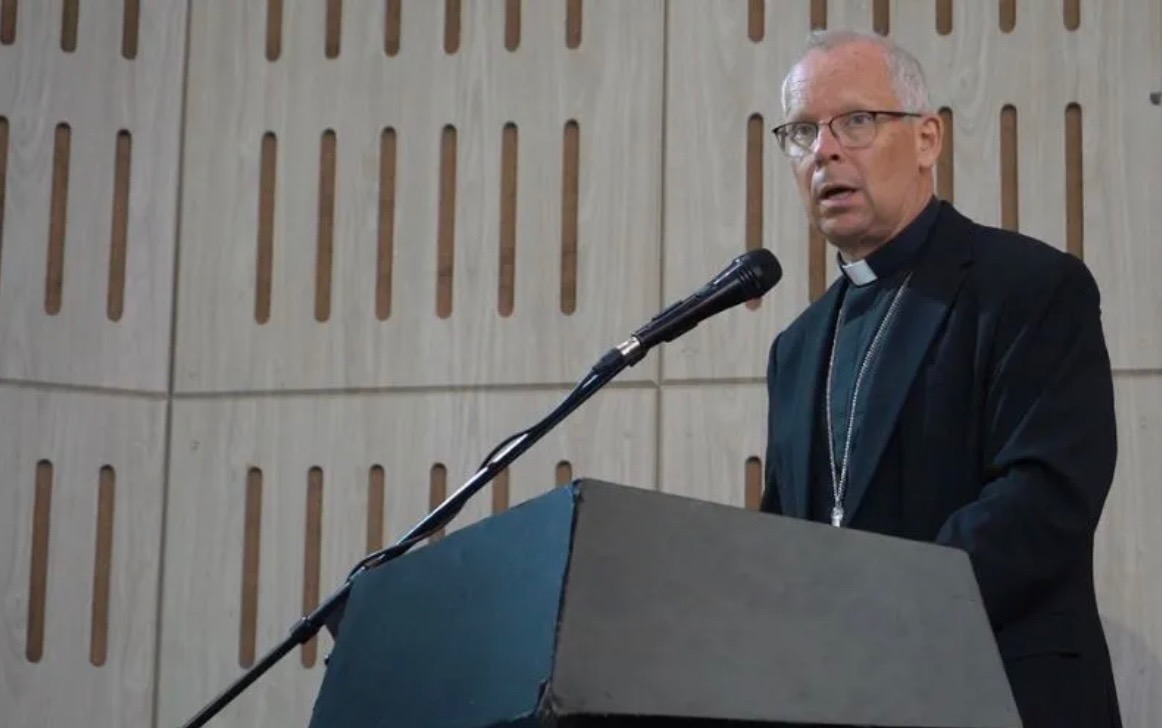
The former papal nuncio to Kenya, Archbishop Bert van Megen, delivered the keynote address titled “The Intersection of Faith, Ethics, and Technological Development: Toward Ethical Stewardship in Service of the Poor.”

Van Megen framed technological development as a moral question with direct implications for vulnerable communities, cautioning that modern financial and technological infrastructure, while promising inclusion, could instead sideline vulnerable populations if not designed with them in mind.
“Artificial intelligence, fintech ecosystems, and digital identity infrastructures are not merely tools; they are rapidly becoming systems of governance,” he said, adding that “they determine access to credit, healthcare, mobility, and even citizenship itself.”
He noted that “in previous eras, exclusion was visible. Today, it is increasingly encoded.”
The Dutch-born archbishop, whom Pope Leo XIV appointed as the new apostolic nuncio to Germany on April 9, cautioned that digital systems presented as neutral or efficient can quietly exclude people who lack stable digital records or formal participation in financial systems.
“The danger is not only that technology may fail the poor,” he said. “The deeper danger is that it may systematically exclude them while appearing neutral, efficient, and even progressive.”
Drawing from Dilexi Te, van Megen said Christian love must become the standard by which technological systems are evaluated.
“If this is true, then love is not one value among many,” he said, referring to the apostolic exhortation’s opening words: “I have loved you.”
“It is the criterion by which all systems, including technological ones, must be judged,” he said.
He warned that societies focused on speed and optimization often marginalize vulnerable populations.
“In a world driven by speed, scale, and efficiency, attention to the poor becomes structurally inconvenient,” the Vatican diplomat said. “We must ask: Are we building systems that can still afford to notice the vulnerable?”
He said the poor increasingly risk becoming “statistically invisible” within modern digital systems.
“Modern technological systems operate through abstraction,” he said. “They convert persons into data points, profiles, and probabilities.”
According to the archbishop, many economically disadvantaged people lack “stable digital identities,” “formal financial histories,” and “continuous data trails,” making them difficult for algorithmic systems to process.
“The poor are the privileged recipients of the Gospel,” he said, quoting Dilexi Te, while warning that they risk becoming “present in life, but absent in the data that drives decisions.”
“This is not simply exclusion; it is invisibility by design,” the apostolic nuncio said.
Using examples from AI-powered credit systems and fintech ecosystems operating across Africa, he explained how algorithmic systems can interpret poverty itself as a financial liability.
“Irregular income becomes ‘risk’; informal economies become ‘instability’; community-based sharing becomes ‘lack of ownership,’” he said.
“The poor are not excluded explicitly … They are filtered out silently,” he noted.
It is ‘false’ to call technology ‘neutral’
The archbishop also challenged the widely repeated claim that technology is neutral.
“We often hear that technology is neutral. While this is convenient, it is equally false,” he said.
“Technology is never simply a passive tool,” he went on to say, adding: “Every system is shaped by human decisions such as what to measure, what to prioritize, what to optimize, and what to ignore.”
Quoting Pope Benedict XVI’s June 2009 encyclical letter on integral human development in charity and truth, Caritas in Veritate, he said: “Technology is never merely technology. It reveals man and his aspirations.”
He also warned that technology “can give those with knowledge and economic resources an impressive dominance.”
“When access to essential goods, credit, healthcare, and education is mediated through digital systems, then control over those systems becomes a form of social authority,” van Megen said, adding: “If that authority is concentrated, inequality is not merely preserved, it is amplified.”
‘Structural ethics’ must shape design of digital systems
The Vatican envoy called for what he termed “structural ethics,” arguing that ethical responsibility must shape the design of systems themselves.
“Ethics today must move from personal virtue to system design,” he said.
He went on to propose that technological systems prioritize vulnerable users, preserve non-digital alternatives, create accountability structures, and accept exceptions where justice requires flexibility.
“Systems should not be designed around the most efficient or profitable user but around those who are most vulnerable,” van Megen said.
He linked those principles to Catholic social teaching, including “the dignity of the human person, the common good, solidarity, and subsidiarity.”
Catholics called to ‘shape ethical frameworks for emerging tech
The Vatican diplomat further urged Catholics to play a more active role in shaping emerging technologies.
“The Church must do more than critique. It must also propose,” he said. “It is called to shape ethical frameworks for emerging technologies; advocate for policies that protect the most vulnerable; form leaders capable of integrating faith, ethics, and innovation; offer a vision of development rooted not in domination but in dignity.”
Van Megen said technological advancement cannot be separated from moral responsibility.
“We are not merely building technologies,” he said. “We are constructing the moral architecture of the future — the conditions under which human life will flourish or fail.”
For him, “the question is not whether technology will shape the future. It will.”
“The question is: Will it recognize the poor or render them invisible?” van Megen said, and affirmed: “The answer will not be found in code alone. It will be found in conscience.”
Cullen said he hopes to expand faith-driven technological initiatives “inspired by Dilexi Te to more projects in Africa.”
“We are hopeful of continuing to spread the love of Christ across the continent,” Cullen added.
This story was first published by ACI Africa, the sister service of EWTN News in Africa, and has been adapted by EWTN News English.