


One year ago, Sarah-Elizabeth Pilato, a Catholic mother of three from New York, found out she was pregnant at the age of 40. It was a surprise to her and her husband but the couple were excited to bring another life into the world.
Then, suddenly, their excitement ended when Pilato went into her doctor’s office and was told that her baby no longer had a heartbeat. She had undergone a miscarriage. It was this experience that inspired her to write a book called “H.U.G” — an acronym for “Here, Understood, and Gently held.”
“It was a very quick emotional roller-coaster ride,” Pilato told EWTN News. “And when I had the miscarriage, my doctor, she looked at me and she basically said, ‘Iʼm so sorry. Miscarriage is really not talked about. I donʼt know why women donʼt talk about it, but itʼs very common.’ And in that moment, as she looked at me, I thought to myself, ‘OK, Iʼm going to talk about it.’”
She recalled sitting in the doctor’s office, alone, looking for anything that would help her with her grief — a pamphlet, a picture on the wall, anything — and there was nothing. Instead, all she was handed as she walked out the door was her bill for the office visit.
“There was just nothing for me to make me feel that I was going to be OK and that I wasnʼt alone. I felt completely isolated and I felt like I was the only person in the world that was feeling this,” she recalled.
Once she got home, she felt lost, not knowing what to think or do. After some time alone at home, she heard God tell her to sit down and write.
“Iʼm like, ‘Well thatʼs a really weird thing to do right now. Thatʼs like the last thing that I want to do is open my laptop,’” she said. “But, when God gives you directions itʼs always best to follow. And so I sat down and I opened my laptop. Iʼve got the tissues out, Iʼm still a mess, and I just started writing what I was feeling.”
Her writing went up on her blog and after several hours, Pilato returned to the blog post where she saw hundreds of women commenting and sending her messages of their own similar experiences.
“Thatʼs when I knew that we needed to share these stories and that I wasnʼt the only one that had ever felt like this,” she shared. “And it became so important to me, in that moment, that no one ever felt like we felt again — if we can make that feeling go away for as many women as possible, it would be worth it.”
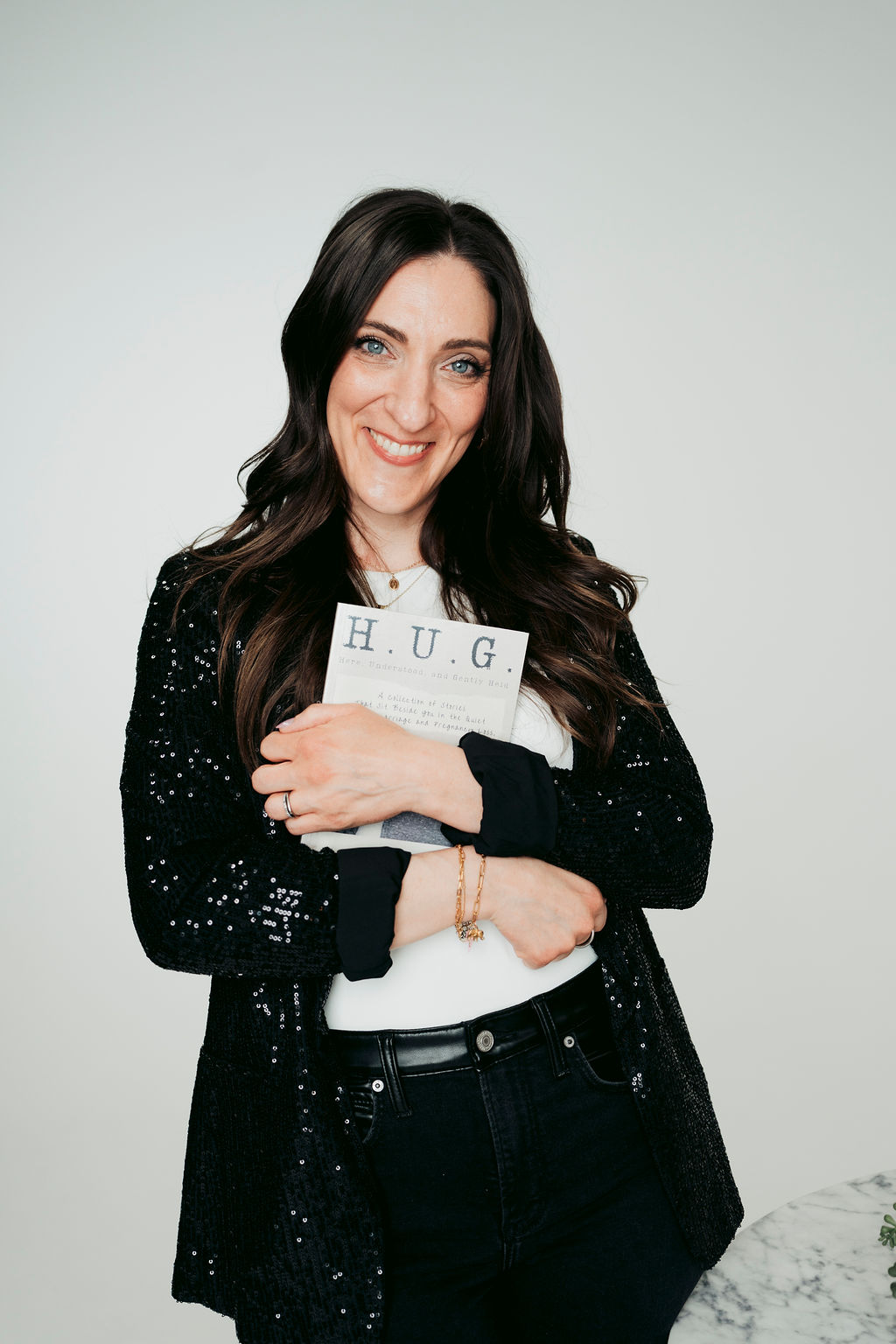
This is when Pilato was inspired to write her book, “H.U.G.,” which is made up of over 30 testimonies from women who have walked through pregnancy loss as well as men who share their perspectives as husbands and fathers walking alongside their wives. After each story, there are several reflection questions.
“This book is meant to be for the woman thatʼs experiencing it at any stage,” Pilato explained. “And itʼs really the kind of book that you can open, look at the table of contents, and theyʼre all labeled — a hug for when you just want to scream or a hug for when you feel alone, a hug for when you donʼt have the words to pray … So, you can pick it up, put it down, pick it up, put it down whenever you need it, wherever youʼre grieving.”
She added: “I wish Iʼd had a book to just hug when I was laying there on my couch that would just make me feel seen.”
Speaking to the men in the book, Pilato realized through her own miscarriage that her husband “had no idea what to do with me or how to respond or what to do with his own emotions.”
“[Men are] kind of forgotten and theyʼre processing in a very different way. And I realized that he didnʼt know what to do and so I realized that he needed to have a story as well,” she said.
Pilato explained that the book was entirely funded by donations from individuals, and with the donations she is now working to get the book available “in any place that a woman might be grieving.”
“We have them in hospitals, in urgent cares, in churches, therapy offices — Iʼve had requests come in from all different places. And our goal is to get the book into every state,” she said.
Books are available for purchase or, if an organization is unable to pay for them, they can request free books to be donated to them.
“I do always say if your organization has the budget and you would like to pay, absolutely, it helps, it all goes back into the book, but if not, if we have inventory, we make it happen,” she said. “So, it is all God filling our inventory, bringing us to the people. And so far, weʼve been able to get books to women as soon as two hours after theyʼve heard that theyʼre experiencing a loss.”
The author shared that her main hope for women who come across her book is that “she feels seen and loved and finds hope in her future. I think Itʼs so hard to feel seen and loved and hopeful in the moment, but by reading these stories, I believe that she can feel that and get closer to it in her healing.”