

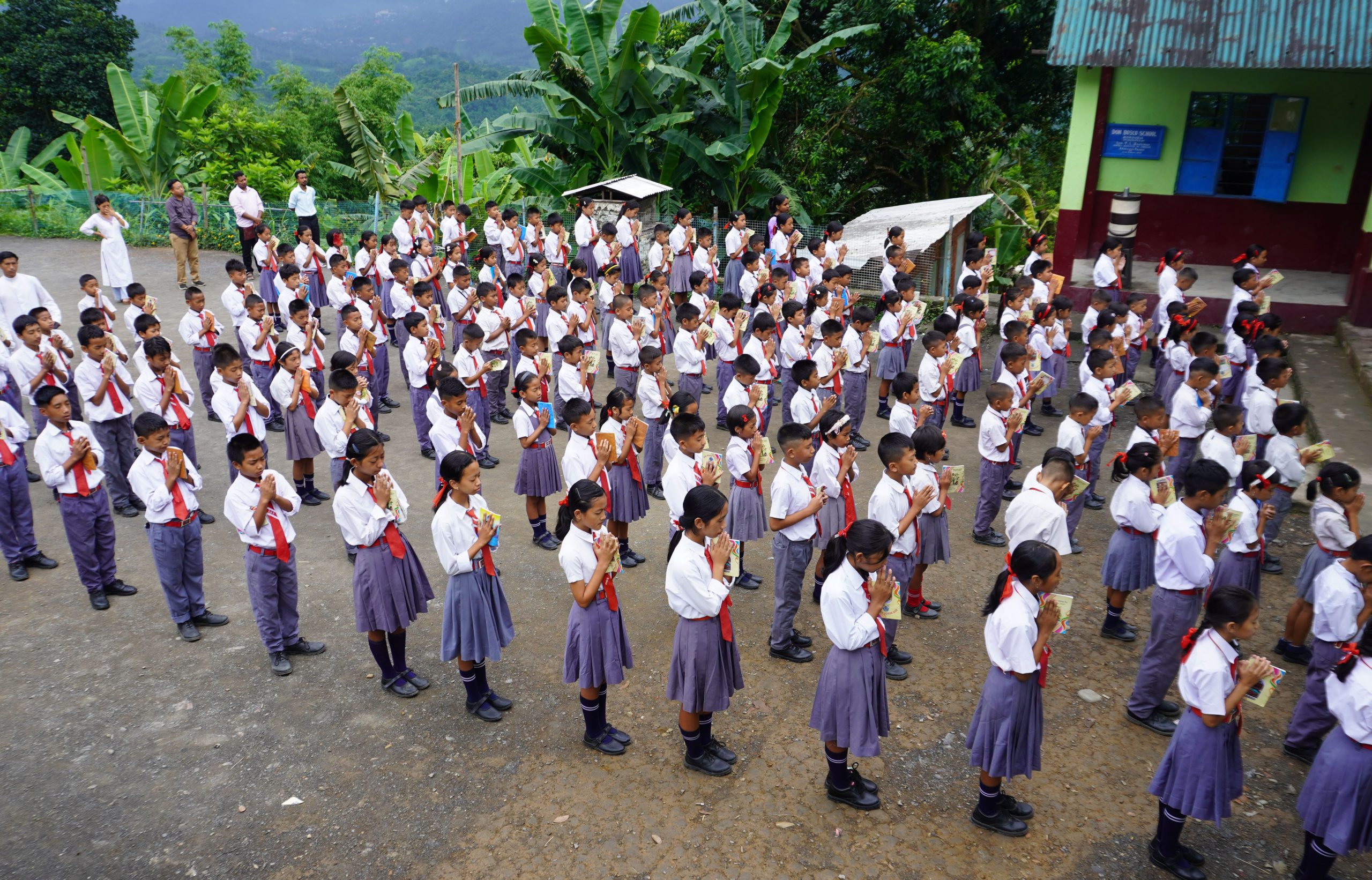
Catholic and other Christian groups have expressed concern after the High Court of Chhattisgarh — a central Indian state governed by the Hindu nationalist Bharatiya Janata Party (BJP) — declined to set aside a state government order making Hindu prayers mandatory in government schools, dismissing a challenge to it as “premature.”
“The government order of June 12 [mandating Hindu prayers in schools at assemblies, meal breaks, and at closing] came as a shock to us,” Archbishop Victor Henry Thakur of Raipur, the state capital, told EWTN News on July 13.
“We were looking forward to the judiciary to uphold the fundamental rights of the religious minorities enshrined under the constitution. But the July 2 verdict of the High Court belies our hope, as it has dismissed the plea against the government order as ‘premature,’” Thakur said.
What the circular requires
The ruling came on a petition filed by former Chhattisgarh Waqf Board chairman Abdul Salam Rizvi and two others challenging the June 12 order. According to The Hindu, which cited a government official, the morning assembly would include the national anthem, national song, Deep Mantra, Saraswati Vandana, Guru Mantra, and excerpts from the biographies of great personalities.
During the midday meal, students would recite a food prayer, the Bhojan Mantra, while the closing session at the end of the school day would include the state song, the Gayatri Mantra, and the Shanti Mantra. The order also threatened punitive action “to ensure strict implementation of the order,” with officials inspecting schools to check for violations of the prescribed guidelines.
The court’s ruling
While dismissing the petition against the June 12 order as “premature,” the High Court said the plea was “based on mere apprehension rather than any actual grievance.”
The judge, Justice Amitendra Kishore Prasad, said the petitioners could approach the court “afresh by way of an appropriate petition, supported by cogent and relevant material, if any exigency arises in the future.”
However, Thakur said: “In a secular democratic country, young children or their families should not be forced to wage legal battle against the system to uphold their fundamental rights.”
“We urge all concerned to ensure that the schools — temples of learning and harmony — are not reduced to communal battlefields of division and religious dominance,” reiterated Thakur, who heads the Catholic Church in Chhattisgarh, where Christians number less than 2% of the state’s 25 million people and the Catholic Church runs over 250 schools.
Article 30 of the Indian Constitution empowers all religious and linguistic minorities to establish and administer educational institutions of their choice.
Protests and ‘deep disappointment’
The notification of the order drew protests from Christian and civil rights groups and opposition political parties, which dubbed it a Hindu nationalist “majoritarian show.”
Sushil Anand Shukla, spokesperson for the opposition Congress party, said: “Students of all faiths, castes, and communities study in government schools and making the recitation of specific religious mantras compulsory could hurt the sentiments of people belonging to other faiths.”
The Progressive Christian Alliance (PCA), in a statement on July 10, expressed “deep disappointment” with the High Court order: “The judgment fails to adequately protect the fundamental rights of students of religious minorities and other faith streams … who now face daily pressure to participate in religious practices that are not their own.”
“The dismissal overlooks the real and immediate coercive atmosphere created by a government circular that uses the … school setting where children have little agency to opt out without fear of stigma or exclusion,” said the Rev. Akhilesh Edgar, general secretary of the Evangelical Churches in India, in the statement issued on behalf of the educational wing of the PCA.
“We organized protests in several places including Raipur against this move to enforce Hindutva [Hindu nationalist] agenda,” said Pastor Simon Digbal Tandi, coordinator of the PCA.
“This court order has come even as we were preparing to move the court,” said Tandi, who heads the PCA’s Chhattisgarh chapter.
Tandi also said “the government is hypocritical and playing double talk.” While the government had told the court the order drew no objections, he said, it had already begun allotting 25,000 rupees (about $260) per village school to install sound systems to carry out the prayers.