

U.S. Secretary of State Marco Rubio delivered a speech at the Munich Security Conference (MSC) over the weekend that elicited a standing ovation and widespread accolades, including from Bishop Robert Barron of the Diocese of Winona-Rochester, Minnesota.
In his Feb. 14 speech, Rubio said Europe and the U.S. are part of “one civilization — Western civilization” and are “bound to one another by the deepest bonds that nations could share,” including shared “Christian faith, culture, heritage, language, ancestry, and the sacrifices our forefathers made together for the common civilization to which we have fallen heir.”
“It was here in Europe where the ideas that planted the seeds of liberty that changed the world were born,” he said. “It was here in Europe … which gave the world the rule of law, the universities, and the scientific revolution.”
To applause, Rubio said the destiny of the U.S. will “always be intertwined” with Europe’s and “the fate of Europe will never be irrelevant to our own.”
Rubio recalled that at the first MSC meeting in 1963, “thousands of years of Western civilization hung in the balance” after the devastation of two world wars and before a united Europe and United States eventually “prevailed” against the “evil empire” that was the communist Soviet Union.
He said that after the fall of the Berlin Wall in 1989, it was “foolish” to assume that “every nation would now be a liberal democracy” and “we would now live in a world without borders where everyone became a citizen of the world” thanks to the replacement of nationhood by commerce and trade.
This was a mistake, he said, citing “free and unfettered trade” as the reason for the deindustrialization that has taken place in the U.S. and Europe as well as the “rapid” militarization of countries that are “adversaries and rivals” who have taken over “our critical supply chains.”
Mass migration threatens ‘cohesion of our societies’
Rubio blamed the pursuit of “a world without borders” for the “unprecedented wave of mass migration that threatens the cohesion of our societies, the continuity of our culture, and the future of our people.”
He called for both Europe and the U.S. to “gain control of our national borders,” saying enforcing immigration law is “not an expression of xenophobia or hate but rather a “fundamental act of national sovereignty.”
“And the failure to do so is not just an abdication of one of our most basic duties owed to our people,” he said. “It is an urgent threat to the fabric of our societies and the survival of our civilization itself.”
He also criticized what he called “a climate cult” that has led to the self-imposition in Europe and the U.S. of “energy policies … that are impoverishing our people, even as our competitors exploit oil and coal and natural gas and anything else — not just to power their economies but to use as leverage against our own.”
He said President Donald Trump refuses to see the “West’s age of dominance” as declining, saying that the U.S. has “no interest in being polite and orderly caretakers of the West’s managed decline.”
Instead, Rubio said the U.S. wants to “revitalize” its alliance with Europe and, together, “renew the greatest civilization in human history.”
Looking to the future, Rubio called for the U.S. and Europe to be “unapologetic in our heritage” as both societies rebuild by reindustrializing, limiting immigration, and investing in military defense.
“We made these mistakes together,” he said, “and now, together, we owe it to our people to face those facts and to move forward, to rebuild.”
The speech received a standing ovation.
Barron’s assessment
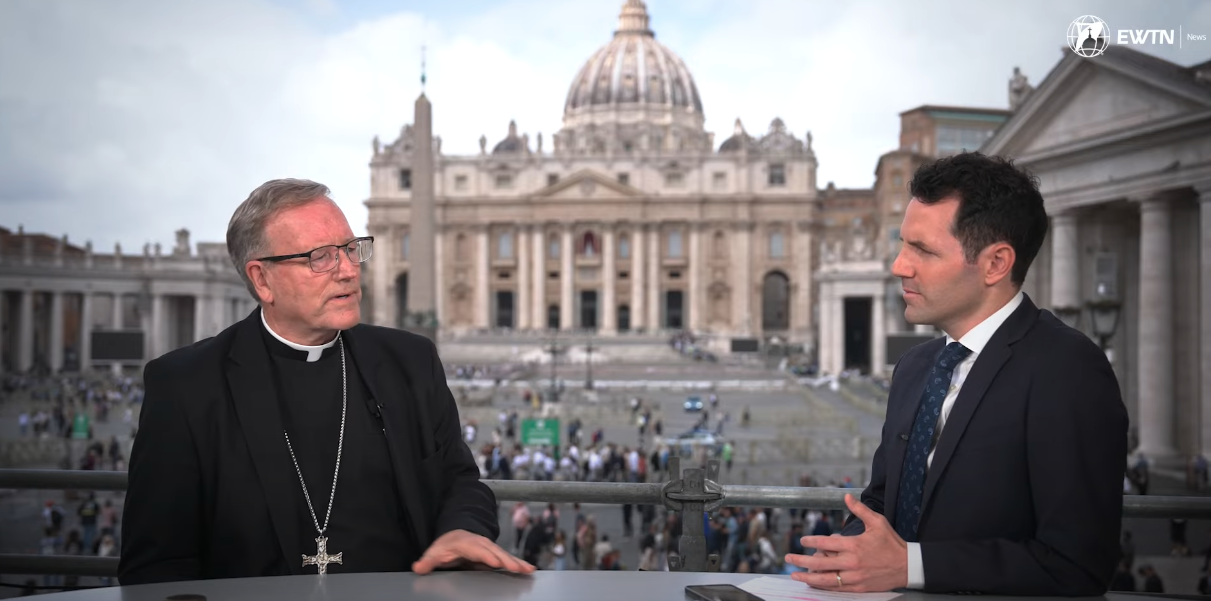
In an X post following Rubio’s speech, Barron said that “what most grabbed my attention was his stress on the common culture that unites Europe and America.”
Barron pointed out that “that culture is grounded ultimately in the Christian faith. It is simply the case that reverence for the dignity of the individual, for human rights, for political freedom, and for equality comes, in the final analysis, from the Christian Gospel.”
“Basic to his presentation was the conviction that Europe and America will truly flourish when each rediscovers its spiritual mooring,” the bishop observed.
Last week, the presidents of the Italian, French, German, and Polish bishops’ conferences issued a statement in which they also called upon Europeans to “return to the foundations of their hope.”
“Christianity has been one of the essential foundations of our continent,” they wrote, and Europe must “rediscover its soul in order to offer the entire world its indispensable contribution to the ‘common good.’”
“The world needs Europe,” the bishops wrote. “This is the urgency that Christians must embrace in order to then commit themselves decisively, wherever they are, to its future with the same keen awareness as the founding fathers.”
The Munich Security Conference
The MSC was founded in 1963 and chaired until 1998 by Ewald-Heinrich von Kleist-Schmenzin, a German publisher, former Wehrmacht officer, and participant in the July 1944 plot to assassinate Adolf Hitler.
The MSC is not a decision-making body but an independent venue for launching diplomatic initiatives and shaping international security policy discourse. It serves as an annual gathering for heads of state, foreign and defense ministers, military leaders, experts, and representatives from business, academia, and civil society to discuss global security challenges in an informal setting.