
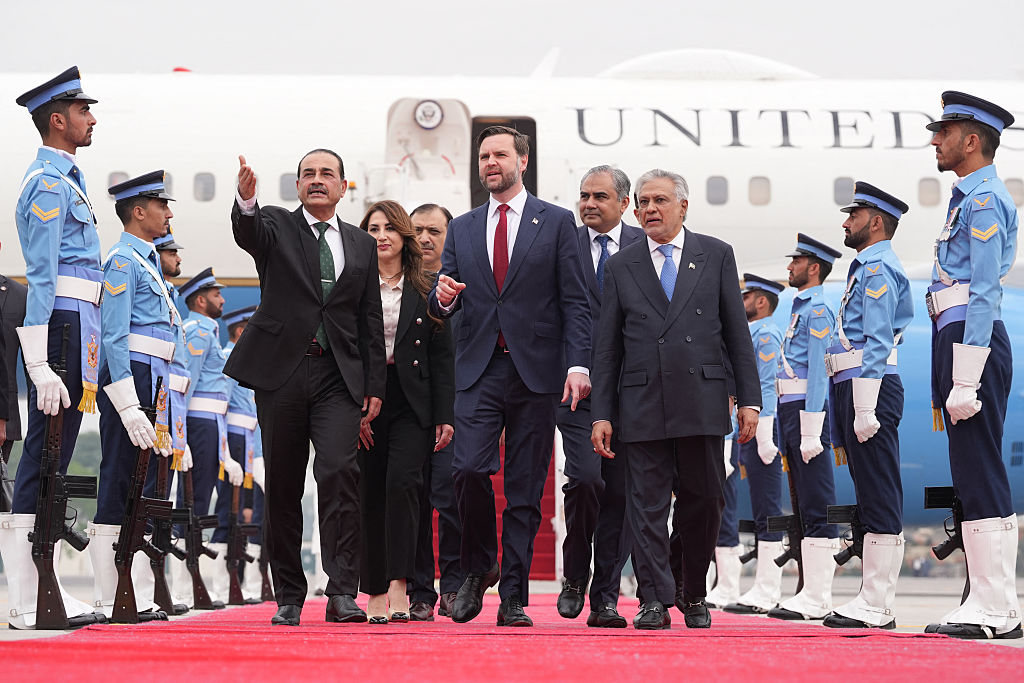
U.S.-Iran peace talks collapsed on Sunday after a 21-hour marathon session, with Vice President JD Vance blaming Iranʼs refusal to commit to abandoning its nuclear program, even as Catholic leaders in Rome and Washington condemned the broader conflict as immoral and pleaded “Enough of war!”
“The bad news is that we have not reached an agreement. And I think that’s bad news for Iran much more than it’s bad news for the United States of America,” Vance told reporters in Islamabad, where the meetings took place. “We’ve had a number of substantive discussions with the Iranians. That’s the good news.”
He added that the core impasse remained Iran’s nuclear ambitions: “But the simple fact is that we need to see an affirmative commitment that they will not seek a nuclear weapon, and they will not seek the tools that would enable them to quickly achieve a nuclear weapon. That is the core goal of the president of the United States. And that’s what we’ve tried to achieve through these negotiations.”
Vance emphasized that the U.S. side negotiated “in good faith,” but Iran “has chosen not to accept our terms.” He further noted, “We leave here with a very simple proposal, a method of understanding that is our final and best offer. We’ll see if the Iranians accept it.”
Iran has insisted the aims of its nuclear program are civilian.
The high-level face-to-face talks in Pakistan, a mediator between the two countries, followed weeks of military confrontation that began in late February and produced a tenuous two-week ceasefire, which ends April 22. With no deal secured, the future of that truce now hangs in greater uncertainty.
Despite the breakdown in negotiations, Pakistani Foreign Minister Ishaq Dar pushed both sides to continue to “uphold their commitment to ceasefire.”
Vance, a Catholic convert and Iraq War veteran, has reflected on the moral weight of these national security decisions in the context of his faith. Speaking to the Washington Post last week about U.S. actions to prevent Iran from obtaining a nuclear weapon, he said, “I certainly hope that God agrees with the decision that Iran shouldn’t have a nuclear weapon, but I’ll keep praying about it.” He added that his approach has been “to pray that we are on God’s side” because “that would mean a lot of innocent people dead.”
Catholic leaders in the U.S. and at the Vatican have responded to the broader conflict with strong calls for peace and a return to dialogue.
In Rome, Pope Leo XIV led a peace vigil at the Vatican April 11, where he delivered a forceful appeal against the violence.
“Enough of war!” he declared, lamenting the human and spiritual cost of the fighting. He stressed that prayer is “the most free, universal and disruptive response to death,” and is among the things that “break the demonic chain of evil and put themselves at the service of the Kingdom of God; a kingdom in which there is no sword, no drones, no revenge, no trivialization of evil, no unfair profit, but only dignity, understanding and forgiveness.”
He and other Catholic leaders have drawn on the Church’s just war tradition, which holds that the use of force must meet strict moral criteria, including just cause, right intention, last resort, proportionality, and discrimination between combatants and non-combatants.
The Holy Father called on all parties to reject escalation and instead commit to patient, honest dialogue aimed at genuine coexistence and the protection of civilians.
“Stop! Itʼs time for peace! Sit at tables of dialogue and mediation, not at tables where rearmament is planned and death actions are deliberated,” he said.
At a special Mass for Peace held in Washington, also on April 11, Cardinal Robert McElroy argued that the current war fails to meet the strict criteria of just war theory, particularly in light of civilian suffering and the risk of disproportionate harm.
The cardinal urged the faithful to pray for an immediate end to hostilities and for diplomats to pursue a just settlement that protects human life.
Predicting the failure of negotiations “because of recalcitrance on both sides” and the United States’ reentry into hostilities after the ceasefire, he said:
“At that critical juncture, as disciples of Jesus Christ called to be peacemakers in the world, we must answer vocally and in unison: No,” he said. “Not in our name. Not at this moment. Not with our country.”
He warned of the “expansion of the war far beyond Iran, the disruption of the world economy, and the loss of life.”