
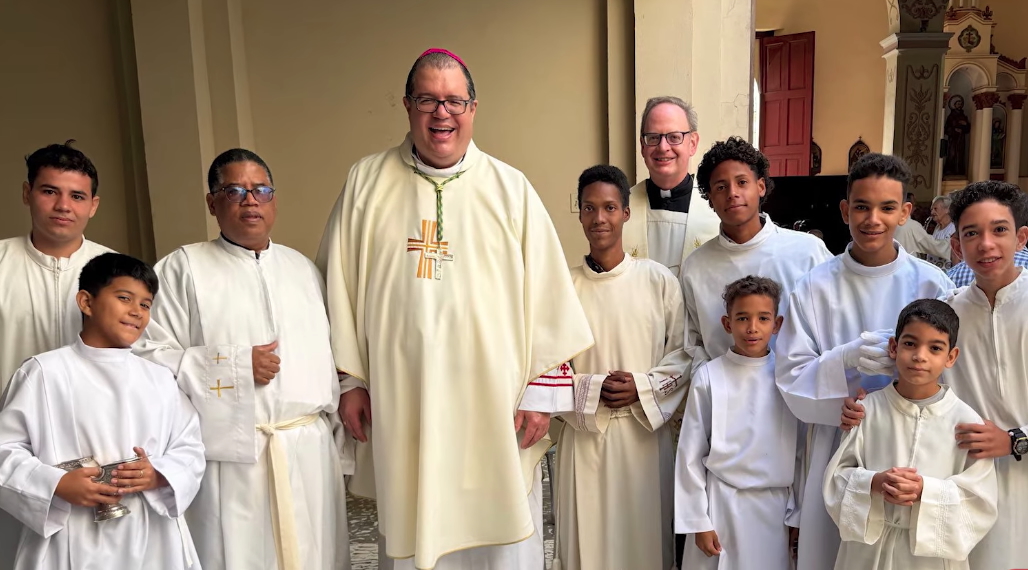
Bishop Manuel de Jesús Rodríguez of Palm Beach, Florida, advocated for greater internet access within Cuba and for Cubans to be able to exercise political freedom and freedom of expression, because this “forms part of human dignity.”
The Dominican-born prelate made the appeal in an interview with “EWTN Noticias,” the Spanish-language broadcast edition of EWTN News, after a March visit to Cuba to attend the installation of Osmany Massó Cuesta as bishop of Bayamo-Manzanillo.
Speaking with “EWTN Noticias,” Rodríguez addressed recent events in the Caribbean nation, including the government’s Holy Week announcement that it would release more than 2,000 people from prison.
The bishop stated that this was “a first step toward a long-term and more stable solution.”
“It is certainly neither the definitive nor the complete solution, but it is a sign that should be appreciated as a positive step,” he said.
He noted that this step “must be followed by other measures” capable of “increasingly guaranteeing the growing integral development of Cuban men and women at the social level.”
“In Cuba,” he stated, “a process must take place wherein Cubans are granted increasingly greater access to the internet, where the exercise of freedom of expression is made possible, and where political freedom — naturally — can also be exercised, for that is part of human dignity.”
“However,” he noted, “all of this must always proceed from an attitude of dialogue and collaboration.”
Regarding the Catholic Church in Cuba, the prelate stated that in recent years, the bishops have been granted the opportunity “to speak on the radio,” thereby enabling them to evangelize and provide moral support to the people “within the limitations inherent to the prevailing situation and circumstances.”
In Cuba, where a one-party system is imposed, the internet is monopolized by the state-owned company ETECSA. The most affordable data plan available to citizens costs 120 Cuban pesos ($5) and offers only 2 GB. In contrast, a person arriving from abroad can access a minimum plan of 10 GB, although the cost is not listed on the website.
The state also holds a monopoly over print, television, and radio media. Those wishing to establish independent media outlets have the internet as their only alternative, albeit at the risk of being harassed and detained by the communist regime, as documented on March 11 by the Inter American Press Association.
The Catholic Church ‘is no one’s enemy’
Rodríguez first visited Cuba as a young man in 1998 on the occasion of the historic apostolic journey of St. John Paul II. He returned in 1999 as a missionary and lived on the island until 2000.
“Upon returning after 25 years, I have found a people who still possess the same faith, a people filled with hope, and a Church that has continued to grow and renew itself. However, suffering and distress in general have multiplied. When I was here more than 25 years ago, the humanitarian and social situation was already appalling.”
“But now, the crisis has reached truly inhumane proportions … and our solidarity and response are urgently needed,” Rodríguez emphasized.
The blackouts and shortages of food and medicine plaguing the island intensified starting in January, after the United States effectively stopped oil shipments from Mexico and Venezuela, a measure that has further complicated daily life, affecting, among other things, transportation, the accumulation of trash on the streets, and foreign tourism.
And although a Russian vessel arrived in late March carrying 730,000 barrels of oil and the U.S. government is sending donations to be distributed by Caritas Cuba, this is not enough.
Rodríguez therefore called upon the Cuban authorities to understand that the Catholic Church “is no one’s enemy,” for it is not married “to any ideology or to any political party” but rather preaches “Jesus Christ and his message of love, fraternity, respect for human dignity, peace, and hope.”
“By working with the Church, they will be safeguarding the dignity of the Cuban people and will also be collaborating in a deliberate process aimed at implementing measures to restore the people’s dignity,” he stated.
“Therefore, I invite the authorities of Cuba — the government of Cuba — not to be afraid to collaborate” with the Church, Rodríguez urged, who assured that “we, the Catholic bishops of the United States, are here to support the bishops of Cuba in whatever is needed.”
This story was first published by ACI Prensa, the Spanish-language sister service of EWTN News. It has been translated and adapted by EWTN News English.