

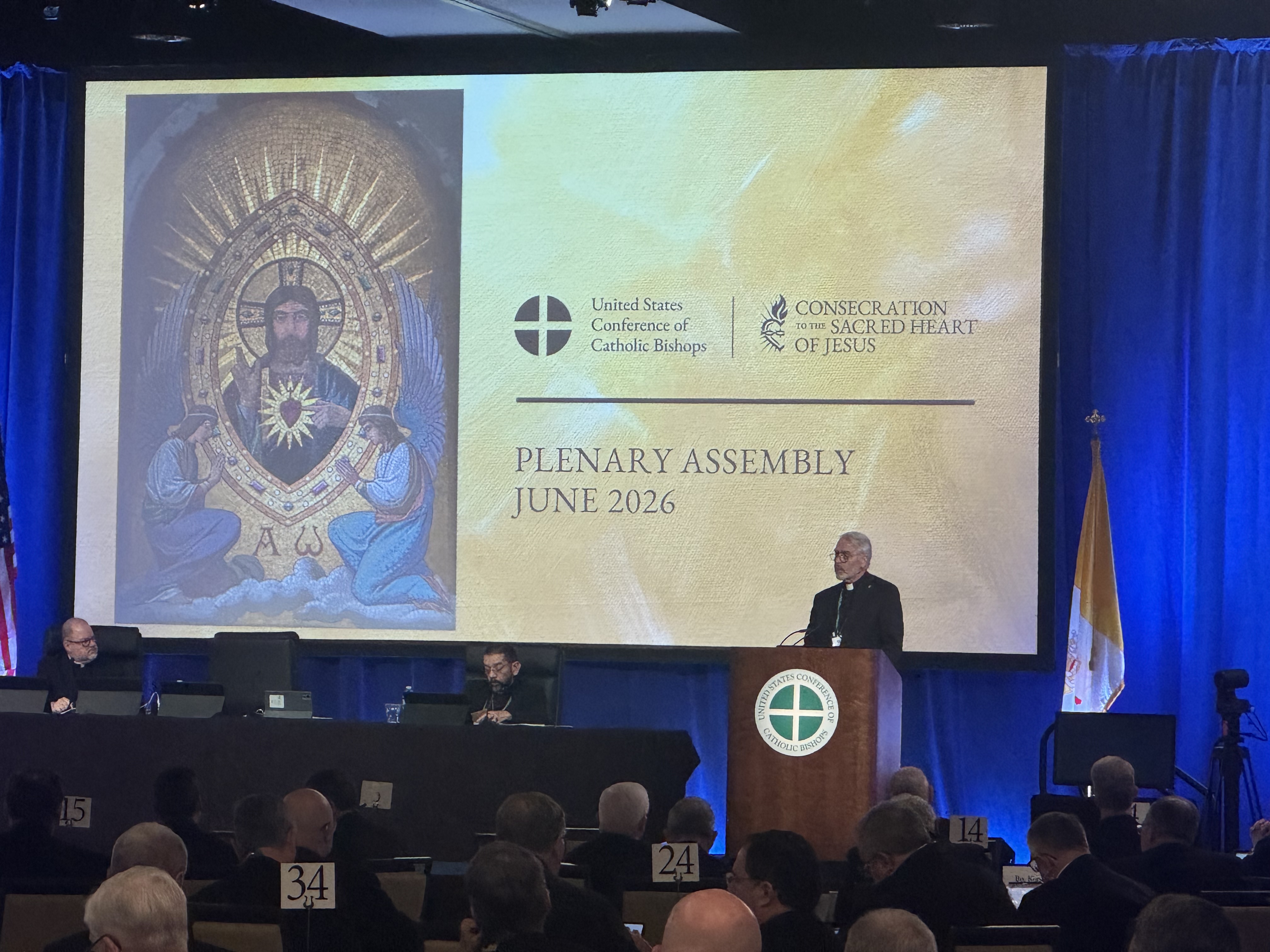
ORLANDO, Florida — Archbishop Paul S. Coakley, president of the United States Conference of Catholic Bishops (USCCB), on Wednesday offered his first remarks as president to his brother bishops.
At the USCCB spring plenary session in Orlando, Florida, on June 10, Coakley, bishop of Oklahoma City, detailed what the U.S. bishops have recently accomplished, and outlined the challenges they still face and work they have to do.
The work of the bishops “is good work,” Coakley said. “It is necessary work, as can be seen in the many ways we, as a conference, have responded to the many challenges our world faces today.”
The bishop said he is “especially pleased to recognize the impact” of the conferenceʼs special message on immigration issued at the bishops‘ November meeting, which expressed the bishops’ opposition to “indiscriminate mass deportation of people.”
“That message demonstrated our united concern as pastors for the dignity of every person, especially our migrant brothers and sisters,” Coakley said.
“I am also grateful for our unity: our unity as bishops of the United States, our unity with the Holy Father, Pope Leo, and our unity with all his predecessors since the founding of this nation,” he said.
“For 250 years, the bishops of this country have worked together, alongside priests, religious brothers and sisters, and so many faithful men and women as witnesses to Christ and to make known his love in so many concrete ways,” he said.
This work has been accomplished through parishes, schools, hospitals, and charitable agencies, which are “performing the corporal and spiritual works of mercy, including welcoming wave after wave of new arrivals to this land,” Coakley said.
“Admittedly, we have not been always perfect in doing this, but overall, I would say our track record is very good,” he said.
The bishops “are commanded to put out into the deep water, to move beyond our comfort zones and the safe places where we can maintain our illusions of safety and control,” he said.
Mission of the conference going forward
The president shared “challenges” that the bishops face and how the Church must offer “hope” in order to address them.
“The Church’s witness to Christ” is especially needed today “in an age of constant flux, of forced migration, polarization, disruptions, climatic and economic upheavals, artificial intelligence, and wars,” and when “many are wondering what it even means to be a human person,” Coakley said.
The bishop posed the questions “What are some of the challenges to hope that need to be addressed? Where must hope be restored and how, as a conference, can we help?”
“First and foremost,” these questions can be addressed “by continuing to defend human dignity,” Coakley said.
“The dignity of the human person continues to be threatened,” he said. Through “threats to the unborn, to the elderly, to the sick and suffering” and “through the violence of war and injustice.”
“Society tends to disregard and cast aside what it deems useless, but life, human life, can never be adequately valued based on it being useful or useless. Or a burden or unworthy of protection,” he said.
“To restore hope necessitates preaching exactly that — that life is a gift from God,” he said.
“Human dignity is also threatened by the scourge of racism, by abuse, disdain, and contempt — especially towards the poor, the stranger, the condemned, and the outcast,” Coakley said.
Reducing polarization in our nation
“Another area in which we can promote hope is in our willingness and efforts to work with others — both in and outside of the halls of government — to reduce polarization,” Coakley said.
“Together we are working on ways to promote faithful citizenship — through dialogue, deeper realization of who is our neighbor, and by placing faith before politics — a faith that inspires hope, respect, and the pursuit of the common good,” he said.
Following a “cordial visit to the White House last January, which I am grateful to have made, we recognize the need for further progress,” Coakley said regarding his Jan. 12 meeting with President Donald Trump, about four months before the president called the pope “weak on crime and terrible for foreign policy” in a social media post that drew a response from U.S. bishops.
The Church must “stay in the conversation,” Coakley said. “As our Holy Father has said in so many contexts and in so many ways, ‘Now is the time for dialogue and building bridges.’”
“Polarization within our country, and even within our Church, is a scandal that can only be overcome through encounter, through the cultivation of interpersonal relationships and conversations between those who may disagree,” Coakley said.
In order to “help restore hope to a world so desperately in need of it,” the bishops must reach “out to all those who are hungry to hear the words of hope that come from the Lord,” he said.
“This year we saw record numbers enter the Church, and this, after last year’s record numbers. This is a great sign of the outpouring of the Holy Spirit. It is also a further example of how we need to put out into the deep — proclaiming the risen Son of God and sharing the Gospel with others,” he said.
As the bishops prepare to consecrate the nation to the Sacred Heart of Jesus on June 11, Coakley said: “I am reminded how deep, unfathomable, and profound is the love that lives in that heart, and how it embraces the entire world.”
“Can there be a greater message of hope? Can a greater gift of hope be offered?” he asked.
“It is the love flowing from the Sacred Heart of Jesus that feeds our hope,” he said.
“I know that we have much work to do before we rest, but we are comforted by two things — we are in this vineyard working together, and, in the end, it is the Lord who will accomplish it all,” Coakley concluded.