
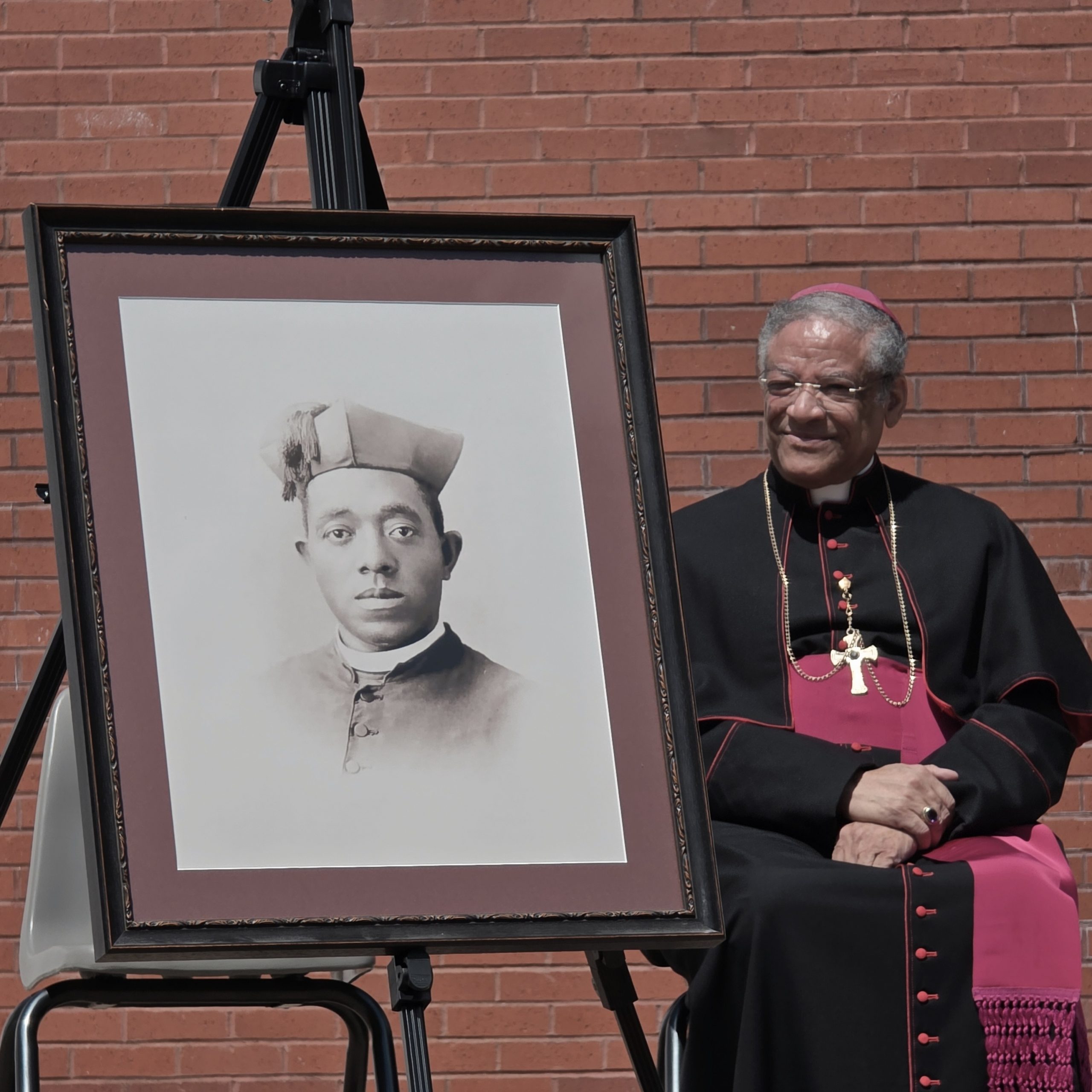
The Diocese of Springfield in Illinois announced plans to create The Shrine for Father Augustine Tolton, the first Black Catholic priest born in the U.S. whose priesthood is fully verified in Church and civil records.
Bishops, shrine organizers, city officials, and the faithful gathered at St. Boniface Church in Quincy, Illinois, on April 29 to announce the shrine will be a holy site of the first recognized Black priest in the United States and will offer pilgrims an opportunity to learn about his life and pray where he prayed.
“This is an extraordinary moment not only for our area but for the Catholic Church in our country,” Bishop Thomas John Paprocki of the Diocese of Springfield said.
The shrine will be located at the closed St. Boniface Church, which was built on the site of Tolton’s first solemn high Mass in Quincy, making it a fitting site for a shrine dedicated to his life and growing legacy.

“To restore St. Boniface as a shrine dedicated to Father Tolton means preserving sacred history while creating a living place of prayer, hope, and renewal — all tied to a holy priest whose life is an example of authentic discipleship of Christ,” Paprocki said. “This shrine will place Quincy firmly on the spiritual map for pilgrims seeking inspiration, healing, and deeper faith.”
Honoring Toltonʼs life that shows the faithful we “can do extraordinary things and live a heroic Christian life,” Paprocki said.
The shrine will be a sacred place where pilgrims can pray for Tolton’s intercession and attend daily Mass. It is intended for all the faithful’s prayers, but especially for seminarians and priests, for patience, reconciliation, and harmony, and all that Tolton endured in his life, organizers said.
Father Tolton
Tolton, whose first name is sometimes rendered as Augustine, Augustus, or August, was born into slavery in 1854, but in 1862, his mother and siblings made an escape across the Mississippi River to the free state of Illinois, eventually settling in Quincy. There, he attended St. Peter’s Catholic School and discerned a call to the priesthood.
Despite his calling, no American seminary would accept him as a Black man. He chose to leave and go to Rome to study where he was later ordained a priest. Though he believed he would serve in Africa, he was instead sent back to Quincy.
“Father Tolton overcame the odds of slavery, prejudice, and racism to become a humble priest and someone after whom we should model our lives,” Paprocki said.
Known for his powerful preaching and singing, Tolton ministered in Quincy for several years before later transferring to Chicago. He died on July 9, 1897, at the age of 43 and is buried at St. Peter’s Cemetery in Quincy.
Bishop Joseph Perry, retired auxiliary bishop of Chicago and past vice president of the board of the National Black Catholic Congress, is leading the cause for the canonization of Tolton.
The cause was formally opened in 2010 by the Archdiocese of Chicago and on June 12, 2019, Pope Francis declared him “venerable.” The cause is now focused on documenting a miracle attributed to Tolton’s intercession.

“Father Tolton’s own struggles pose a shining example of how to grapple with disappointment, protracted disappointments that constrain our lives, as well as how to endure when endurance may appear illogical,” Perry said at the event. “In the end, his faith, hope, and love were found intact.”
Fundraising efforts
The Quincy-based Committee for the Shrine for Father Augustine Tolton estimates that the church building will require $5 million in renovations, plus an additional $5 million to $7 million for campus expansion and continued care.
“This shrine will only be possible through the generosity of the faithful,” Father Steven Arisman, chair of the Committee for The Shrine for Father Augustine Tolton, said.
“I encourage Catholics everywhere to prayerfully consider supporting this project. By helping build this shrine, you are helping preserve Father Tolton’s legacy and offering future generations a place where hearts can be lifted to God and lives transformed by grace,” he said.