
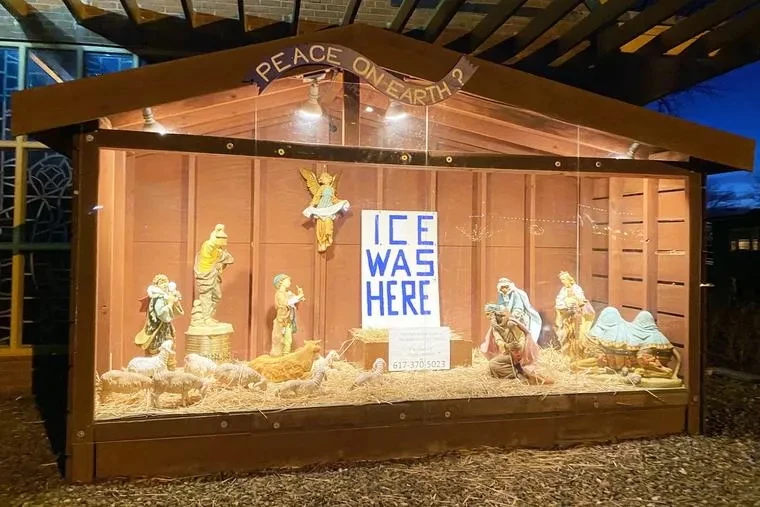
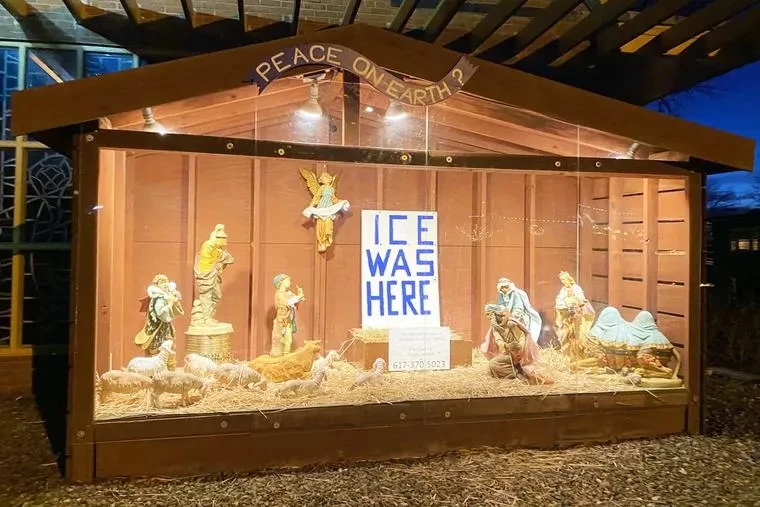
A Nativity display with anti-ICE messaging outside St. Susanna Church in Dedham, Massachusetts. / Credit: Matthew McDonald
Boston, Massachusetts, Dec 9, 2025 / 11:00 am (CNA).
The pastor of a Catholic parish near Boston says an anti-immigration-enforcement display in its Nativity scene will stay up at least for the time being, and he is asking for a meeting with the archbishop.
The announcement Monday night — more than three days after the Archdiocese of Boston said the display should be removed — leaves the parish and Archbishop Richard Henning of Boston at an impasse.
“We are waiting for an opportunity of dialogue and clarity with [Arch]bishop Henning before reaching any final decisions,” Father Stephen Josoma said, according to a video of a press conference published by MassLive.com.
The display, put up Nov. 29 outside St. Susanna Church in Dedham, Massachusetts, includes a large sign saying “ICE Was Here” and another sign explaining that the absent figures of Jesus, Mary, and Joseph are safe inside the church building. The display also includes a telephone number to report the presence of U.S. Immigration and Customs agents to an organization that monitors them.
A spokesman for Archbishop Henning on Friday described the display as inappropriate and said it should be removed.
“The people of God have the right to expect that, when they come to church, they will encounter genuine opportunities for prayer and Catholic worship — not divisive political messaging. The Church’s norms prohibit the use of sacred objects for any purpose other than the devotion of God’s people. This includes images of the Christ Child in the manger, which are to be used solely to foster faith and devotion,” said Terrence Donilon, a spokesman for the Archdiocese of Boston, by email.
“Regarding the recent incident, St. Susanna Parish neither requested nor received permission from the Archdiocese to depart from this canonical norm or to place a politically divisive display outside the church. The display should be removed, and the manger restored to its proper sacred purpose,” Donilon said Friday.
Father Josoma’s stance
Father Josoma said Monday he disagrees with the archdiocese’s characterization of the anti-ICE Nativity display.
“That some do not agree with our message does not render our display sacrilegious, or is the cause of any scandal to the faithful,” Father Josoma said during a press conference Monday night outside St. Susanna’s. “Any divisiveness is a reflection of our polarized society, much of which originates with the changing, unjust policies and laws of the current United States administration, not emanating from a Nativity display outside of a church in Dedham.”
Dedham is a town of 25,000 about 10 miles southwest of Boston.
Father Josoma did not respond to a request for comment from the Register. But he told his congregation at the end of Mass on Sunday morning that the archbishop had asked him to remove the anti-ICE display.
“It’s been a very unusual week to say the least. We did get a letter from the archbishop asking us to take the Nativity set down, or at least the signs down. Our parish council and Pax Christi group will be meeting after Mass today to discuss that, to pray about that, to discern our response to that,” Father Josoma said.
Later on Sunday, WCVB Channel 5 reported that Father Josoma said the parish council would meet Monday afternoon instead.
Cardinal Sean O’Malley, the previous archbishop of Boston, ignored politically charged messages in the St. Susanna’s Nativity scenes in previous years, including those highlighting gun violence (2017), immigration detention centers (2018), and climate change (2019).
The negative reaction to the anti-ICE display from Archbishop Henning, who took over as head of the Archdiocese of Boston in October 2024, was not expected, Father Josoma said.
“It kind of came as a surprise to us,” Father Josoma said.
Father Josoma said he sees the anti-ICE Nativity display at St. Susanna’s as in line with a special message on immigration enforcement that the U.S. Conference of Catholic Bishops issued Nov. 12, in which the bishops said they are “disturbed” by what they called “a climate of fear and anxiety around questions of profiling and immigration enforcement,” that they “are saddened by the state of contemporary debate and the vilification of immigrants,” and that they “lament that some immigrants in the United States have arbitrarily lost their legal status.”
“The bishops’ message[s] on their own are totally in line with what we have done over the past week, this past Advent season. We’re a bit surprised at that,” Father Josoma said, referring to the archdiocese’s reaction.
Canon law perspective
A canon law expert contacted Monday said that while a pastor has ordinary authority over his parish, in certain circumstances a bishop can step in and issue orders.
“[In] this situation, the Archbishop of Boston is well within his obligation to prevent scandal in his diocese (canon 1311 §2) by demanding that the Nativity scene be altered or removed. The scene, in the archbishop’s opinion, is divisive and overtly political and falls under the prohibition against ‘the use of sacred objects for any purpose other than the devotion of God’s people’,” said David Long, an assistant professor of canon law and dean of the School of Professional Studies at The Catholic University of America in Washington, D.C.
“In his private letter, the archbishop warned the pastor of a possible canonical offense (canon 1339 §1) in displaying the Nativity scene in this manner. The pastor publicly acknowledged the letter and the warning. Therefore, if the pastor persists in the behavior or refuses to comply with the bishop’s directive, the archbishop may proceed to apply a number of penal remedies,” Long said.
As to the role of parish entities such as the parish council, Long said they don’t have authority in this situation.
“The pastor’s deferral to a parish council or a parish peace and justice commission to decide whether to change the Nativity scene is not appropriate. The pastor has been given a directive by the archbishop, and deferring to the parish council would grant the council authority it does not have, since a parish council (canon 536 §2) only has a consultative voice,” Long said.
This story was first published by the National Catholic Register, CNA’s sister news partner, and has been adapted by CNA.