
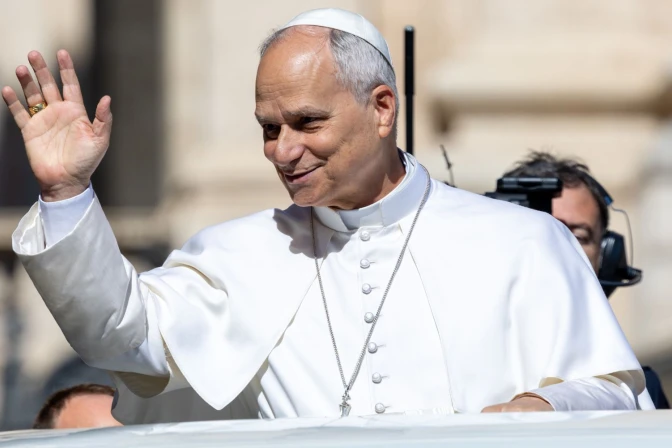
Pope Leo XIV’s first encyclical, Magnifica Humanitas, is a paean to peace that warns of the danger of “a world in a permanent state of belligerence” even more threatening than the Cold War era.
In that era, the pope writes, despite the existence of grave conflicts, “the awareness persisted that a new global conflict had to be avoided at all costs.”
Following the Second World War, “peace was made the focus of the international order, as attested in particular by the United Nations Charter” but now, war has been “revived as an instrument of international politics, while the very ethical principles that had previously limited its use are being eroded,” writes the pope.
The Holy Father makes no reference to any specific conflict, but rather offers an assessment of a world shaken by violence.
“Today, more than ever, without prejudice to the right to self-defense in the strictest sense, it is important to reaffirm that the ‘just war’ theory, which has all too often been used to justify any kind of war, is now outdated,” the pope indicates in the encyclical.
The right to self-defense
This is not a radical shift, but rather a predictable trajectory that Leo XIV himself outlined from the first day of his pontificate, when, following his election on May 8, 2025, he spoke from the balcony of the Apostolic Palace of a peace that was “unarmed and disarming.”
Recently, during one of his customary encounters with the press upon leaving Castel Gandolfo, where he spends most Tuesdays, he responded to a question from EWTN journalist Javier Romero concerning self-defense.
Self-defense, he said, has always been accepted by the Church. However, he qualified the application of the concept of a just war in the current context: “To talk about just war today, itʼs a very complex problem. You have to analyze it on many levels, but ever since the entrance into the nuclear age, the whole concept of war has to be reevaluated.”
“I always believe that itʼs much better to enter into dialogue than to look for arms and to support the arms industry, which gains billions and billions of dollars each year, instead of sitting down at the table solving our problems and using money to solve humanitarian issues, hunger in the world, et cetera,” he added.
In an interview with EWTN News, Cardinal Michael Czerny, prefect of the Dicastery for Promoting Integral Human Development, emphasized that, although the pope reaffirms “the right to self-defense” in the encyclical, it remains “impossible to justify a war.”
The cardinal said the new encyclical is “a very, very strong call. And it has to do with responsible use. And the Holy Father gives the example of military power. We have achieved a certain level of control. And we must do the same with artificial intelligence in warfare as soon as possible.”
Teaching on just war subject to historical circumstances
The Church’s teaching on “just war” is, by definition as noted by the Second Vatican Council, dynamic and subject to historical circumstances. Popes have progressively raised the bar for accepting the legitimacy of armed conflict.
Thus, in 2003, the Iraq War drew outright condemnation from Pope St. John Paul II in response to the United States’ planned offensive: “No to war! War is not always inevitable. It is always a defeat for humanity,” the Polish pontiff declared on Jan. 13, 2003, before more than 170 ambassadors accredited to the Vatican.
About four weeks later, on March 19, 2003, the United States began its preemptive war against Iraq.
The first major point of reference for contemporary doctrine on war is the Second Vatican Council itself. Its pastoral constitution, Gaudium et Spes (Joy and Hope), established a provisional criterion in 1965: “As long as the danger of war remains and there is no competent and sufficiently powerful authority at the international level, governments cannot be denied the right to legitimate defense once every means of peaceful settlement has been exhausted.”
It continued: “State authorities and others who share public responsibility have the duty to conduct such grave matters soberly and to protect the welfare of the people entrusted to their care. But it is one thing to undertake military action for the just defense of the people, and something else again to seek the subjugation of other nations. Nor, by the same token, does the mere fact that war has unhappily begun mean that all is fair between the warring parties,” reads a section of paragraph 79 of this document.
A quarter of a century later, in 1992, the Catechism of the Catholic Church (CCC) addressed at length the notions of “legitimate defense” and “safeguarding peace,” within a more complex international context.
After acknowledging the approval of certain Church leaders of “cruel practices” such as torture in times past, the text affirms that “Because of the evils and injustices that accompany all war, the Church insistently urges everyone to prayer and to action so that the divine Goodness may free us from the ancient bondage of war.”
According to the CCC, “The strict conditions for legitimate defense by military force require rigorous consideration.” It also states that “the evaluation of these conditions for moral legitimacy belongs to the prudential judgment of those who have responsibility for the common good.”
These conditions include “lasting, grave, and certain” damage; the exhaustion of “all other means of putting an end to” a conflict; the existence of “serious prospects of success”; and the assurance that “the use of arms must not produce evils and disorders graver than the evil to be eliminated.”
Referring modern weaponry such as nuclear arms, the CCC also underscores that “The power of modern means of destruction weighs very heavily in evaluating this condition.”
The Church has previously expressed its concern regarding so-called killer robots, or autonomous weapons, whose level of technological sophistication has increased notably in recent years.
Pope Francis called upon G7 leaders gathered in Italy in 2024 to ban the use of autonomous weapons capable of operating without human mediation in armed conflicts.
However, Magnifica Humanitas marks the first time that this appeal has been incorporated into an encyclical.
“Any technology that facilitates attacks without seeing the face of human beings lowers the moral threshold of conflict. Target selection and the use of force must not confuse combatants and non-combatants, nor ignore the impact on defenseless populations,” the pope emphasizes.
This story was first published by ACI Prensa, the Spanish-language sister service of EWTN News. It has been translated and adapted by EWTN News English.