

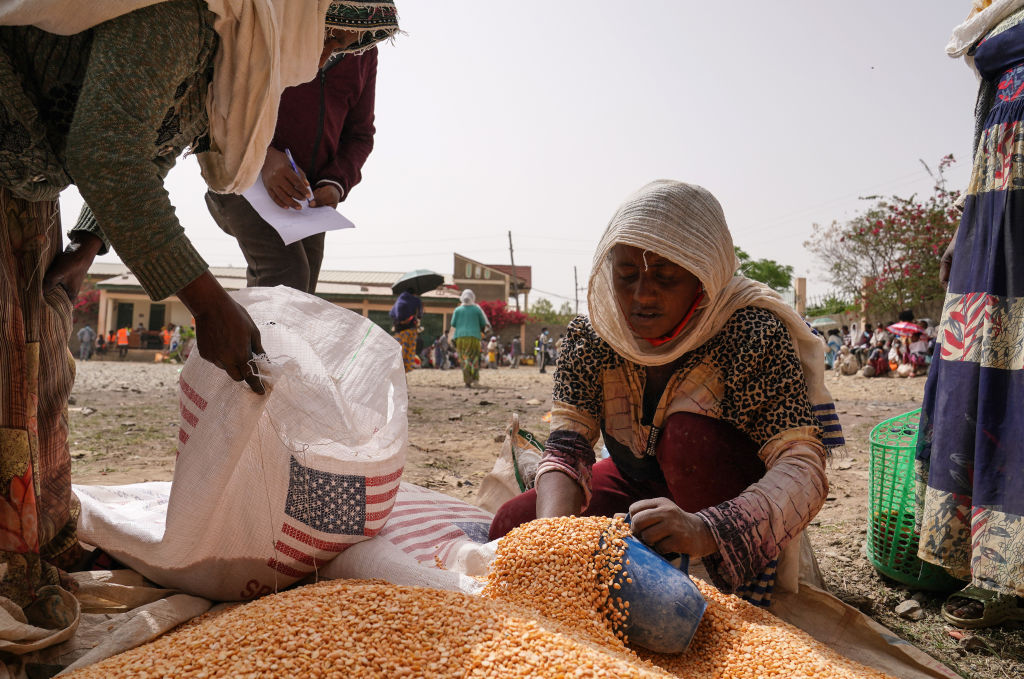
The U.S. Department of Agriculture (USDA) will provide up to $235 million through Catholic Relief Services (CRS) for emergency food and nutrition assistance in Sudan and Ethiopia amid widespread hunger.
“More than 110,000 metric tons of U.S.-grown agricultural commodities” will be delivered to the two East African countries under an agreement in principle between CRS and the USDA, according to a July 14 USDA announcement.
“American farmers feed, fuel, and clothe the world, and under President Trump’s leadership, we’re utilizing that bounty to serve those in need while ensuring that the benefits of U.S. food aid flow back to America’s hardworking farmers, ranchers, and producers that make this assistance possible,” Michelle Bekkering, USDA’s deputy undersecretary for trade and foreign agricultural affairs, said in a statement. “We’re also enforcing strict accountability so that aid goes to those who actually need it, safeguarding hard-earned taxpayer dollars, and delivering aid that builds self-reliance instead of long-term dependence.”
“Authorized under Title II of the Food for Peace Act,” the announcement said, “the agreement leverages Catholic Relief Services’ operational footprints in East Africa, including the Sudan Emergency Project and the Joint Emergency Operation in Ethiopia.”
CRS has faced a sharp drop in federal support after the Trump administration collapsed global‑health and humanitarian functions of the U.S. Agency for International Development into the State Department in 2025. USAID earlier supplied roughly half of the agency’s $1.5 billion budget.
CRS President and CEO Sean Callahan said in a July 14 press release that the agreement came “at a critical moment for struggling families in Sudan and Ethiopia.”
“For decades, our partnership with USDA has connected the generosity and productivity of American farmers with some of the world’s most vulnerable communities,” Callahan said. “We are committed to ensuring these resources are managed responsibly and translated into meaningful support for families working to overcome crisis.”
“We are hopeful fellow trusted organizations carrying out lifesaving work across the world are supported in their efforts to meet these critical needs for extremely vulnerable families and communities,” he said.
Callahan told EWTN News that CRS tracks the delivery of food commodities “to the last mile and employs robust monitoring, verification, and financial oversight to help ensure assistance reaches the people it is intended to serve.”
“We continually assess security conditions, adjust operations as needed, and work closely with local partners to help ensure assistance reaches the people it is intended to serve,” he said.
Maura O’Brien, a former USAID official who led its Sudan and South Sudan office and serves as coordinator for the Michael B. Kim Institute for Ethical Inquiry and Leadership at Haverford College, said CRS has been a trusted partner but USAID’s absence will be felt.
“Not having any U.S. presence in the field makes any assistance more vulnerable to fraud, waste, and abuse — especially in a conflict environment. Oversight and coordination are essential to effectively delivering desperately needed relief to communities in East Africa,” O’Brien said.
USDA did not immediately reply to a request for comment.