

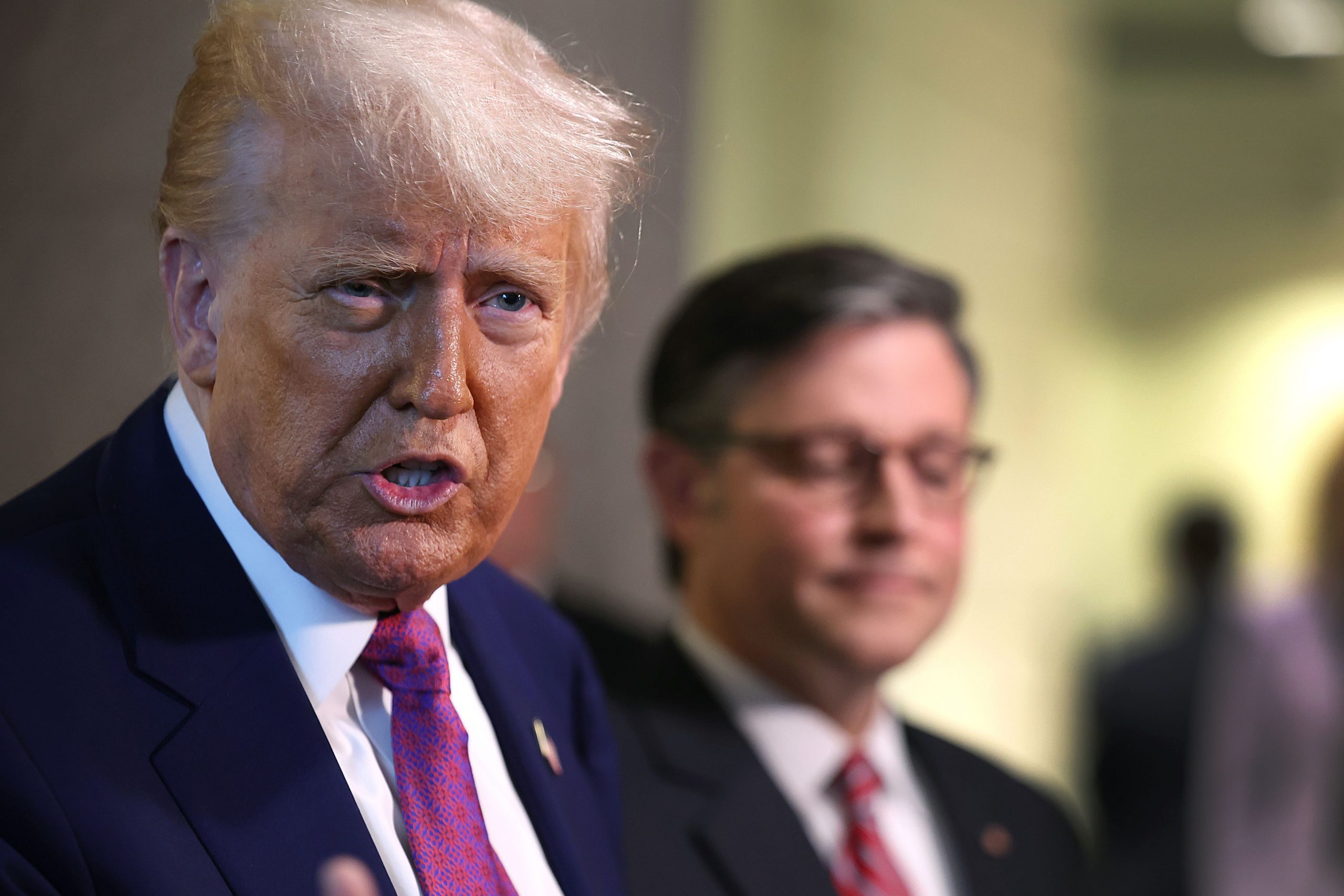
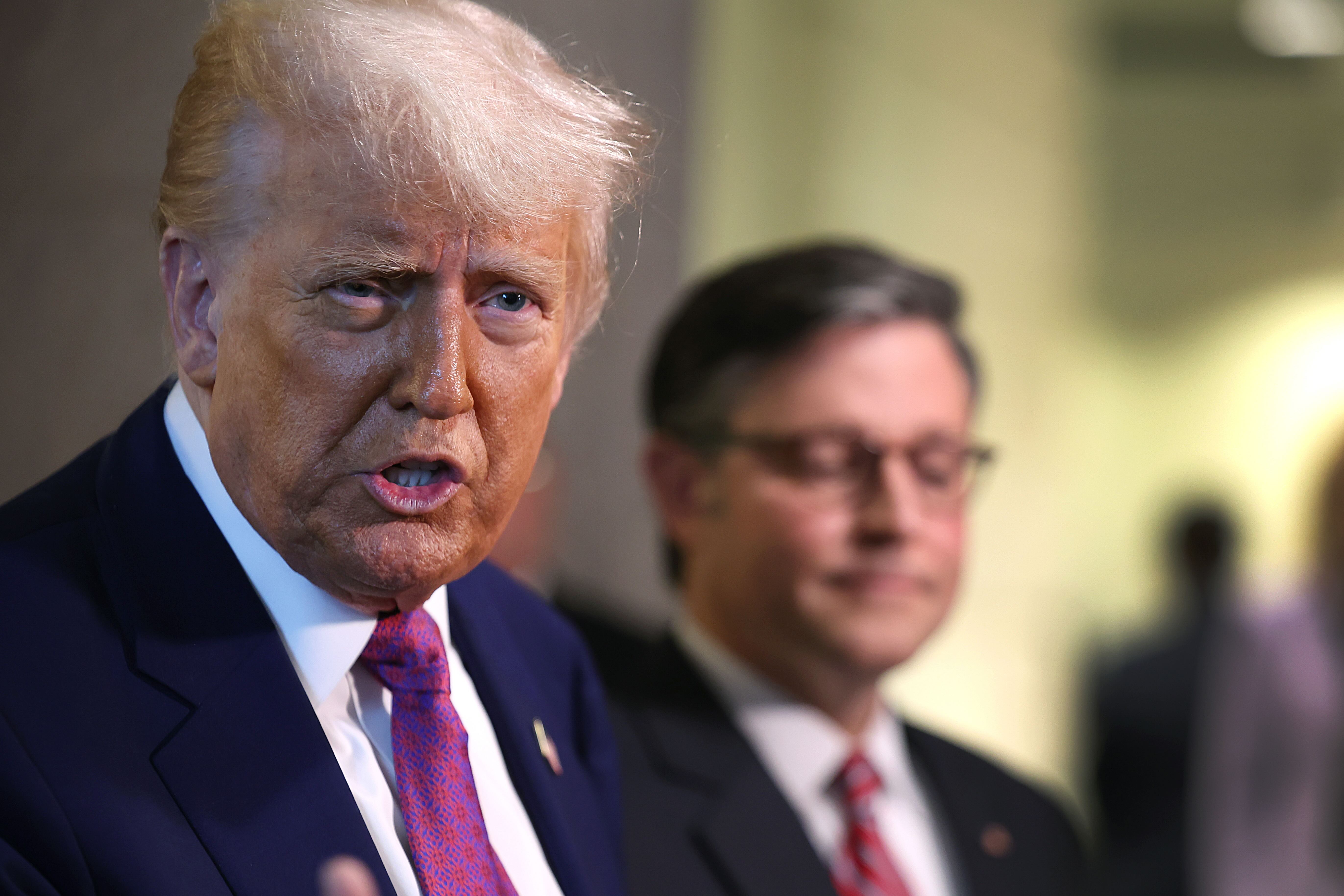
With Speaker of the House Mike Johnson by his side, President Donald Trump speaks to the press following a House Republican meeting at the U.S. Capitol on May 20, 2025, in Washington, D.C. | Credit: Tasos Katopodis/Getty Images
Jan 20, 2026 / 12:21 pm (CNA).
Catholics are offering mixed reactions to the first year of President Donald Trump’s second term, which included domestic policy actions that align with U.S. bishops on gender-related issues, and also tensions over immigration, expansion of the death penalty, and reduced funding for organizations that provide food and basic support to people in need.
Trump secured his electoral victory in 2024 with the help of Catholics, who supported him by a double-digit margin, according to exit polls. A Pew Research Center report found that nearly a quarter of Trump’s voters in 2024 were Catholic.
Throughout his first year, Trump — who calls himself a nondenominational Christian — has invoked Christianity and created a White House Faith Office. He created a Religious Liberty Commission by executive order in May 2025 and became the first president to issue a proclamation honoring the Catholic feast of the Immaculate Conception in December.
Last year, the president also launched the “America Prays” initiative, which encouraged people to dedicate one hour of prayer for the United States and its people in preparation for the 250th anniversary of the Declaration of Independence on July 4, 2026.
Immigration, poverty, and NGOs
John White, professor of politics at The Catholic University of America, said the first year of Trump’s second term “challenged Catholics on many levels.”
“The brutality of ICE has caused the U.S. Conference of Catholic Bishops to issue an extraordinary statement at the prompting of Pope Leo XIV,” White said, referring to the Immigration and Customs Enforcement agency. The U.S. Conference of Catholic Bishops (USCCB) issued a special message in November opposing indiscriminate mass deportations, calling for humane treatment, urging meaningful reform, and affirming the compatibility of national security with human dignity.
The Trump administration, with JD Vance, the second Catholic vice president in U.S. history, cut billions of dollars in funding to nongovernmental organizations (NGOs), which financially damaged several Catholic nonprofits that had received funding. Trump also signed into law historic cuts to the Supplemental Nutrition Assistance Program.
“The cuts to NGO funding, SNAP, and Medicaid benefits, alongside the huge increases in health care costs, have hurt the poor and middle class at home and around the world,” he said. “Instead of being the good Samaritan, Trump has challenged our Catholic values and narrowed our vision of who we are and what we believe. JD Vance’s interpretation of ‘Ordo Amoris’ of a hierarchy to those whom we love rather than a universal love is a case in point and has been repudiated by Pope Francis and Pope Leo XIV,” he said.
The cuts aligned federal policy with the administration’s agenda, which included strict immigration enforcement, mass deportations of immigrants who are in the country illegally, and less foreign aid support.
Catholic Charities USA was previously receiving more than $100 million annually for migrant services, and the Trump administration cut off those funds. In response, the organization scaled back its services.
Since Trump took office, the administration said it has deported more than 600,000 people.
Karen Sullivan, director of advocacy for the Catholic Legal Immigration Network (CLINIC), which provides legal services to migrants, said she is “very concerned about the way that immigration enforcement has been carried out,” adding her organization is “very concerned that human dignity of all persons [needs to] be respected.”
Sullivan said the administration is “enabling their officers to use excessive force as they are taking people into custody” and “denying access to oversight at their detention centers.” She also expressed concern about the administration increasing fees for asylum applications and giving agents more leeway to conduct immigration enforcement at sensitive locations, such as churches, schools, and hospitals.
She said the large number of deportations and the increase in expedited removals has “been a strain” on organizations that seek to provide legal help to migrants.
CLINIC receives inquiries from people who are facing deportation and also those who fear they may be deported. She said: “The worry and the fear among those people [who may face deportation] makes them seek out assistance and advice even more often.”
“The pace of the changes that have been happening in the past year have been very difficult to manage,” she said. “We are having to respond very quickly to changes.”
Executive actions on gender
Susan Hanssen, a history professor at the University of Dallas (a Catholic institution), viewed the first year of Trump’s second term in mostly successful terms.
“As Catholics we know that the law educates, and during Trump’s first year in office we witnessed an actual shift in public opinion on the LGBT/transgender ideology due to his asserting the scientific and natural common sense that there are only male and female,” Hanssen said.
Trump took executive action to prohibit what he called the “chemical and surgical mutilation” of children, such as hormone therapy and surgical transition. He signed a policy restricting participation of transgender athletes in women’s sports. He legally recognized only two genders, determined by biology: male and female.
“His strong executive action on this essential point — domestically in making the executive branch remove its trans-affirming language, the executive department of education stop subverting parental rights over their children, and women’s rights in sports, and (importantly) putting an end to USAID’s [U.S. Agency for International Development] pushing this gender agenda on the countries who need our economic assistance,” she said.
“This has led to a genuine public shift, with fewer independent corporations choosing to enforce June as LGBT Pride month on their customer base, fewer DEI programs pushing the gender agenda on hiring, and a shift (especially among young men) towards disapproval of gender transitioning children and even towards disapproval of the legalization of so-called same sex ‘marriage,’” she added. “We will need to see how these executive branch victories will affect judicial and legislative action moving forward.”
Father Tadeusz Pacholczyk, senior ethicist at the National Catholic Bioethics Center, had a similar view of some of the social changes.
“The current administration has focused significant energy on the important task of ‘putting folks on notice,’ so it’s hard to deny, for example, that the misguided medico-pharmaceutical industry that has profited handsomely from exploiting vulnerable youth and other gender dysphoric individuals can no longer miss the loud indicators that these practices will not be able to continue unabated,” he said.
Death penalty
Trump signaled a renewed and more aggressive federal capital-punishment policy in 2025, in opposition to the Catechism of the Catholic Church, which teaches that the death penalty is “inadmissible.”
Trump signed an executive order on his first day in office directing the Justice Department to actively pursue the federal death penalty for serious crimes. He also directed federal prosecutors to seek death sentences in Washington, D.C., homicide cases. His administration lifted a moratorium on executions, reversing a pause in federal executions and following President Joe Biden’s commutations of federal death sentences.
Archbishop Timothy P. Broglio, then-president of the USCCB, in a Jan. 22, 2025, statement called Trump’s support for expanding the federal death penalty “deeply troubling.” Newly elected USCCB president Archbishop Paul Coakley likewise called for the abolition of the death penalty.