

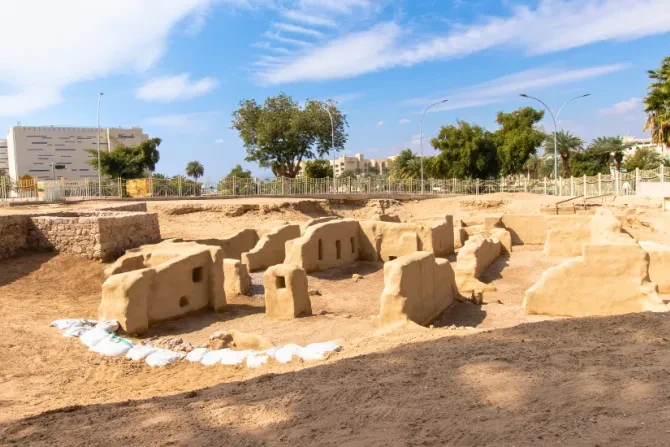
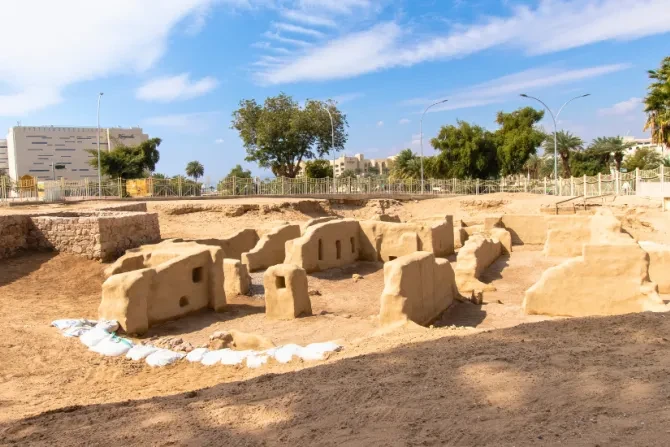
The ancient Aqaba Church witnesses to early Christianity in Jordan. / Credit: Sanad Sahliyeh/ACI MENA
ACI MENA, Dec 21, 2025 / 07:00 am (CNA).
In Aqaba, a port city on the Red Sea in Jordan, an archaeological church site dating to the late third or early fourth century is being highlighted as one of the world’s oldest purpose-built Christian worship spaces, constructed before Christianity received official recognition in the Roman Empire.
Discovered in 1998 during excavations led by a team under American archaeologist Thomas Parker, the structure is being considered a significant milestone in early Christian history.

The team of researchers described a basilica-style layout, central nave, side aisles, and an eastern apse, suggesting an already organized local Christian community.
Artifacts reported at the site include preserved walls, glass lamps, pottery, and Roman coins, which helped date the building to roughly A.D. 293–303.
Nearby, archaeologists also uncovered a cemetery thought to be tied to the same community, with small metal pieces interpreted as parts of a bronze cross.

With the site now officially reopened to visitors, Jordanian authorities are framing it as both a cultural landmark and a symbol of the country’s long-standing religious plurality, underscoring Aqaba’s place (ancient “Aila”) in the broader Christian landscape of the region.
This story was first published by ACI MENA, CNA’s Arabic-language news partner, and has been translated for and adapted by CNA.