
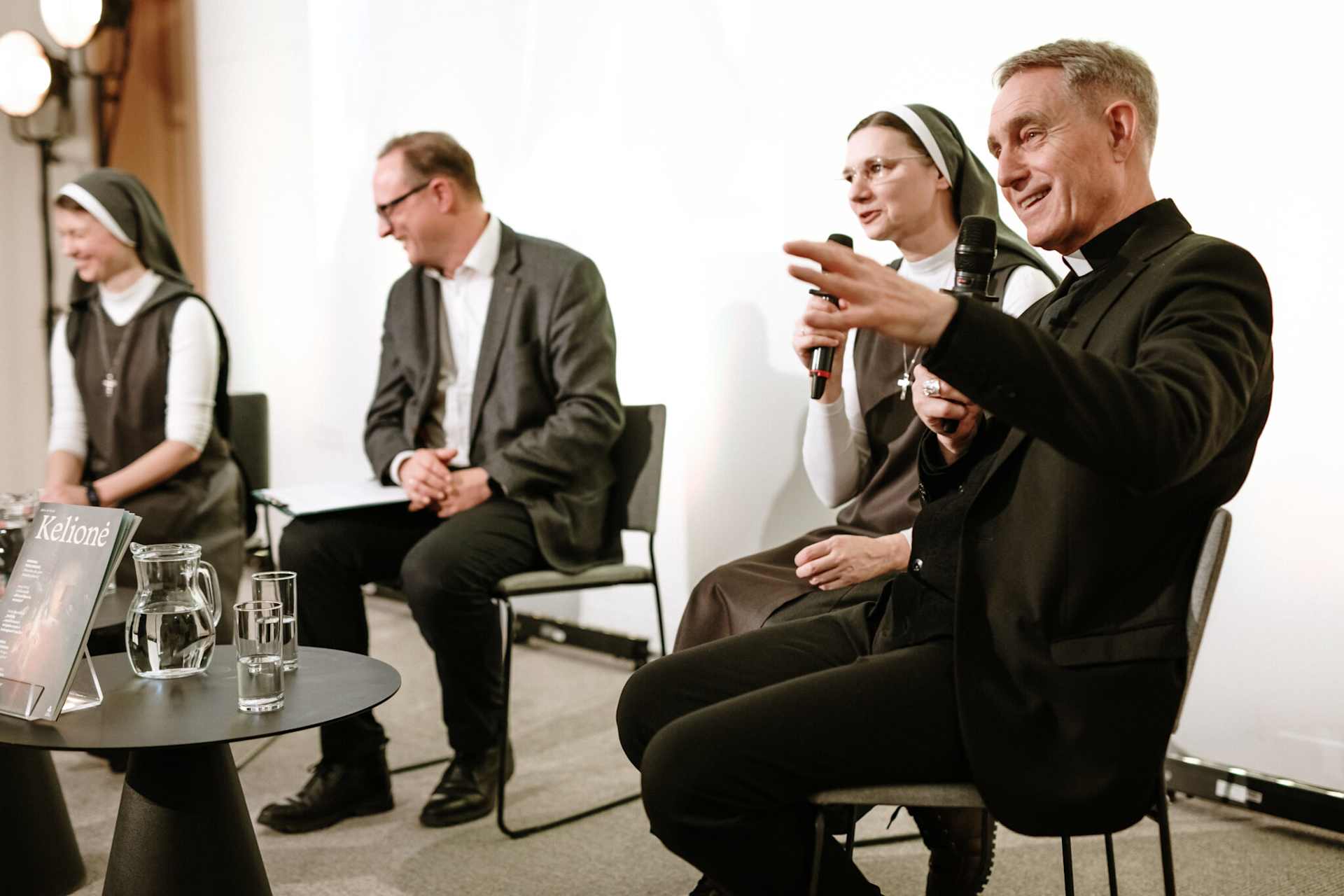

Archbishop Georg Gänswein speaks at an event hosted by the Catholic magazine Kelionė at the Lithuanian National Library in Vilnius, Lithuania, on Jan. 7, 2026. | Credit: L. Macevicienes/Zurnalaskelione.lt
Jan 11, 2026 / 10:32 am (CNA).
Archbishop Georg Gänswein, the apostolic nuncio to the Baltic states and longtime personal secretary to Pope Benedict XVI, said he now prays not for but to the late pontiff, asking for his intercession, and expressed hope the beatification cause will open soon.
Speaking at an event hosted by the Catholic magazine Kelionė at the Lithuanian National Library on Jan. 7, Gänswein offered personal reflections on his new diplomatic mission, the celebration of Christmas in Lithuania, and his decades-long collaboration with Joseph Ratzinger.
“I come from the most beautiful part of Germany, but I have lived in Rome for most of my life,” Gänswein said. “As a bonus and thanks for all my work, I received an assignment to work in the Baltic states,” he said jovially.
Asked about differences between Christmas in Rome and in the Baltic region, the archbishop answered with characteristic humor: “I celebrated Christmas in Rome for 28 years, and in Vilnius for two. The first difference is the cold.” He added that Lithuania’s seasonal displays left a strong impression, drawing attention to “very beautiful Christmas decorations,” and saying the Christmas trees “are very beautiful, maybe even more beautiful than in St. Peter’s Square, in the Vatican.”
Gänswein also expressed gratitude that the celebration of Christ’s birth in Lithuania is not merely cultural or superficial. He said he has sensed a reverence in which “its depth is felt here,” pointing to a faith that remains attentive to the mystery at the heart of the season.
During the conversation, the nuncio returned to the influence of Benedict XVI, describing his years beside Ratzinger as a gift of divine providence.
“All the years of cooperation together have left an indelible experience,” he said. “It was not only intellectual and theological formation, but also formation of the heart, soul, and everything that we can call life.”
Gänswein recalled to the audience that his first encounter with Ratzinger came when he was still a young seminarian, reading the future pope’s articles and books while Ratzinger was a professor in Germany. “I tried to read and study all of his writings,” he said, explaining that he came to see Ratzinger not only as a theologian and academic, but as “a man full of faith and intelligence.”
After his priestly ordination in 1984, Gänswein served as an assistant parish priest before continuing his studies. He later completed doctoral work and eventually arrived in Rome, where he first met Ratzinger while the cardinal was serving as prefect of the Dicastery for the Doctrine of the Faith. Gänswein said Ratzinger invited him into collaboration, an invitation he regards as mysterious and grace filled.
“What did he call me for? I don’t know,” he said, “but I see it as a great gift of Providence.” In 2003, he added, he became Ratzinger’s personal secretary.
Speaking of Benedict XVI after the late pope’s death, Gänswein made a striking remark about prayer and spiritual closeness: “And now, when Pope Benedict XVI has departed to be with the Lord, I notice that I do not pray so much for him, but to him, asking for his help.” He said there were moments, including during his service in the Baltics, when he found himself asking for Benedict’s intercession.
At the same time, he stressed the Church’s caution regarding sainthood causes. “The Church is a very wise and very prudent mother,” he said, noting that in beatification causes she is “twice wise and twice prudent,” and that time must pass to discern whether public esteem reflects genuine holiness rather than passing fame.
In a December 2025 interview with German Catholic television network K-TV, Gänswein said, “Personally, I have great hopes that this process will be opened.” The interview aired shortly before a private audience he held with Pope Leo XIV during a discreet mid-December visit to Rome.
The Kelionė gathering also featured talks from other invited speakers. Educator Vytautas Toleikis, who works as a moral education teacher at Vilnius St. Christopher Gymnasium, is the founder of the informal education group “Walkers.” He described taking students on weekly walks around Vilnius to encounter people he personally admires. He said the goal is to broaden students’ horizons through lived encounters with kindness and human warmth, adding that these meetings often surprise him as much as they do the young people.
Singer Sasha Song, who represented Lithuania at the 2009 Eurovision, shared a brief personal testimony about his struggle with addiction and the transformation he experienced after rehabilitation. He said the experience taught him to value life differently, describing his current state as one marked by gratitude and a renewed sense of happiness.
Prof. Robertas Badaras, a toxicologist with four decades of experience, reflected on how substance abuse has changed since the Soviet period. He noted that while alcohol once dominated, society now confronts an expanding array of substances, including a vast number of hallucinogens and stimulants.
Actress Justė Liaugaudė, representing the “Red Noses Clown Doctors,” spoke about offering emotional support to patients of all ages, especially those who struggle to find joy amid illness. She described how the organization’s presence has expanded in clinical settings, including, she said, being the only non-medical personnel permitted to accompany children into operating rooms — a reminder that compassion can reach where words and medicine sometimes cannot.
For Gänswein, however, the evening’s most enduring note returned to what he called the quiet, lifelong schooling he received at Benedict’s side, a formation not only of the mind, but of the whole person and the conviction that gratitude, faith, and truth are never merely ideas, but realities meant to be lived.