
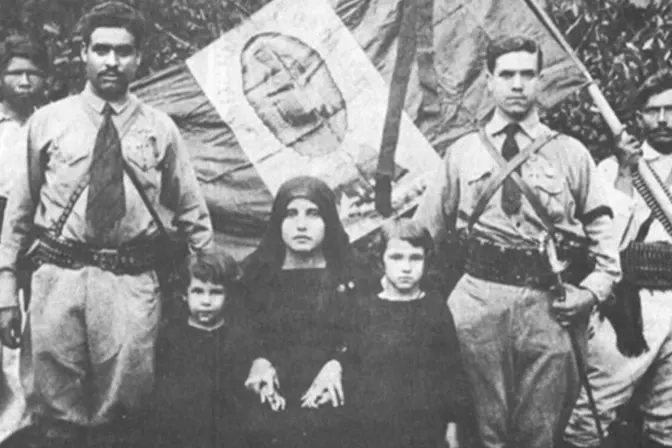
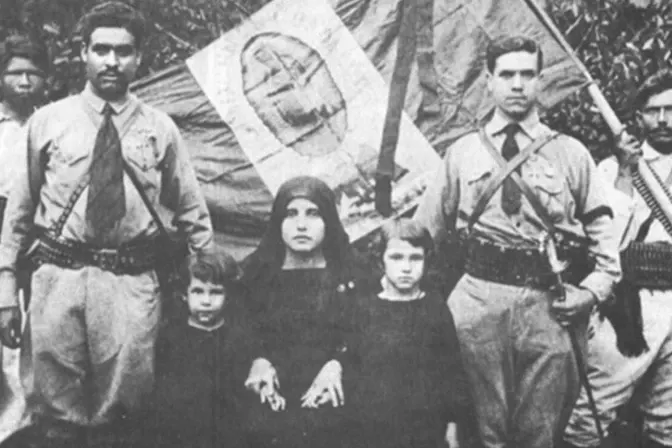
Cristeros with family members with the Mexican flag behind them with Our Lady of Guadalupe image substituted for the center field. | Credit: Public domain
Jan 21, 2026 / 14:03 pm (CNA).
As the centenary year of the Cristero War, also known as the Cristiada, begins, Auxiliary Bishop Pedro Mena of the Archdiocese of Yucatán in Mexico emphasized that “history is a great teacher.”
In an interview with ACI Prensa, the Spanish-language sister service of EWTN News, Mena noted that when he was in elementary and high school, the Cristero War was not mentioned in Mexican history classes.
Mena, 70, emphasized that Christians, “from the perspective of our faith, must know the entire history” and “learn from this event,” acknowledging that “it will always be controversial; it has its virtues, its flaws, its excesses, but I believe we must learn from this event.”
Father Javier Olivera Ravas will also be giving a conference on “The Cristero Resistance” on Feb. 6 at the Foro Cine Colón in Mérida, Yucatán.
Addressing the theme accompanying the announcement for the conference — “Where There Is the Cross and Sacrifice, Glory Is Born” — Mena highlighted that as the early Church theologian Tertullian said, “‘the blood of the martyrs is the seed’ of new Christians.”
The prelate recalled that when Pope John Paul II visited San Juan de los Lagos in 1990, in the region known as the Altos de Jalisco — where the Cristeros had a very strong presence — “one thing that really struck me was that they placed in the square in front of the cathedral [the title] ‘Land of Martyrs.’”
According to Mena, the large number of vocations found in that region, and in other areas with a strong Cristero history, is explained by the fact that parents often take their children “to different places and say: ‘This is where such and such a martyr lived, this is where so-and-so martyr was the parish priest, this is where this layperson lived.’ In other words, from a young age, they were thinking about those who had given their lives for Christ.”
Church-state relations in Mexico
In the decades following the Cristero War — which officially took place from 1926 to 1929 — the government did not repeal the oppressive laws restricting religious freedom that had triggered the rebellion but rather simply ceased to enforce them.
Mena noted how, during Pope John Paul II’s first trip to Mexico in 1979, “there were those who protested because he was wearing his cassock, which was prohibited by the laws that were still in effect at the time.”
In 1992, the 1917 Constitution — the origin of many of the restrictions that would later trigger the Cristero War — was reformed, and the so-called “Calles Law” was replaced with the current “Law on Religious Associations and Public Worship.” In this way, relations between church and state were reestablished.
Nevertheless, the prelate acknowledged that the relationship between the Catholic Church and state can occasionally be “a little tense,” although “there are open channels through which we can dialogue” with the authorities.
Lessons from the Cristero War for today
For the auxiliary bishop of Yucatán, an important lesson that the Cristero uprising in Mexico taught, a century after it occurred, “is that we must always sit down and discern how we, as a Church, are responding.”
“The important thing right now is to understand this great event in depth, as much as possible, to sit down and discern it from the perspective of God’s word and our mission as a Church,” he said, pointing to an important concern: “Is the evangelization we are carrying out in the Church today creating mature Christians?”
Regarding the apostolate to young people today, who are immersed in social media, the prelate emphasized the importance of “making them think,” “engaging them in a dynamic where they feel challenged,” and “encouraging them to ask questions.”
This story was first published by ACI Prensa, the Spanish-language sister service of EWTN News. It has been translated and adapted by EWTN News English.