
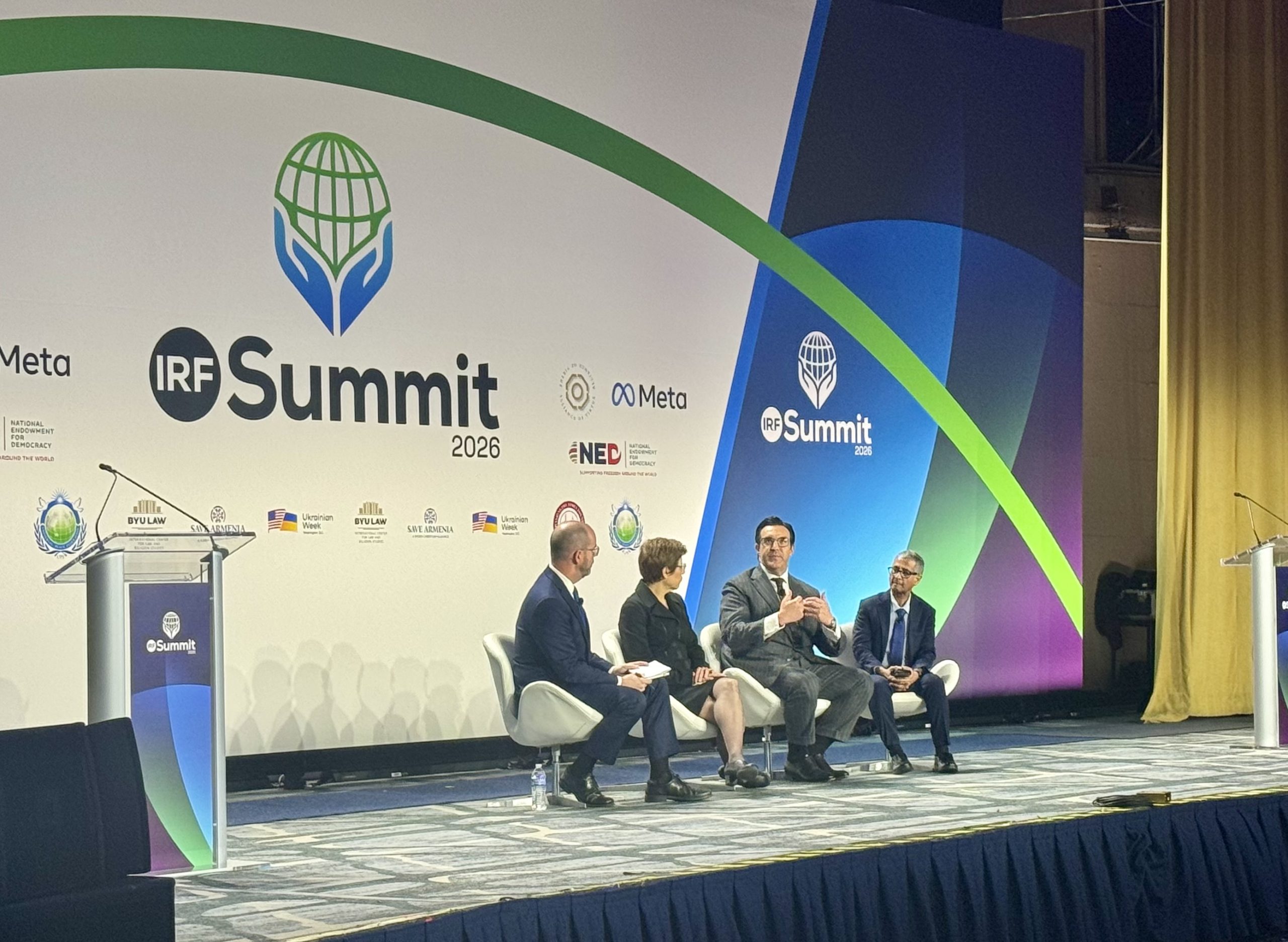
Religious freedom advocates addressed how democratic countries can prioritize and promote religious freedom at a plenary session of the 2026 International Religious Freedom (IRF) Summit in Washington, D.C.
The Feb. 2 panel was led by Knox Thames, a human rights lawyer, advocate, and author. He sat down with panelists Melissa Rogers, lawyer and former executive director of the White House Office of Faith-Based and Neighborhood Partnerships; Jordan Sekulow, director of the American Center for Law and Justice; and Ahmed Shaheed, professor of international human rights law at the University of Essex.
In order to prioritize global religious liberty, nations must “work across faiths and beliefs as widely as possible,” Rogers said. “The best coalitions are the broadest and the loudest.”
Rogers recommended that groups not only be large and diverse but also “persistent.” Activists must “have a lot of meetings and stay after it while understanding schedules in people’s offices, in the White House, and otherwise can be tricky. So staying after it, staying in communication, that’s a big deal.”
“Also … being able to express that big goal, the big principles we’re fighting for, and the big achievements that we want to make. At the same time, being able to break those down into steps so that we can chart our progress. To appreciate that progress is a good thing.”
Shaheed also spoke to the importance of persistence. He added: “We will not get the result we want overnight, but we keep pushing — it matters.”
“The most important thing” to do is “to reach out to different levels, multilevels of activity,” Shaheed said. He suggested working with the government, municipal actors, parliamentarians, and the grassroots leaders as well.
“So the ability to reach out to these different levels … is a very, very important tool,” he said.
Storytelling to promote human dignity
“What we have seen is that countries that respect religious liberty are likely going to be countries that are allies in the United States,” Sekulow said. “I think the concern right now we see in our country is that there’s so many countries that don’t have religious liberty at all, and everything is underground.”
“You can’t say that every country that doesn’t have religious liberty is obviously an enemy of the United States. That’s not true either. But if you truly want this for the people or your faith group or just fellow citizens, I think that we have to put … our individual faiths aside.”
Sekulow, who works for a Christian-based organization, said that when they represent Christians and win, “we don’t win for Christians only. We win for everyone.”
In order to promote religious liberty and ensure these wins for religious liberty, countries must utilize the “personal stories,” Sekulow said. “If you just talk about it generally, it doesn’t work for people.”
“It comes down to: Why is religious speech treated so much different from all the others’ speech? It’s because the power of it. It’s the power,” he said. “I think that’s why it’s important we’re here, because we can meet so many people with the stories and then tell those stories through our media departments, take it to the U.N., so that the wife, the husband, the family, has to be seen in the room by the country that is persecuting the father, that is imprisoning the father.”
“This is about saving people’s lives. Most of our faiths call us to do that if we can. To save the innocent. Almost every faith calls for that,” he said.
Defending religious liberty comes down to focusing on “a broader human rights agenda, because that gives a lot of power,” Rogers said. “Sometimes there’ll be tensions among different rights and liberties. But when we’re working together, we can find where we agree and be shoulder to shoulder on that.”
“Where there are differences, we can have dialogue, respectful dialogue about those conflicts, and make sure that we’re working to increase understanding and trust at a time of deep polarization in our own country and around the world.”
“This is just essential to the cause of religious liberty and for the benefit of human dignity and all the rights that are necessary to realize that dignity on behalf of everyone, everywhere,” Rogers said.