
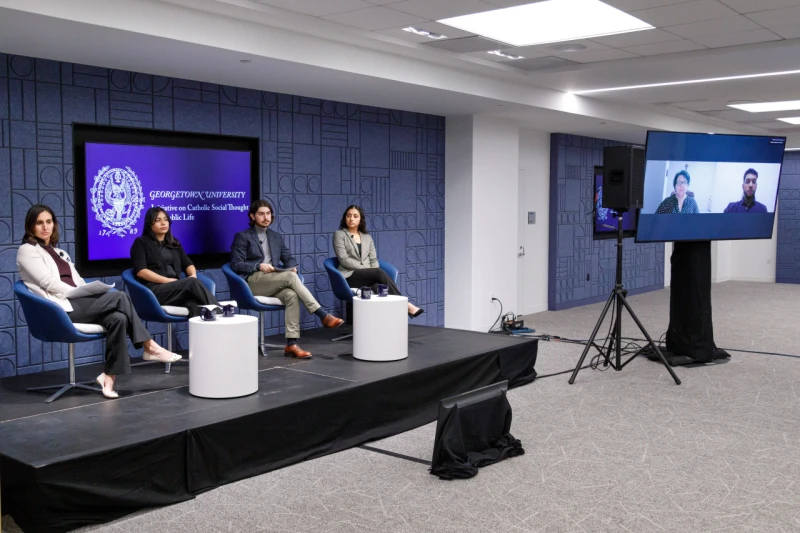
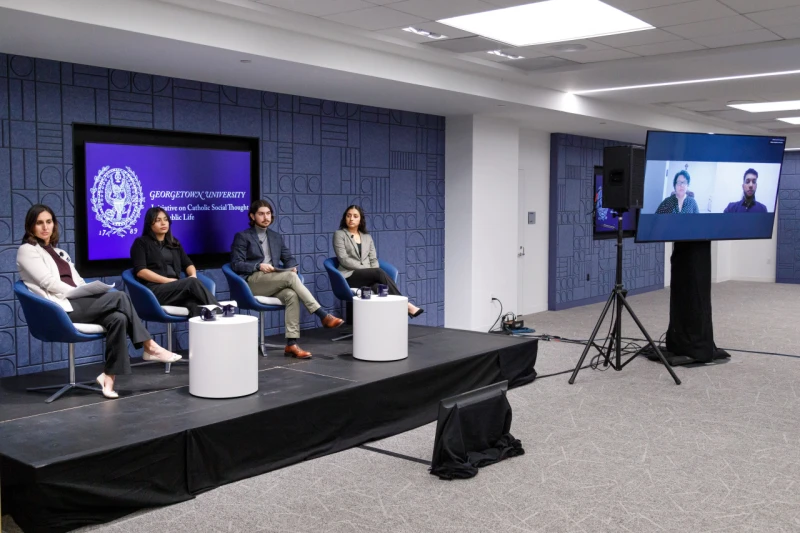
Paula Fitzgerald, Roxana Rueda Moreno, moderator Christian Soenen, Rosa Reyes discuss the effects of mass deportation at a conversation sponsored by the Georgetown Initiative on Catholic Social Thought and Public Life. / Credit: Madalaine Elhabbal/CNA
Washington, D.C. Newsroom, Dec 5, 2025 / 12:44 pm (CNA).
Life for members of the Latino community has “changed drastically,” according to leaders of groups serving Latino Catholics.
“Since the increased immigration enforcement, our communities, our families, are living in constant fear and anxiety,” said Roxana Rueda Moreno of Iskali, a Chicago-based organization that helps form young Latino Catholics to be leaders within their communities.
“It’s not a fear of ‘we’re doing something wrong,’” Moreno said. “It’s a fear of being in the wrong place at the wrong time.” She described families sheltering in their residences to avoid detentions, children staying home from school, and parents staying home from work.
Moreno said her uncle was detained in October and that she was not able to locate him until a month later.
“I searched for one month, I called hospitals, I called detention centers, hoping somebody would give me an answer, that somebody would give me news,” Moreno said. “A month later I was able to locate him, thanks be to God, and came to find out he was in a different state.”
Moreno also shared the story of a mother within her community “who is now raising her daughter who has severe autism alone,” since her husband was detained. She also spoke of a man who was killed during an altercation with federal officers in September.
“Those are only some of the stories that we carry as a city, as a community. Stories filled with pain, sorrow, uncertainty, but they are also stories of resilience and faith and courage, of a community that refuses to let go,” Moreno said. “We are holding onto each other as much as we can and we are choosing to live in hope, because that’s where we can stand from now.”
Paula Fitzgerald, executive director of Ayuda (translated “help” in Spanish), said her work to provide legal, social, and language services for low-income immigrants has become increasingly difficult due to several changes in the way immigration enforcement has played out since the start of the Trump administration’s expansion of Immigration and Customs Enforcement (ICE) operations.
“In the beginning we received so many calls from schools, places of worship, saying, ‘What can we do to protect our spaces so our community can continue to come here and be safe?’” she said. “Usually we’ve been able to provide answers — there was a memo that protected these spaces from ICE enforcement before, and all of that has deteriorated.”
The administration in early 2025 rescinded a policy that treated schools, hospitals, and places of worship as “protected” or “sensitive” locations, and ICE agents are permitted to conduct arrests at or near those locations.
Fitzgerald said many of the immigrants her organization serves are victims of crime, including domestic violence and human trafficking.
“Any given week we have a domestic violence survivor come in and try to figure out what to do. Should I report to MPD? Am I safe reporting?” she said.
Fitzgerald told CNA she is most concerned about the “deterioration of trust with law enforcement.”
“The fear now in terms of reporting their crime, their victimization to the police is at an all-time high, and it puts them in a really vulnerable position between the fear of their abuser versus the fear of law enforcement or being turned over to ICE,” she said.
Fitzgerald said ICE’s presence at courthouses for the purpose of detaining immigrants on their way to hearings as well as the detention of people at “immigration facilities that aren’t designed to hold people” are concerning.
“It is great to see Catholic leadership standing in solidarity with migrants and immigrants who are being mistreated,” Fitzgerald said. “I think it’s only all of us standing together across faiths, across communities, standing for what we know is right and standing up for those communities, that we’re going to make a change. So I’m grateful to the Catholic leadership for standing up and in defense of our communities and for everyone else who does so as well.”
U.S. bishops issued a special message in November about their concerns over immigration enforcement, profiling and vilification of immigrants, conditions in detention centers, and arbitrary loss of legal status.
A Dec. 4 conversation, “Making Life Unbearable: The Impacts of Immigration Enforcement on Families and Communities,” was organized by Georgetown University’s Initiative on Catholic Social Thought and Public Life. About 1,300 people signed up for the event online, and about 50 people attended in person.
Rosa Reyes, director of the Dream Partnership and a student adviser at Trinity Washington University, and Yolanda Chávez, a theologian and pastoral leader who was deported to Mexico, also spoke at the event.