

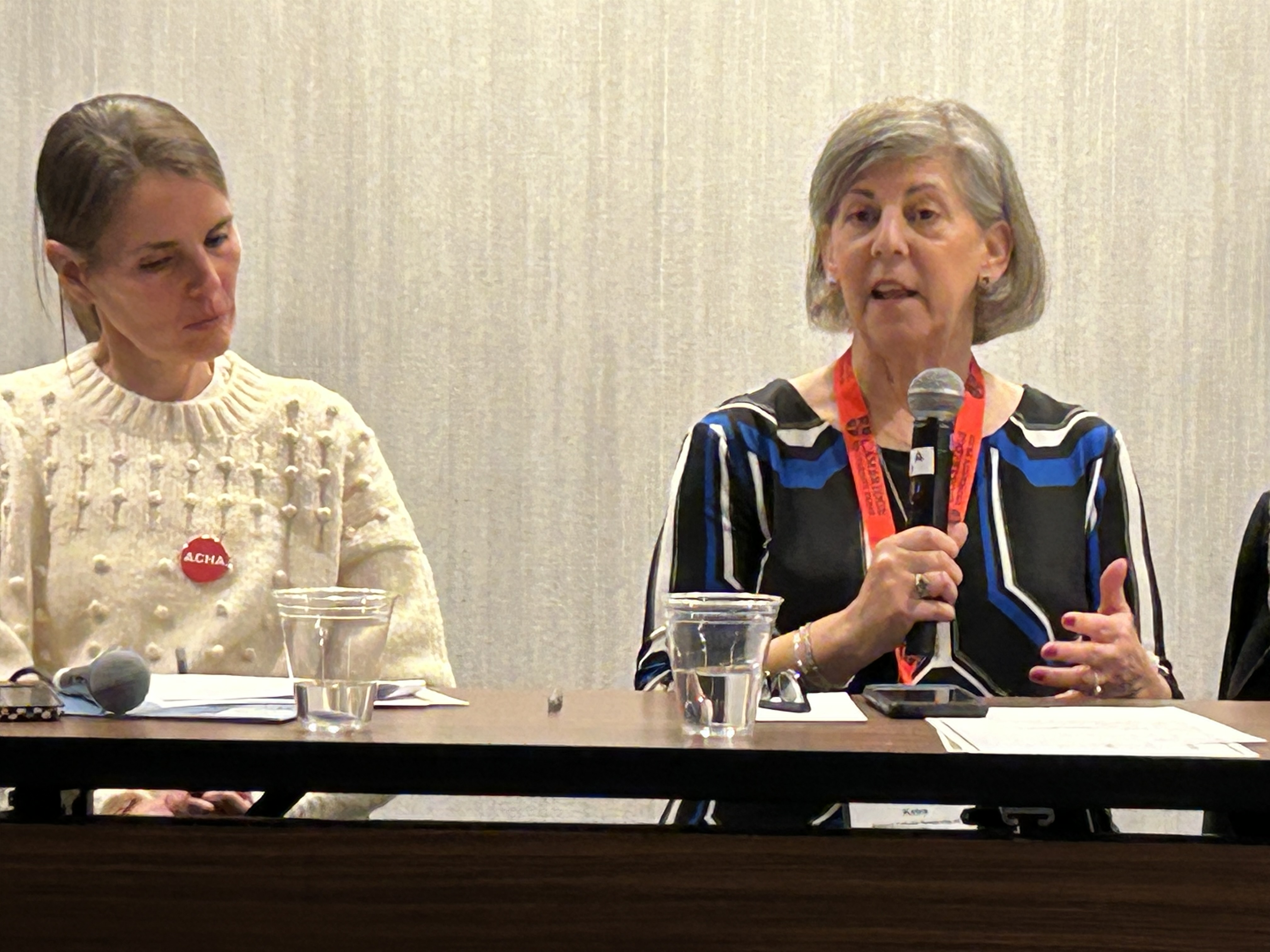
The National Catholic Partnership on Disability’s Charleen Katra (right) speaks at a panel accompanied by former American Catholic Historical Association President Mary Dunn (left). | Credit: Ken Oliver-Méndez/CNA
Jan 13, 2026 / 10:41 am (CNA).
CHICAGO — A Catholic nonprofit that helps parishes and schools provide faith formation and catechesis for people with disabilities was selected to win the 2026 award for service to Catholic studies from the American Catholic Historical Association (ACHA).
The National Catholic Partnership on Disability (NCPD) was presented the award during a panel discussion about the historical and modern interactions between the Church and Catholics with disabilities at the annual ACHA meeting in Chicago on Jan. 8.
During the discussion, panelists highlighted the ongoing efforts to make Catholic parish and school life more welcoming to members of the faithful who have disabilities and also spoke about persistent struggles to ensure that inclusivity is comprehensive throughout the Church.
“Though this recognition of our mission and ministry was very unexpected, it is both energizing and affirming,” Charleen Katra, executive director of NCPD, told CNA in a statement.
Katra said the award helps bring attention to the NCPD’s efforts to ensure Catholics with disabilities receive access to their baptismal rights: “To be educated in the faith; to live a sacramental life; and to respond to God’s call.”
“Persons with disabilities have unique gifts that bless the Church,” she said. “Thank you for blessing NCPD with this honor. We gratefully accept it on behalf of Catholics living with disabilities, and their families, who seek meaningful participation in the Church!”
Mary Dunn, outgoing ACHA president, said NCPD was selected because of its efforts to “promote real belonging” for those with disabilities and said “the lines between history and practice are always thin.”
Katra, who has a background in special education, said in the panel discussion that she first became involved in special religious education when she tutored a child with an intellectual disability named Brandon, who needed catechesis to prepare for the sacraments.
She said there are “a lot of different ways” to learn about God. Brandon needed multisensory learning that included a lot of visuals, which was not a learning experience offered at the parish at that time. In her current role, she helps provide training and resources to parishes to make sure Catholics with disabilities have access to a learning experience that fits their needs.
Although many parishes have incorporated these options into their catechesis, Katra said she still hears from families whose needs are not met by the Church. In some cases, she warned, families will leave the Catholic Church altogether if those needs are not met: “The Church can’t not look at this.”
“What happens?” she said. “They go somewhere else that will meet their needs or their loved one’s needs.”
“No one should not feel at home in the house of the Lord,” she added.
University of Southern Mississippi English professor Leah Parker, who has expertise in disability studies related to literature, said 15% of children in American public schools receive some form of special education, which highlights the need for greater inclusion.
“We’re all made in the image of God,” she said. “… I need my brothers and sisters with disabilities. We are incomplete without each other.”
The ACHA gave out two other awards during its 2026 annual meeting.
The Excellence in Teaching award was presented to Harvard ecclesiastical history professor Kevin Madigan. The Lifetime of Distinguished Scholarship Award was given to Yale history and religious studies professor Carlos Eire.