
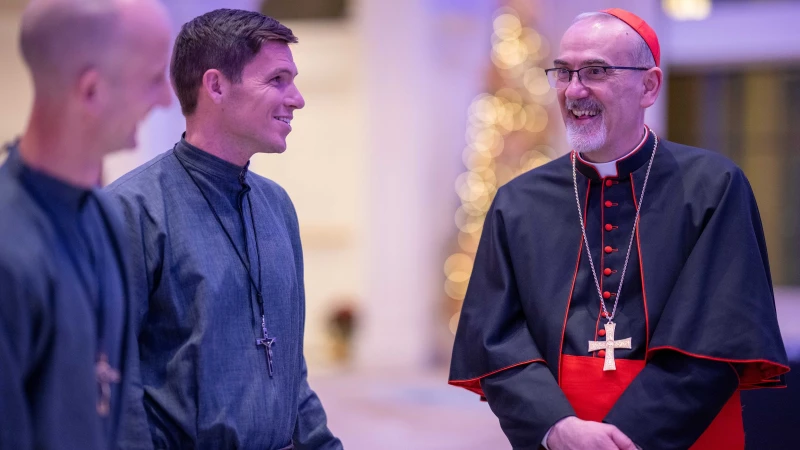
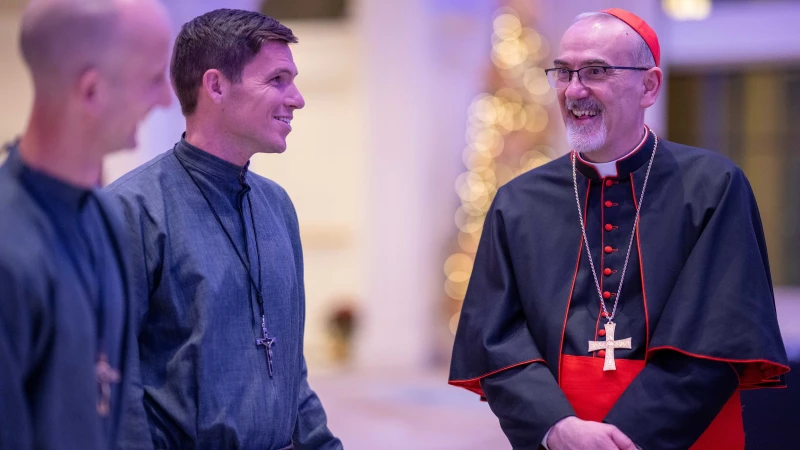
Cardinal Pierbattista Pizzaballa, the Latin Patriarch of Jerusalem, speaks with members of Society of Our Lady of the Most Holy Trinity (SOLT), during a Dec. 5, 2025 fundraising dinner to support of Christians in the Holy Land at St. John’s Resort in Plymouth, Michigan. / Credit: Courtesy of Detroit Catholic, photos by Tim Fuller.
Ann Arbor, Michigan, Dec 6, 2025 / 15:30 pm (CNA).
Cardinal Pierbattista Pizzaballa, the Latin Patriarch of Jerusalem, expressed cautious hope for peace in Gaza, calling on people of the region to combat hatred and “think differently” about each other.
Pizzaballa, whose authority extends over Latin Catholics in Israel, Palestine, Jordan, and Cyprus, also holds the office of grand prior of the Order of the Holy Sepulchre. He began a four-day pastoral visit to metro Detroit on Dec. 4, celebrating Mass with the Chaldean community at St. Thomas Chaldean Catholic Church in West Bloomfield, Michigan. Detroit Archbishop Edward J. Weisenburger and Chaldean Bishop Francis Y. Kalabat joined him. Throughout the visit, the cardinal offered a sober yet grounded message of hope for Christians in the Holy Land.
At a press conference on Dec. 5, Weisenburger welcomed the cardinal and praised his efforts to promote a “just and lasting peace” in Gaza. Asked by CNA what hope remains for Holy Land Christians amid what he had described as some of the worst devastation in decades, Pizzaballa cautioned against equating hope with immediate political solutions.
“Hope is a complicated word,” he said. “You must not confuse hope with a political solution, which will not arrive soon, not in Gaza, the Holy Land, or the Palestinian-Israeli conflict. If you put your hope in this, you will be frustrated.” He emphasized that both political and religious institutions must work to nurture hope.
“Hope,” the cardinal continued, “is a word that cannot remain alone. It has to put roots in something else,” namely, faith and desire. He added, “There needs to be a desire for it to be realized. A second consideration is that if institutions fail, we need people to think differently, to act differently, both Israelis and Palestinians. This may not resolve all the problems, but it says to people, ‘All is not lost.’”
Christians represent only about 1% of Gaza’s population—roughly 500 people—and about 2% of the population in both Israel and the West Bank, where there are about 190,000 and 45,000 Christians, respectively. Many continue to emigrate, raising fears about the future of Christianity in the region. Gaza has only one Catholic parish, for example.
The patriarch described the increasingly dire conditions in Gaza since the Oct. 7, 2023, Hamas terrorist attack on Israel. Most infrastructure—homes, hospitals, and schools—has been reduced to rubble, he said, leaving families in tents as winter approaches and food remains scarce. During a visit after Hamas and Israel concluded a ceasefire this fall, he brought food, including chicken, to Christians sheltering at the Holy Family parish compound. “It was the first meat they had seen in nine months,” he said. Although food enters Gaza, much of it ends up in markets, where many have no cash to purchase it, he said.
Despite the devastation, sacramental life continues. Hosting some 500 displaced Gazans, the parish has school activities and daily liturgies, including Mass, Vespers, the Rosary, and Eucharistic Adoration. First Communions and even a wedding have taken place. The parish’s sacramental life has emboldened solidarity among those taking shelter at the church, but has been a spiritual aid, Pizzaballa said.
“Every time I speak with them, I never hear a word of anger; never,” Pizzaballa said. “And one person, I can’t even say the name, he was the director of the hospital. One evening, in Gaza, between the bombs falling not far from the compound, he said, ‘You know, bishop, we Christians have a problem. Amidst all the violence, we are not able to hate them.’”
While Israel and Hamas agreed to a ceasefire on Oct. 9, Pizzaballa said Gazans are only now emerging from “survival mode.” He said, “They ask, ‘What do we do now? When will rebuilding start? What governance will there be? Who will decide? What about our children?’ There was no emotional space for these questions before, but now they are coming out.”
Weisenburger acknowledged the complexity of the situation, saying it cannot be “simplified into sound bites.” He reflected on the human cost of the war: “Too many of those bombs that killed some 70,000 people, wiped their homes from the face of the earth, and destroyed their cities, schools, and hospitals, were from us. I think we in America must accept some responsibility for rebuilding.” He expressed gratitude for the cardinal’s message of hope, adding that generous Detroiters had already pledged about $500,000 for needs in the Holy Land. “By doing something, we can nurture hope,” he said.
In his homily at the Chaldean community Mass, Pizzaballa compared Isaiah’s vision of restoration with present-day devastation in the Middle East, including the suffering of Chaldeans in Iraq at the hands of ISIS. He stressed the Church’s mission of fostering peace. Regarding the Hamas attack, he said, “We have to say this very clearly: it is not acceptable at all.” He added, however, that Israel’s “retaliation, what happened after in Gaza, is an even more difficult answer.” He emphasized, “We are not against Israel,” while insisting that “The situation will never change as long as the Palestinians are not recognized as people with their dignity and a right of self-determination.”
On Dec. 5, the cardinal visited fellow Franciscans at St. Bonaventure Monastery and prayed at the tomb of Blessed Solanus Casey. He received a first-class relic of Blessed Solanus to bring to Jerusalem. The Chaldean community also presented him with relics of four Chaldean martyrs. The next day, he visited Sacred Heart Seminary and spoke with seminarians and faculty.
About 500 people attended the Dec. 5 fundraising dinner held at St. John’s Resort, the former seminary campus dedicated to charitable hospitality. Weisenburger said the resort’s owner, the Pulte Family Charitable Foundation, donates 100% of its net profits for such events to charity.
Pilgrimages to Holy Land to resume
Holy Land Christians continue to feel the economic repercussions of the war, particularly in Bethlehem, which is located in the West Bank area of Jordan that is administered by Israel and where tourism has plummeted. Author and filmmaker Steve Ray, who has led more than 200 pilgrimages, plans to guide a group of over 50 pilgrims from Dec. 28 to Jan. 6.
“I’ve heard that 70% to 80% of the revenue of Christians comes from pilgrims. To have all the tour buses parked for two years is financially devastating,” he said. On the question of safety, he added, “Social media blows things way out of proportion. No pilgrims have ever been hurt. We are not concerned.” He plans four more pilgrimages in 2026, including one for Ave Maria University students.
Concluding his sweep through Detroit, Pizzaballa is set to celebrate Mass at the Shrine of the Little Flower, which treasures the relics of St. Therese de Lisieux.