
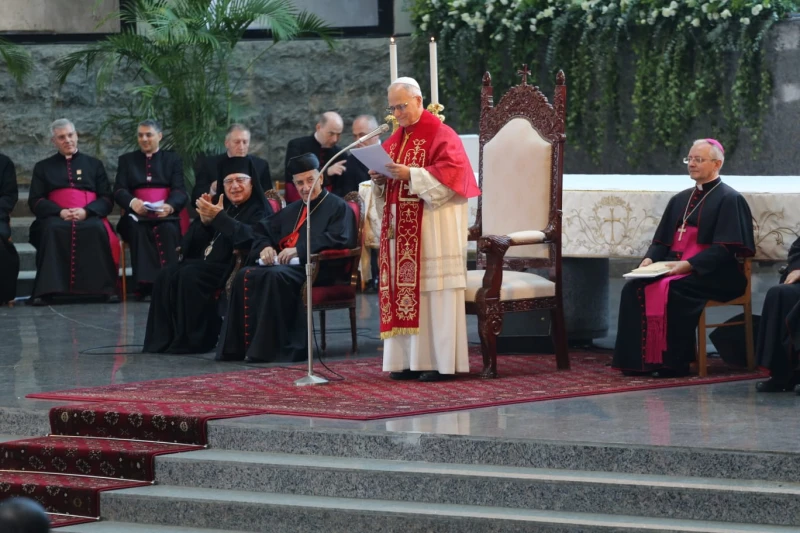
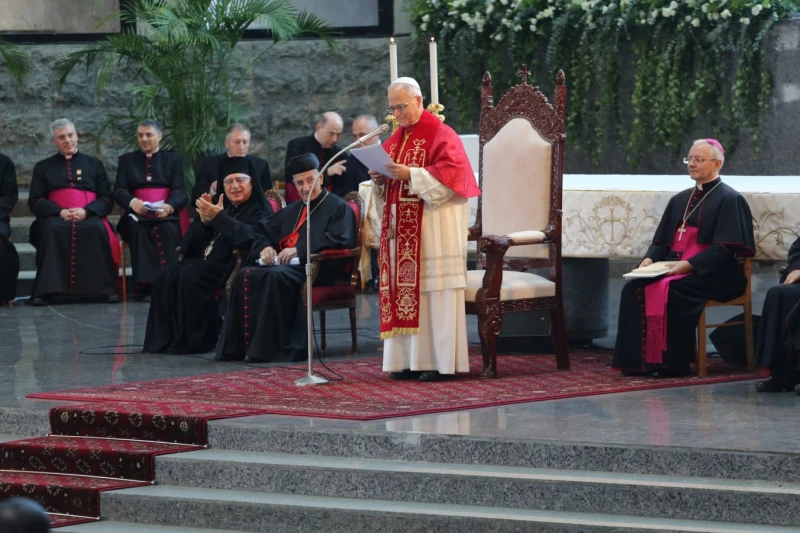
Pope Leo XIV addressed Lebanon’s bishops, clergy, and pastoral workers at Harissa, Lebanon, on Dec. 1, 2025. / Credit: Elias Turk/EWTN
Harissa, Lebanon, Dec 1, 2025 / 05:32 am (CNA).
Pope Leo XIV told Lebanon’s bishops, clergy, and pastoral workers on Monday that Christians can remain steadfast in hope “even when surrounded by the sound of weapons,” urging them to look to the Virgin Mary as a model of faith in dark and uncertain times.
Meeting them at the Shrine of Our Lady of Lebanon in Harissa on the second day of his apostolic visit, the pope said that Mary teaches believers how to persevere when daily life becomes a struggle. “It is in being with Mary at the foot of Jesus’ cross that our prayer, that invisible bridge which unites hearts, gives us the strength to continue to hope and work,” he said.
Leo recalled St. John Paul II’s words to the Lebanese — “In the Lebanon of today, you are the ones responsible for hope” — and urged believers to nurture a climate of fraternity wherever they live and work. He stressed the need to trust one another so that “the regenerative power of forgiveness and mercy may triumph,” adding that the fruits of this message are visible in Lebanon’s resilience.
The pope compared faith to an anchor that holds firm in turbulence. “Our faith is an anchor in heaven,” he said. “Hold fast to the rope.” He reminded those present that peace requires loving without fear and giving without measure. Quoting Pope Benedict XVI, Leo said Christians are called to celebrate “the victory of love over hate… forgiveness over revenge,” a message he said continues to guide the Church’s mission.
During the gathering, Pope Leo was welcomed by clergy and the shrine’s rector before processing to the presbytery, where Armenian Catholic Patriarch Raphaël Bedros XXI Minassian greeted him. The celebration included prayers, testimonies, Arabic chants, the Gospel reading (John 19:25–27), the Magnificat, the Our Father, a blessing, Marian hymns, and the exchange of gifts.
Pope Leo also presented a Golden Rose to the Virgin Mary, a traditional papal gift to major Marian shrines. The ornament, a gold branch of roses set in a silver vase and mounted on white marble, bears the papal coat of arms and symbolizes the pope’s devotion to the Mother of God. Leo said the rose’s fragrance calls Christians to be “the fragrance of Christ,” drawing a parallel to the richness and diversity of Lebanese family tables and encouraging the faithful to live that spirit of shared love each day.
The pope also highlighted testimonies shared during the meeting. Father Youhanna spoke of Debbabiyé, where Christians, Muslims, and refugees live together in mutual trust. Loren, a migrant worker, appealed to all communities to welcome those forced from their homes, telling them, “Welcome home!” Sister Dima described keeping a school open during violence, teaching children to share “bread, fear, and hope.”
The pope noted that the shrine itself remains “a symbol of unity for the entire Lebanese people.” Rising about 2,130 feet above sea level and roughly 16 miles north of Beirut, the sanctuary offers sweeping views of Jounieh Bay and stands not far from Bkerke, the seat of the Maronite patriarch. Its white-painted bronze statue of Our Lady of Lebanon, 28 feet tall and weighing about 33,000 pounds, was cast in France and placed atop a 66-foot stone pedestal shaped like a tree trunk. The adjacent basilica, designed to evoke both a cedar tree and a Phoenician ship, seats around 3,500 people and opens toward the Marian statue through its glass façade. The site is entrusted to the Lebanese Maronite Missionaries.
Later at the apostolic nunciature, Pope Leo was scheduled to welcome the Council of Eastern Catholic Patriarchs together with Cardinal Pietro Parolin, the Vatican secretary of state, and Cardinal Claudio Gugerotti, prefect of the Dicastery for the Eastern Churches. He was then set to share lunch with them and with the country’s Orthodox patriarchs, joined by Cardinal Kurt Koch, prefect of the Dicastery for Promoting Christian Unity, in a gesture underscoring the ecumenical dimension of his visit.