
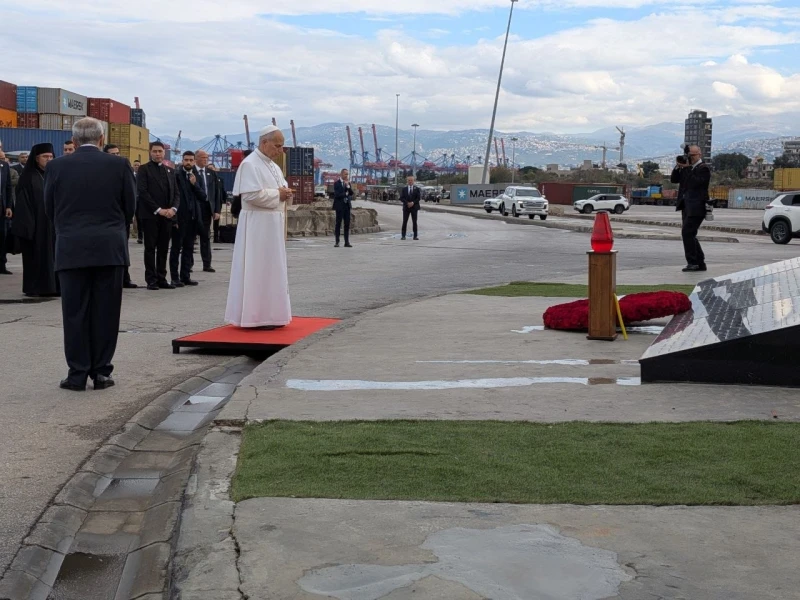
Pope Leo XIV prays in silence at the site of the 2020 port explosion in Beirut, Lebanon, on December 2, 2025. / AIGAV Pool
Beirut, Lebanon, Dec 2, 2025 / 03:15 am (CNA).
Pope Leo XIV paused on the final morning of his trip to Lebanon before the ruins of the Beirut port explosion, praying in silence and placing a wreath in memory of the victims. He also met families of those killed and survivors still carrying the wounds of the 2020 blast.
The pope lit a candle and laid down a wreath of red flowers at the site, and seemed at one point to hold back tears. Afterwards, he spoke with family members of victims, some of whom who were holding photographs of their relatives killed in the blast.
The pope’s silent prayer at the port unfolded against an unresolved search for justice, a grief still felt across Lebanon.
Five years after the August 4, 2020 explosion, one of the largest non-nuclear blasts in history, families of the 236 people killed and more than 7,000 wounded say they are still waiting for truth and accountability. Vast neighborhoods of Beirut were shattered, yet justice remains elusive. Lebanese Prime Minister Nawaf Salam greeted the pope at the site.
Lebanon’s investigation has been marked by political interference and long periods of inactivity. Although the probe formally resumed in 2025 after a two-year halt, it remains stalled. Successive governments have failed to ensure an independent and impartial process, leaving families of victims facing what they describe as a prolonged denial of justice.
Several senior officials summoned by lead investigative judge Tarek Bitar have resisted cooperation, invoking immunity or filing legal challenges that repeatedly froze the inquiry.
Some movement returned in early 2025. Judge Bitar resumed work in February after new public commitments by President Joseph Aoun and Prime Minister Salam to uphold the rule of law. The following month, interim top prosecutor Jamal Hajjar reversed earlier measures that had paralyzed the investigation. A number of figures, including former Prime Minister Hassan Diab and Major General Abbas Ibrahim, responded to summonses, while others, including members of parliament, continued to refuse cooperation.