
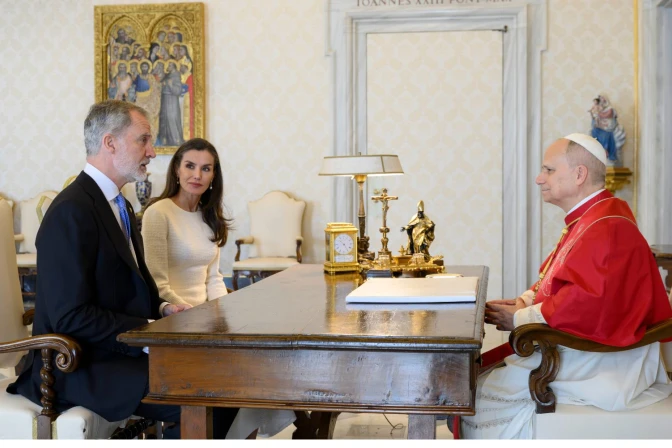
Pope Leo XIV’s upcoming visit to Spain will take place against a political and social backdrop marked by intense polarization.
The divided political climate coincides with an unprecedented event in Spanish democracy: the indictment on charges of alleged corruption by a former prime minister, José Luis Rodríguez Zapatero of the Spanish Socialist Workers’ Party, who held the office when Pope Benedict XVI visited the country 15 years ago.
Zapatero’s scheduled court appearance in connection with his alleged involvement in a scheme linked to the 2021 public bailout of the airline Plus Ultra, originally set for June 2, has been postponed by the judge to June 17–18.
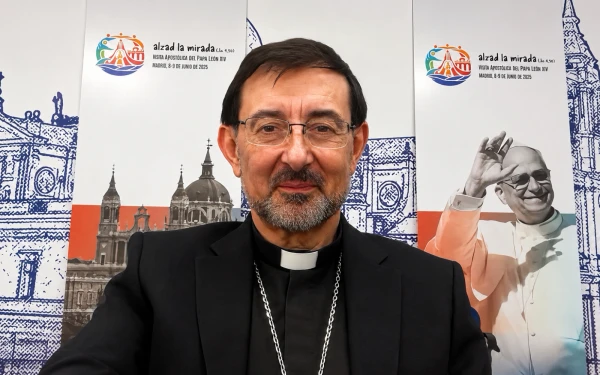
The cardinal archbishop of Madrid, José Cobo, downplayed the impact the case will have on the popeʼs June 6–12 visit. “We are accustomed to operating amid many events in political life. That is simply part of life, and the headlines keep shifting,” he stated in an interview with EWTN News.
The stability of Prime Minister Pedro Sánchezʼs government is also being called into question by some of its coalition partners, such as the Basque Nationalist Party, which has labeled the decision not to call general elections before the end of the year “irresponsible.”
Polarization is not limited to the political sphere, however. According to the Atlas of Polarization by More in Common (2025), nearly 5 million Spaniards have broken off a personal relationship in the past year due to ideological differences, a figure equivalent to 14% of the population. Furthermore, three out of every five citizens say they avoid discussing politics to avoid creating conflict.
According to jurist Rafael Domingo Oslé, professor at the University of Navarra in Spain, this phenomenon reflects a grave deterioration of society at large. “Spain is experiencing a moment of profound social fragmentation, exacerbated by a political class incapable of lowering the tone,” he said in an interview with ACI Prensa, the Spanish-language sister service of EWTN News. In his view, the volume of personal breakups “is a symptom that we are losing the respect necessary to prevent a society from fragmenting.”
A shared language
In this context, the pope’s visit takes on a particular significance as the emergence of a voice capable of introducing a different language into the public debate.
“A papal visit does not, in and of itself, resolve a crisis of this nature. But it can accomplish something that politics, by its very logic, is no longer able to achieve: offering a common framework and a shared language,” Domingo explained.
The key, he added, lies in the pontiff’s unique position: “The pope arrives not as an arbiter of an ideological debate but as a shepherd reminding a weary society that every person, regardless of whom they vote for, possesses a dignity that precedes their opinions.”
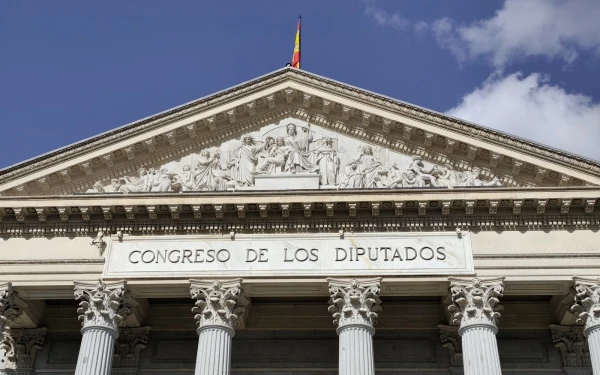
This circumstance has prompted an unusual gesture in recent Spanish politics: a unanimous invitation to the pope extended by both the House and the Senate.
“In a country where parliamentary consensus is nearly impossible, all political forces have agreed to listen to the same voice. That, in itself, is already a healthy gesture,” Domingo emphasized.
Leo XIV will address a joint session of the Legislature on June 8, marking the first time a pontiff has spoken before both Spanish legislative chambers.
The motto of the trip, “Lift Up Your Eyes,” encapsulates the spirit of the visit, according to Domingo, who said he hopes Spaniards will “cease focusing solely on immediate conflict and look toward what truly matters.”
Concurrently, the encyclical Magnifica Humanitas has met with a remarkable reception in the Spanish political world.
In a message posted on X, Sánchez emphasized: “Leo XIV’s encyclical Magnifica Humanitas challenges us all. AI is not neutral, and digital power could lead us to new atrocities if it is not directed toward the common good. The text is also a defense of peace, human dignity, and multilateralism. Spain is clear on this: In this moment of change, we cannot be resigned spectators. Everything that makes us human is at stake.”
Along the same lines, Foreign Minister José Manuel Albares told the press, following his audience with the pope on May 4: “There is a great convergence between the Vatican’s positions and Spain’s humanist foreign policy at this time.”
Despite these points of convergence, tensions between the Church and the political realm remain.
One of the most visible flashpoints is the re-signification of the Valley of the Fallen (Cuelgamuros), a monument to the victims from both sides of the 1936–1939 Spanish Civil War comprising a basilica, a cemetery, and a guesthouse.
For 44 years, the mortal remains of dictator Francisco Franco lay buried there until their exhumation in 2019. Franco was the general who led the victorious right-wing Nationalist side against the leftist Republican side in the conflict.
The current government has led the drive to transform the site into a political memorial, while the Church has advocated for the preservation of the monumentʼs religious dimension.
Italian constitutional scholar Marco Olivetti warned during a press conference at LUMSA University in Rome that “historical memory has been used as a divisive element that shapes public perception of the Church.”
Added to this are legislative clashes such as the attempt to enshrine abortion rights in the Spanish Constitution or proposals to eliminate military chaplains, efforts in direct confrontation with Church doctrine.
However, criticism of the Church does not stem solely from the left. The bishops’ defense of immigrants, including their support for the government’s plan to give legal status to undocumented immigrants, which would benefit nearly half a million people already residing in Spain, has also drawn reproaches from conservative quarters.
Santiago Abascal, the leader of the Vox party, which declares itself Catholic, lashed out at the secretary-general of the Spanish Bishops’ Conference, Bishop Francisco César García Magán: “This character never dares to criticize the mafioso government. Because the government provides him with his business through the invasion [the influx of illegal immigrants]. And that’s his priority: the business. And a profound contempt for the Spaniards who wish to defend their homeland.”
The risk of instrumentalizing the pope’s words
The papal visit is not without risks in a climate of high polarization, Domingo warns. “One party will highlight whatever suits its agenda while remaining silent on the rest; another will try to do the opposite. It’s inevitable.”
Nevertheless, he underscored the Holy See’s experience in “writing speeches that stand as a cohesive whole.”
“Taking the pope out of context is relatively easy; refuting him is much more difficult,” he said.
Cobo shared this concern regarding the pontiffʼs address before the joint session. “I believe this is a gesture that is also very characteristic of the Church, for it entails listening to the Christian tradition speaking about politics, but ‘Politics with a capital P’ [the noble art or statesmanship]. In a society where we are accustomed to talking about political parties, that moment is significant. The fear, indeed, is that we might attempt to make a discourse on ‘Politics with a capital P’ to fit into a partisan narrative, effectively pitting one against the other,” he noted in his interview with EWTN News.
Moreover, the context is exacerbated by the rise of identity-based discourses that conflate politics and faith.
Sociologist Rafael Ruiz Andrés, a professor at Complutense University in Madrid, warned in an interview with ACI Prensa that “there is a whole range of sectors, located primarily within the far-right spectrum, and specifically in Spain within the Vox party, that seek to portray the defense of Christian culture as a central tenet of their platforms.” However, he qualified this by noting that “it’s not necessarily a defense based on religion” but is rather linked to “identity-based culture, and in many instances, positioned in opposition to Islam.”
In his view, one of Pope Leo XIV’s concerns is precisely “that there be this sort of hijacking of Christianity by politics.” In line with this, reports published following a meeting of the executive committee of the Spanish Bishops’ Conference with the pope pointed to the Vatican’s unease regarding attempts to “instrumentalize the Church,” although the bishops subsequently clarified that the pontiff spoke in general terms about “the risks of subjecting faith to ideologies,” without referring to any specific group.
This story was first published by ACI Prensa, the Spanish-language sister service of EWTN News. It has been translated and adapted by EWTN News English.