

Pope Leo XIV sent his blessing to Slovakia’s national pilgrimage in Nitra, where Cardinal Ladislav Nemet urged the faithful to reflect on their Christian roots and bear witness to the faith as tens of thousands marked the feast of Sts. Cyril and Methodius across Slovakia and the Czech Republic.
The feast, July 5, is a public holiday in both countries. The main celebrations took place in Nitra, home to the oldest diocese in present-day Slovakia, founded in 880, and in Velehrad in the Czech Republic.
The Byzantine brothers, who devised an alphabet for the Old Slavonic spoken across Great Moravia, are believed to have been active in Nitra, Velehrad, or both in the ninth century.
Nitra’s national pilgrimage
In 2025, Cardinal Robert Prevost had been expected to preside over the Nitra Mass. He was instead elected Pope Leo XIV that May and was unable to attend.
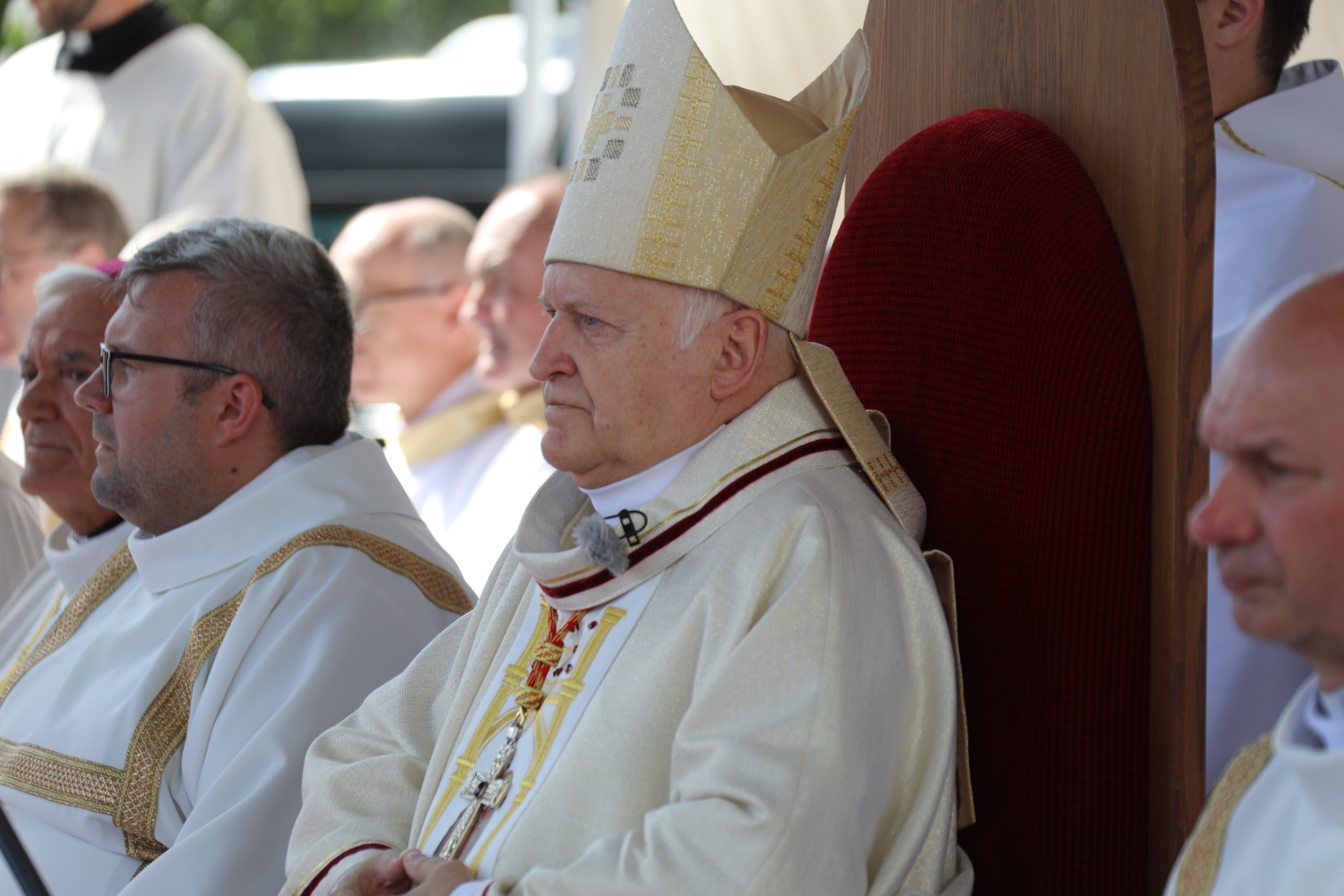
This year, the Mass on Saturday, July 4, on the main square in Nitra was celebrated by Nemet, the archbishop of Belgrade, Serbia. Slovak bishops and the apostolic nuncio to Slovakia, Nicola Girasoli, concelebrated, while the current and former presidents of Slovakia, Peter Pellegrini and Ivan Gašparovič, joined several thousand people for the liturgy.
Girasoli delivered the papal blessing. Citing Pope Leo XIV’s encyclical Magnifica Humanitas, the nuncio said Christians are called to “disarm” their words and temper aggression in public life and the media.
In his homily, Nemet said the feast is an opportunity to reflect on one’s own roots and on the mission of Christians today, who should not live in isolation but bear witness to the faith and values of the Gospel.
Sts. Cyril and Methodius were able to proclaim the Gospel in the mother tongue of the people of Great Moravia, which, the cardinal explained, opened the way to a deeper acceptance of the Christian faith among the Slavs.
“Culture must be respected and developed,” he said. “Culture is created by man, and therefore we have a calling to shape our own culture — to bear witness to how we believe in God and to live as good Christians in peace and cooperation with all.”
The mission, Nemet said, “belongs to every baptized person,” begins “where we are” in everyday life, and shows itself in “how we speak, how we forgive, how we live, how we love.”
During the traditional three-day celebration, which featured an artistic, cultural, and spiritual program, the local bishop, Viliam Judák, unveiled a milestone marker on the Sts. Cyril and Methodius pilgrimage route, which crosses Europe.
Organizers also set a national record when 32 people named after the saints gathered in one place. Each received a T-shirt reading “I am Cyril” or “I am Methodius.”
A concert by church choirs presented works inspired by the saints, and the bishop’s palace opened its doors to visitors as usual.
Across the border in the Czech Republic
In Velehrad, Czech Republic, Archbishop Stanislav Přibyl of Prague celebrated Mass on the feast itself, July 5. Alongside other Czech bishops, including one from Slovakia, organizers counted approximately 20,000 pilgrims.
The bishop of Brno, Pavel Konzbul, who was entrusted with the homily, pointed to the legacy of the learned St. Cyril, also known as Constantine. Konzbul quoted what he called a contemporary American journalist who said a nation that reads little knows little and makes poor decisions “at home, at the shop, in court, and at the ballot box.”
“St. Cyril knew that language and education are the means by which faith becomes a personal, comprehensible, and intimate matter,” Konzbul said.
The bishop advised pilgrims to take a book on holiday to help them enter “the realm of silence, about which St. Augustine wrote: ‘Entering silence means entering joy.’”
Konzbul said society is “facing individualism reinforced” by social media and “a crisis of values and meaning,” and that “many are beginning to realize again that freedom must be defended.” He acknowledged that it is hard not to be afraid at such a time, yet said fear need not paralyze people and can be turned into a driving force.
“Let us pray to the Holy Spirit to give us courage, as he did to St. Methodius, to make the right decisions even in the realm of fears and uncertainties.”
During the two-day celebration in Velehrad, Archbishop Josef Nuzík of Olomouc, president of the Czech Bishops’ Conference, presented the “Velehrad Appeal” for reconciliation and understanding. It responds, he said, “to the growing polarization, aggression, and mistrust in society” and calls on people of goodwill to respect one another “even if they think differently,” to look for what unites them, and to “strive for reconciliation, hope, and peace.”
The text stresses that “our country does not need more division” but “more people who will look for what unites them,” and it presents reconciliation, dialogue, and mutual respect not as a sign of weakness but as “a condition for a good future for our country.” The appeal was supported by the Ecumenical Council of Churches in the Czech Republic.