








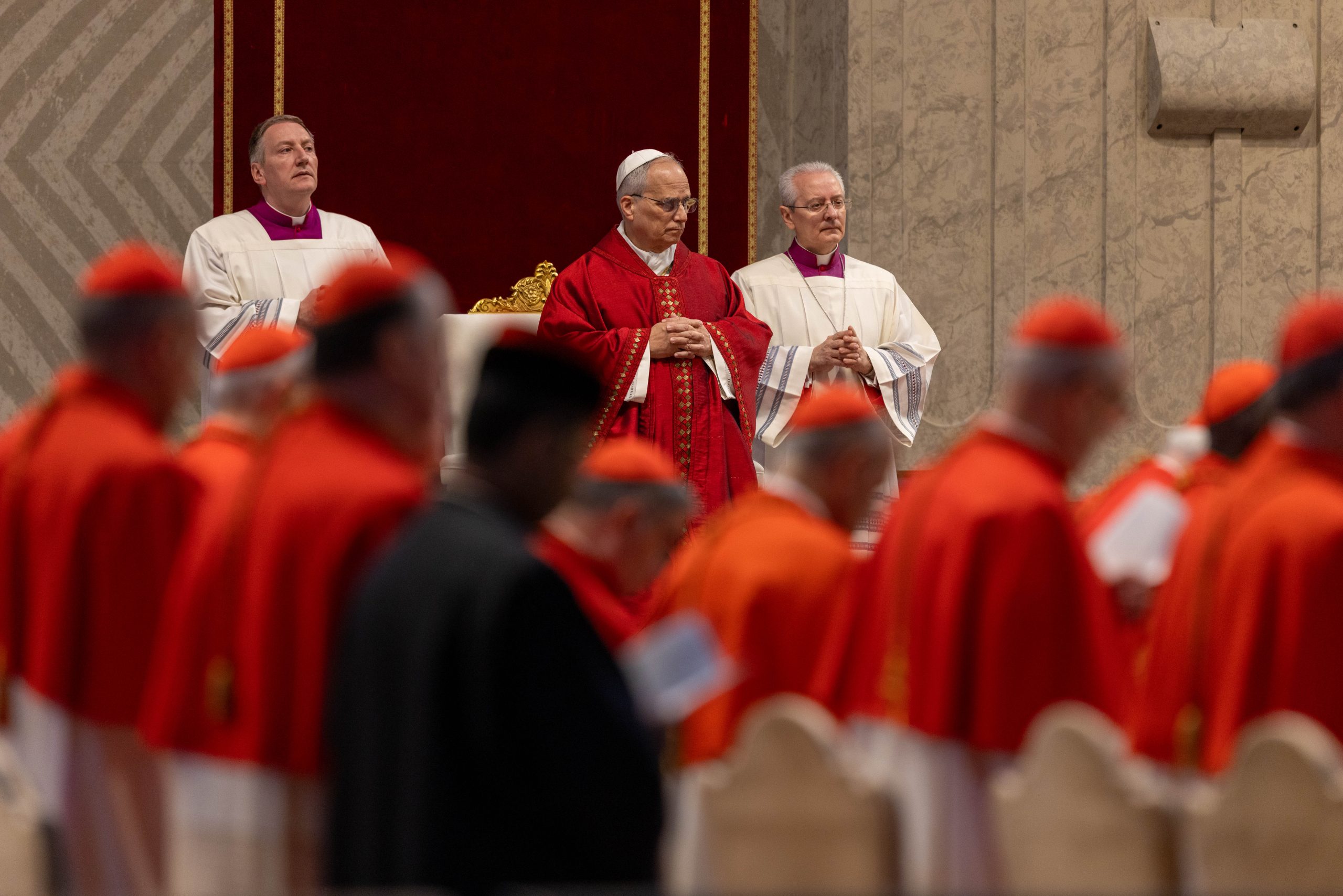
VATICAN — Pope Leo XIV presided over the Celebration of the Lord’s Passion in St. Peter’s Basilica on Good Friday during which the preacher of the papal household exhorted Christians to “approach the Lord’s cross without fear.”
The liturgy began with the pope lying prostrate before the cross and then unfolded in three parts: the Liturgy of the Word, veneration of the cross, and Holy Communion.
There was no opening antiphon; the solemn liturgy began with silent prayer, the unifying thread through the entire celebration.
After the proclamation of the Gospel of John’s account of Christ’s passion, the papal preacher, Father Roberto Pasolini, OFMCap, delivered a homily.

‘The greatest act of love’
“In a time like ours, still torn apart by hatred and violence, when even the name of God is invoked to justify wars and deadly decisions, we Christians are called to approach the Lord’s Cross without fear — indeed, with full trust — knowing that it is a throne upon which one sits and learns to reign with him by placing one’s life at the service of others,” Pasolini said.
“If we can hold fast to the profession of this faith, then our days too will be able to give voice to the songs of both joy and suffering, that mysterious score of the Cross in which the notes of the greatest love can be clearly recognized,” he continued.
The preacher recalled that the day’s liturgy invites Catholics to contemplate the Passion: “Yet the Cross of Christ risks remaining incomprehensible if we look at it only as an isolated fact, as a sudden event. In reality, it is the highest point of a journey, the fulfillment of an entire life in which Jesus learned to listen to and welcome the voice of the Father, allowing himself to be guided day by day all the way to the greatest act of love.”
“Jesus is the man of sorrows who knows suffering well — no violence, no resort to force, no temptation to destroy everything and start over from scratch. We know how difficult it is to embrace such a mission. We are tempted to use aggression and violence, thinking that without them nothing can ever be resolved. But only meekness is the true strength for confronting the darkness of evil,” he continued.

Example of the Servant Songs
In his homily, Pasolini referred to the Servant Songs, four poetic texts found in the Book of the Prophet Isaiah (42, 49, 50, 52–53), which describe a mysterious figure — the “Servant”— who fulfills God’s will through vicarious suffering.
“To understand this journey during the days of Holy Week, the liturgy has had us listen to the so‑called Songs of the Servant of the Lord. These are poetic texts in which the prophet Isaiah sketched the figure of a mysterious servant through whom God would be able to save the world from evil and sin. Christian tradition has recognized in these songs a striking and dramatic foreshadowing,” Pasolini explained.
“In the third song, a new surprise emerges: The servant wants to help, but people respond with anger and violence,” Pasolini said. “Those who live in darkness do not always welcome the light, because the light also exposes what we would prefer to keep hidden — our wounds, our ambiguities.”
“In the fourth song, something deeply unsettling occurs: The violence inflicted on the servant is so intense that it disfigures his face. He has no appearance or beauty, yet the servant has learned not to return the evil he has received,” the preacher said.
The servant “does not resign himself to this logic [of violence]; he absorbs everything without retaliating. For this reason, he bore the sin of many,” the priest explained.
For the papal preacher, the Lord Jesus “did not merely listen to these songs; he lived them intensely, with complete trust in the Father.”
“We see it constantly in wars, in divisions, in wounds: evil keeps circulating because it always finds someone willing to pass it on. Jesus broke this chain by accepting what happened to him. In the Passion, he recognized the score of the songs of love and service that the Father had entrusted to him. In this way, he learned the most difficult obedience — the obedience of loving the other,” Pasolini continued.
“The voice of God no longer guides us — not because it has disappeared, but because it has become just one voice among many, the others promising security and well‑being,” he said.
“What is missing is a word, a song capable of guiding our steps toward a more just world,” he added. “And yet, if we look closely, we can glimpse a silent crowd of people who choose a different voice — a voice that does not shout, that does not impose itself by force, a quiet and persistent song that invites us to love and never return evil for evil. They do not perform extraordinary deeds, but each day they try to make their lives serve not only themselves, but others as well.”

‘Lay down the weapons’
Referencing the act of venerating the cross, Pasolini encouraged those present to use the opportunity to “lay down the weapons” they are holding.
“They may not seem as dangerous as those wielded by the powerful of this world. Yet they, too, are instruments of death, because they are enough to weaken, wound, and drain meaning and love from our daily relationships,” he said.
“Salvation will not drop down from above, nor can it be guaranteed by political, economic, or military decisions. The world is constantly being saved by those who are willing to embrace the Songs of the Servant of the Lord as the shape of their own lives,” the preacher encouraged.
“This is what the Lord Jesus did. He took the Father’s will seriously, accepting it as a score to be carried out to the end, with loud cries and tears.”
“Tonight we too are handed the score of the cross. We can freely accept it if we acknowledge that there is no difficulty that cannot be faced, no guilty party we must point to, no enemy who can prevent us from loving and serving.”
“There is only ourselves — who, by choosing not to return evil, by remaining patient in trials, by believing in good even when darkness seems to swallow everything, can become day by day those servants the Lord needs to bring salvation into the world,” he said.
This story was originally published by ACI Stampa, EWTN News’ Italian-language partner agency. It has been translated and adapted by EWTN News English.