
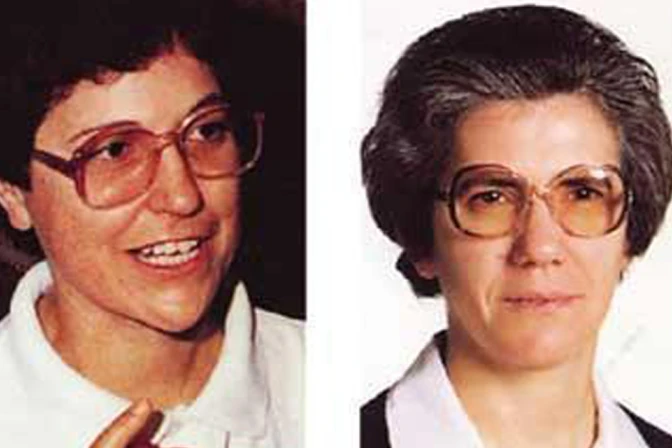
Pope Leo XIV visited the community of Augustinian Missionary Sisters in the Algiers neighborhood of Bab el Oued on Monday and honored the memory of two Spanish religious who were shot to death 32 years ago. The sisters had gone to a chapel to attend Sunday Mass.
Sister Esther Paniagua Alonso, 45, was the first to die. She was shot three times in the head just as she was about to enter the Chapel of St. Joseph in the residence of a small community of French nuns.
Also shot was Augustian Sister Caridad Álvarez Martín, 61, who accompanied Sister Esther to the chapel. A native of Burgos, Spain, she passed away hours later in the emergency department of Ain Naya military hospital, where she had been transported by ambulance.
Doctors spent three hours attempting to save her life, but their efforts were unsuccessful. Sister Caridad, as she was known in religious life, died on the operating table with one bullet lodged in her brain and another in her neck, after suffering three cardiac arrests and hemorrhaging.
The murder of Esther and Caridad was not an isolated incident; rather, it occurred within a context of escalating violence against religious personnel. Months earlier, in May 1994, two other missionaries had been killed.
A year earlier, the Armed Islamic Group had declared it would kill all foreigners.
The political crisis in Algeria during the 1990s triggered the Algerian Civil War, in which between 100,000 and 200,000 people were killed.
Sister Maria Jesús Rodríguez, who at the time served as the provincial superior of the Augustinian Missionaries, told the Pontifical Mission Societies that it was because of this heightened danger that the bishops of Algeria requested that religious communities ensure “no one remain in Algeria unless they did so in complete freedom and having made that decision on a personal level.”
In October 1994, Rodríguez traveled to Algiers and engaged the 12 nuns living there in a process of discernment regarding the course of action they would take.

For several days, accompanied by the then-archbishop of Algiers, Henri Teissier, the nuns undertook a process of personal and communal discernment.
The issue was clear: Should they stay or leave? Both options were “legitimate,” but the decision entailed assuming an obvious risk. “The threat was threefold,” according to Rodríguez: The sisters could be killed “for being foreigners, for being Christians, and for simply being there.”
On Oct. 7, 1994, each of the sisters freely expressed her decision. All of them chose to stay. They commended to God their choice during the Eucharist. “We felt freer after having made that decision,” Rodríguez noted.
‘No one takes our lives from us, for we have already given them up’
“The question ‘And what if something happens to you?’ would invariably come up during meals, to which the sisters would reply: ‘If something happens to us, no one takes our lives from us, because we have already given them up,’” recalled Rodríguez, who remained in Algiers for a few weeks and was still there when Esther and Caridad were killed. The two died on World Mission Sunday.

The two murdered consecrated women were among the 19 Martyrs of Algeria who were beatified by Pope Francis in 2018.
Following the recognition of their martyrdom, their families and fellow sisters were able to return to Bab El Oued in 2018. Among them was Ana Maria Guantay, the current superior general of the Augustinian Missionaries.
“After a very long time, we were able to return to the house, and in the chapel we celebrated the first Eucharist since their martyrdom. I get emotional when I recall it, because it was a place made sacred by the lives of the sisters; one could say that even the walls exuded their presence, for it was there that they prayed, discerned, and wept over the people’s suffering and [their own sense of] powerlessness,” she told the Pontifical Mission Societies.
Currently, the Augustinian Missionary Sisters have transformed the house into a center for welcome and friendship for Algerian women and children.
“We help these children experience peace; that it’s possible to live together, regardless of our cultures or religious traditions: God makes us brothers and sisters through goodness, through love, and through our capacity to help one another get back on our feet,” she explained.
Pope Leo visited the community in 2009 when he served as prior of the Augustinians.
This story was first published by ACI Prensa, the Spanish-language sister service of EWTN News. It has been translated and adapted by EWTN News English.