

SAN CRISTÓBAL DE LA LAGUNA, Spain — For the first time during his apostolic journey to Spain, which concluded Friday, Pope Leo XIV raised his voice with unusual force.
He did so in Tenerife, speaking against human traffickers: those who charge staggering sums to help migrants cross the ocean and those who enslave them mercilessly.
“For every life lost, every family deceived, every body subjugated, every woman threatened, every worker exploited, you will have to appear before divine justice,” the pope said.
“Break those chains and free those you hold in bondage,” he added. “Return what has been taken and make amends as much as you can.”
Then, in a cry reminiscent of Pope Francis’ 2014 appeal to members of the Mafia, Leo declared: “Stop. Repent.”
To those who profit from the suffering of others, he also left open the door of return to God.
“Repent while there is still time,” he said, “for God’s mercy can reach even the most hardened sinner, but it enters only through the narrow gate of truth, justice, and conversion.”
The remarks came during the pope’s meeting with organizations working for the integration of migrants in the Plaza del Cristo de La Laguna, in the capital of Tenerife, before some 4,000 people.
In this final day of his trip, Leo held a second encounter focused on the reality of migration, underscoring the importance he has given the issue throughout his visit.
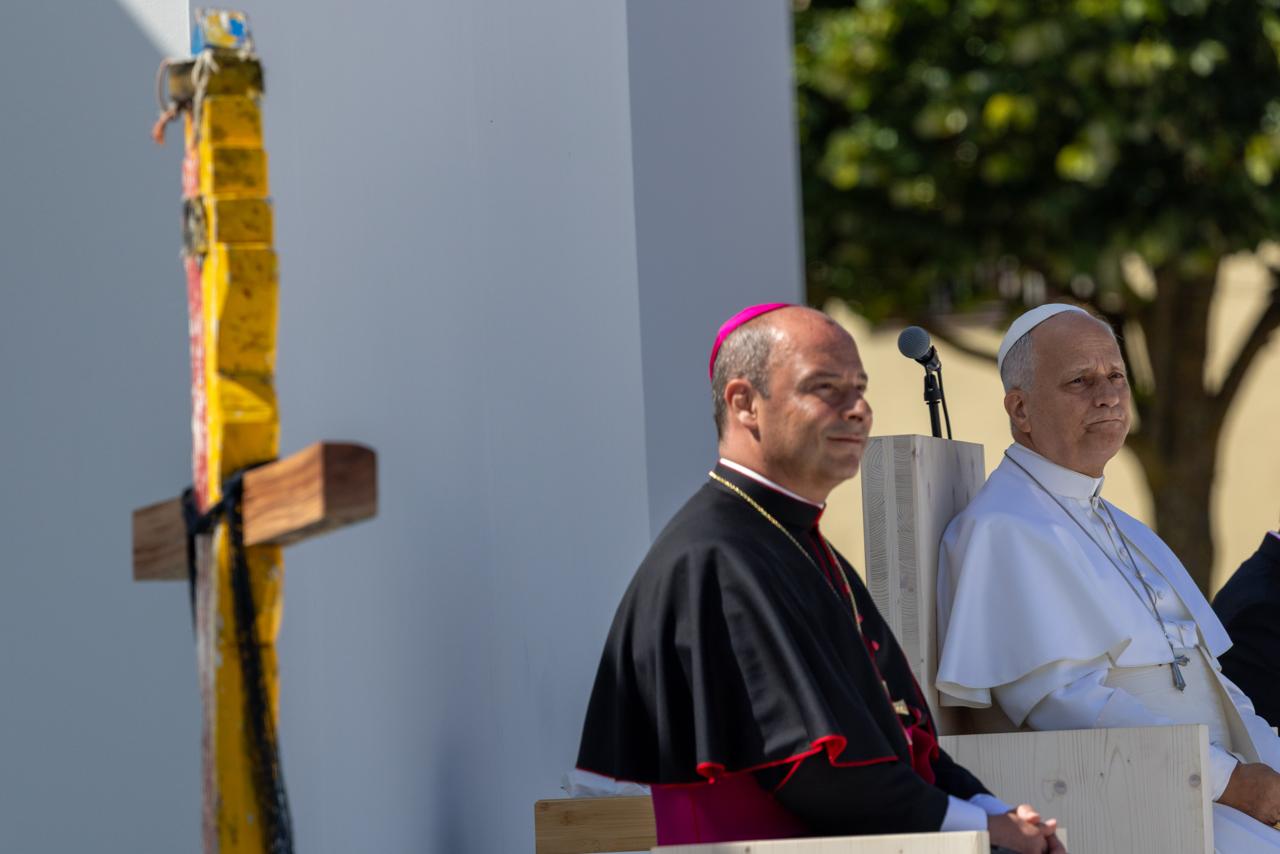
The pope offered several keys for migrants so they do “not … remain forever trapped in the role of victims.”
Speaking to “dear migrant brothers and sisters,” Leo said that part of their journey is “to open yourselves with trust to the community that welcomes you, to learn its language, to respect its laws, to get to know its customs, to participate in communal life, and to offer your gifts with gratitude.”
He also addressed Catholics directly, as he had done the previous day in Las Palmas, asking “that integration not be reduced to a social undertaking, however necessary that may be.”
The pope warned of what he called a “silent shipwreck” that can take place after migrants arrive: “Being left alone in a city, without a voice, without ties, work, or a sense of security, and exposed to those who take advantage of vulnerability.”
“Integration means preventing that second shipwreck,” he said.
Leo said integration must take place “without diluting their identity or closing their hearts to the encounter,” adding that “every welcoming society has responsibilities toward those who arrive,” while those who are welcomed also discover that dignity “flourishes when it becomes a duty and a sincere desire to build together with others.”
Before the final Mass that brought his apostolic journey to Spain to a close, the pope asked the faithful not to forget the many migrants from Latin America, the Philippines, and other parts of the world who are already a living part of the community.
“Let yourselves also be evangelized by them,” he said, “for they surely bring with them gifts that Providence has wished to send to you through those who are integrating.”
His predecessor, Pope Francis, summarized the Church’s approach to migration in four verbs: welcome, protect, promote, and integrate. Leo made that vision his own, insisting that integration cannot be reduced to a merely social task.
“Those who come to our parishes need bread, shelter, language assistance, work, and protection,” he said. “They also must find a community capable of offering paths to knowing Jesus Christ through the witness of life and word, while always respecting the conscience and freedom of each person.”
During the encounter, the pope listened to the testimony of Mbacke, a young Senegalese man who arrived as a child, completely alone.
“I have learned alongside my classmates in all the training activities we have: Spanish, cooking, agriculture, masonry, carpentry, repairs, computer skills, sewing, etc., and in my particular case, basic training in Spain,” he said, thanking the Canary Islands’ El Buen Samaritano Foundation, linked to the Parish of Santa María de Añaza in Tenerife, for giving him a family.
“Thank you for receiving young people like me who arrive alone, without family, and who are only looking for an opportunity to start over,” he added.
His testimony put a face on the drama of migrant minors who cross borders without a parent or guardian. For some who have no family, turning 18 can mean “only the street,” once they leave Spain’s child protection system.
Among those waiting for the pope on this final day was Mamadu, 33, originally from Mali. He arrived 15 years ago, still a child. Today he is fully integrated and speaks Spanish perfectly. He told ACI Prensa that he wanted to see the pope and give him a T-shirt he displayed proudly.
Leo also heard from a Venezuelan migrant priest who has served for seven years on El Hierro, the westernmost and southernmost island in the Canary archipelago. The island, the smallest and least populated of the main Canary Islands, has recorded some of the highest migrant arrivals in recent months: Since March 2023, it has received 50,244 immigrants despite having just 11,600 residents.
“There were days and nights when I wanted to stay in the comfort of my house, but I thought: What would Our Lord do?” the priest said. “And I renewed the service being asked of me. And there, amid pain and suffering, there was always some reason for hope, some smile, some grateful face that gave more than enough reason for our commitment.”
The Holy Father also listened to harrowing accounts, including that of Khalid Allad, a 24-year-old Moroccan who, like many others, reached the Canary coast in 2020.
“My journey in a small boat was not easy at all,” he said. “I tried twice. In the first attempt, 20 people died.”
Although his father forbade him from trying again, he set out a year later.
“Although I was afraid, I decided to leave again, this time without his permission,” he said.
Once in Tenerife, he began a new life thanks to the Don Bosco Foundation.
“They offered me a place to live, taught me Spanish, helped me read and write better, and gave me the confidence to move forward,” he said through tears.
Thalia Johana Saldarriaga Diago, a Colombian immigrant who, thanks to Caritas, not only recovered her independence but also became a volunteer helping others in similar situations, also spoke at the meeting.
“In this way,” the pope said, recalling her witness, “yesterday’s stranger can be today’s brother and neighbor.”
The encounter took place as the European Union entered a new and stricter era in migration policy. The Migration and Asylum Pact, the result of years of negotiations among member states, officially entered into force Friday, promising to strengthen control of external borders, speed up asylum procedures, and increase returns of people without the right to remain in EU territory.
After this effort to put a human face on the drama of migration, and before returning to Rome with an expected delay, the pope celebrated a large outdoor Mass at the port of Santa Cruz de Tenerife.
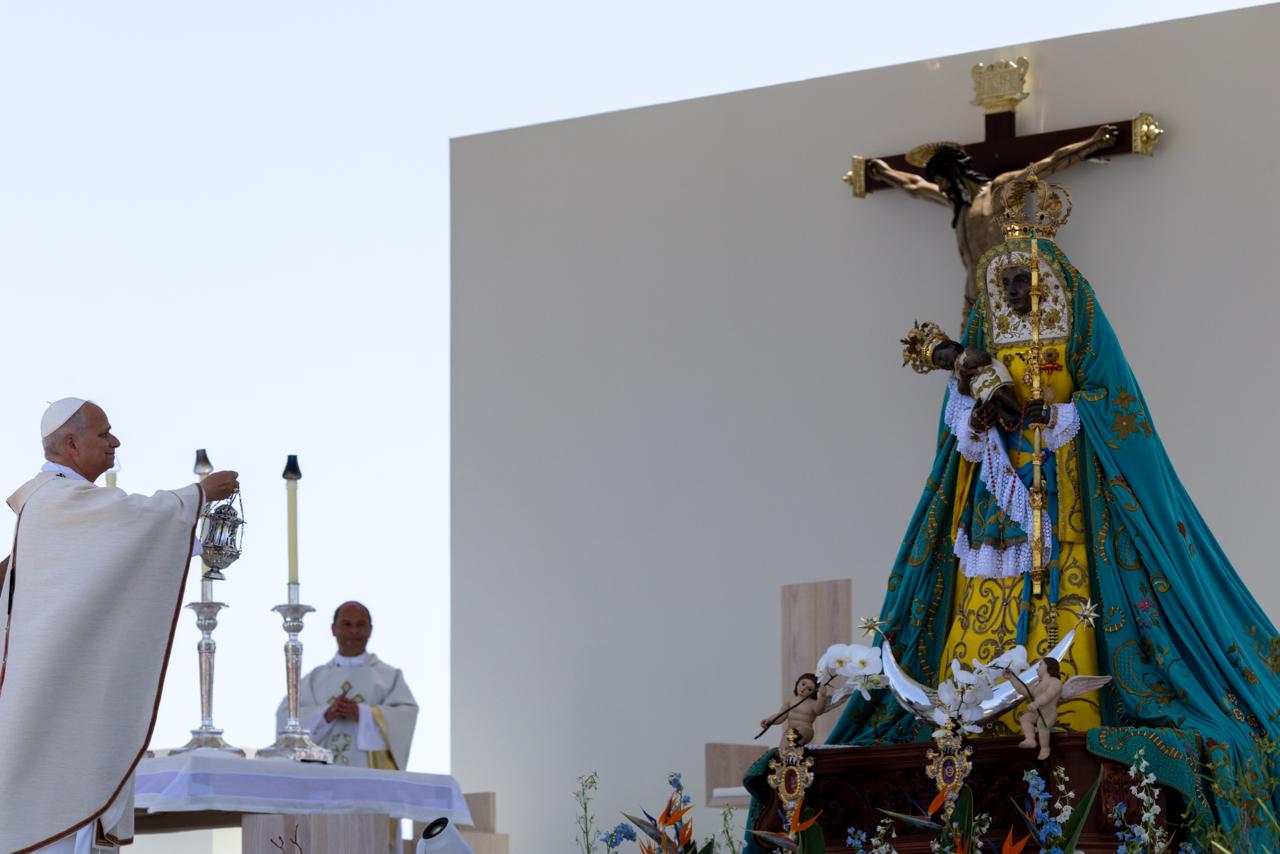
In his homily, Leo cited Pope Francis’ encyclical Laudato Si’ as he reflected on Tenerife’s “tourist vocation” and the island’s contact with visitors from many countries.
“How important it is, especially for those who allow themselves to be guided by the Gospel, not to reduce everything to commerce and profit,” the pope said.
Spain is a global tourism powerhouse, but its success has caused growing tensions in destinations like those the pope visited this week: Madrid, Barcelona, Las Palmas, and Tenerife.
This story was first published by ACI Prensa, the Spanish-language sister service of EWTN News. It has been translated and adapted by EWTN News English.