
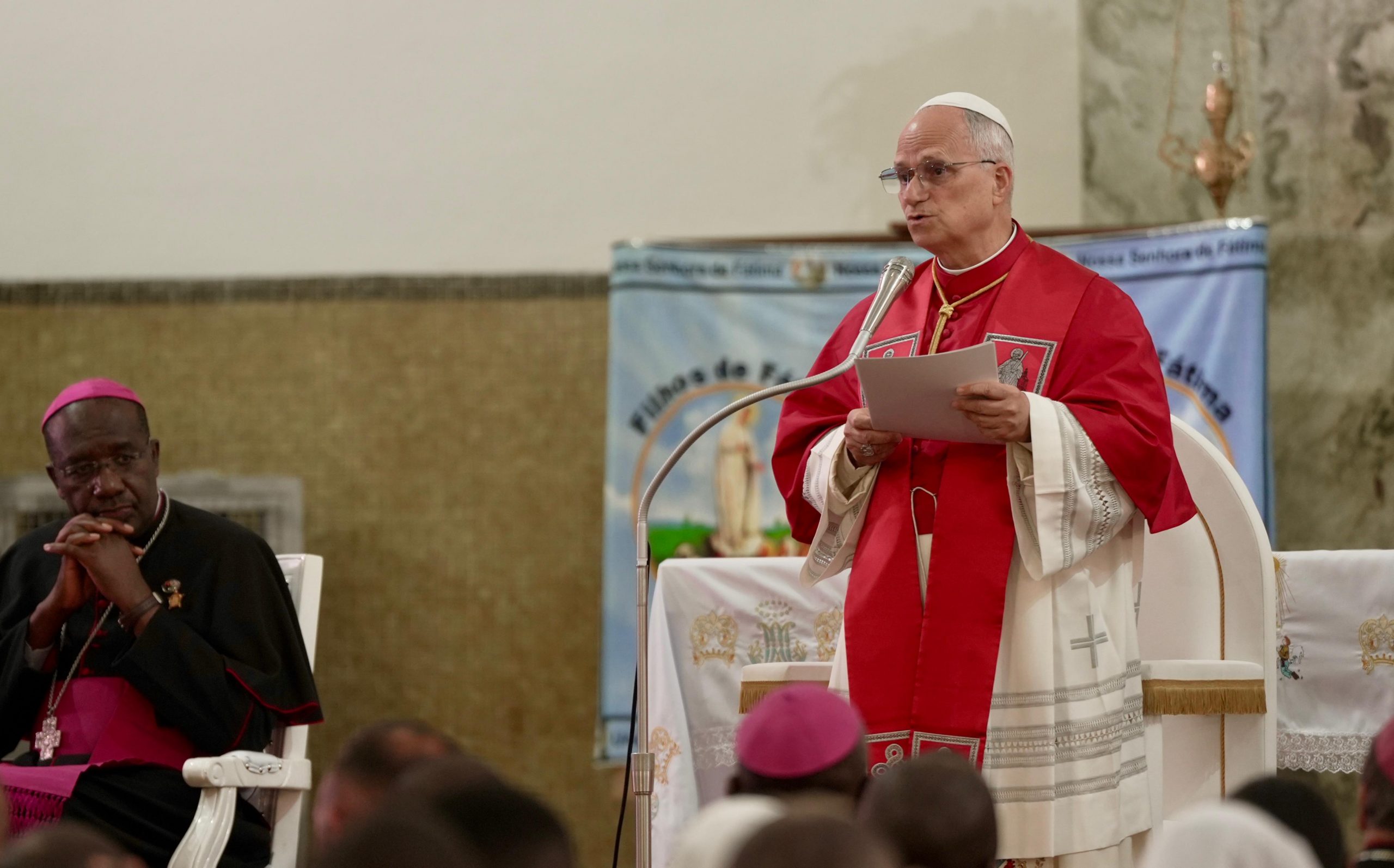
LUANDA, Angola — Pope Leo XIV on Monday thanked the Catholic Church in Angola for its long-standing witness in a nation still marked by the wounds of war, praising its efforts to help build the country on “the solid foundations of reconciliation and peace.”
“Thank you also for your steadfast commitment to contribute to the progress of this nation on the solid foundations of reconciliation and peace,” the pope said April 20 during a meeting with bishops, priests, consecrated men and women, catechists, and other pastoral workers at the Parish of Our Lady of Fátima in Luanda.
The parish, dedicated to Our Lady of Fátima and built by Capuchin Franciscans in 1963, welcomed the pope with a festive reception. Two children greeted him at the entrance with flowers, while young women in red skirts danced on the church square as they awaited his arrival.
The stop was one of the pope’s final public events in Angola before his departure Tuesday for Equatorial Guinea, the last leg of his African journey.
Leo thanked the Church in Angola for its vitality and missionary spirit, telling clergy and religious that the Lord sees the generosity with which they have embraced their vocation.
“It is therefore worth opening your hearts completely to Christ!” he said. “Do not be afraid to say ‘yes’ to Christ, to model your lives entirely on his! Do not be afraid of tomorrow, for you belong completely to the Lord.”
Addressing seminarians and those in formation in particular, the pope emphasized the total gift of self to God in priestly and religious life.
“It is worth following him in obedience, poverty, and celibacy. He takes nothing away! The only thing he takes from us and takes upon himself is sin. Yes, from him you receive everything,” he said.
The pope also highlighted the importance of catechists, calling their ministry a foundational expression of ecclesial life in Africa.
“Particularly in Africa, it is a fundamental expression of the life of the Church, which can serve as an inspiration for Catholic communities throughout the world,” he said.
Fifty years after Angola’s independence, Leo reflected on the country’s future and on the Christian duty to help shape it.
“All Angolans, without exception, have the right to build up this country and to benefit from it equitably; however, the Lord’s disciples have the duty to do so according to the law of charity,” he said.
The pope framed that responsibility above all as a call to fidelity to Christ. Referring to the Angolan bishops’ current three-year pastoral plan, “Faithful Disciples, Joyful Disciples,” he said the first path the Lord opens before the Church is fidelity.
“The first path is fidelity to Christ,” he said, urging ongoing formation, vigilance in personal integrity, and perseverance “in proclaiming the good news of peace.”
Leo said formation must be rooted not only in study and pastoral structures but also in a contemplative life nourished by prayer, adoration, and the broader cultivation of the human person.
“Formation is much broader,” he said. “It concerns the unity of our inner life, care for ourselves and for the gift of God we have received … by drawing on literature, music, sports, the arts in general, and above all, prayer of adoration and contemplation.”
He also encouraged clergy and religious to remain close to the people, especially the poor, and to reject privilege, arrogance, and self-centeredness.
“Do not detach yourselves from the people, especially the poor, and shun the pursuit of privileges,” he said.
The pope gave special thanks to families, calling them indispensable in nurturing vocations and asking relatives to support priests and religious with prayer and honest counsel rather than seeking personal advantage from their ecclesial service.
After winning independence in 1975, Angola was plunged into a civil war that lasted until 2002. The long conflict left enduring scars, making the Church’s message of reconciliation and peace especially resonant today.
Turning to Angola’s history of conflict, Leo said the Church’s fidelity today is especially tied to the proclamation of peace.
“In the past, you have shown courage in denouncing the scourge of war,” he said. “Your contribution is widely recognized and appreciated. But this responsibility is not over!”
He urged the Church to promote a renewed sense of reconciliation by educating people in the ways of peace and by honoring those who have learned to forgive after enduring suffering.
“It is therefore essential that, while interpreting current events with wisdom, you never cease to denounce injustices, offering solutions in accordance with Christian charity,” he said.
Leo also called on the Church to continue cooperating in the country’s “integral development,” especially through education and health care.
“Continue to be a generous Church, cooperating in the integral development of your country,” he said.
He concluded by pointing to the witness of those who gave their lives for Angola and for the Gospel.
“Remember the heroic witness of faith given by Angolans — men and women, missionaries born here or coming from abroad — who had the courage to give their lives for this people and for the Gospel, preferring death to betraying the justice, truth, mercy, charity, and peace of Christ,” he said.
This story was first published by ACI Stampa, the Italian-language sister service of EWTN News. It has been translated and adapted by EWTN News English.