
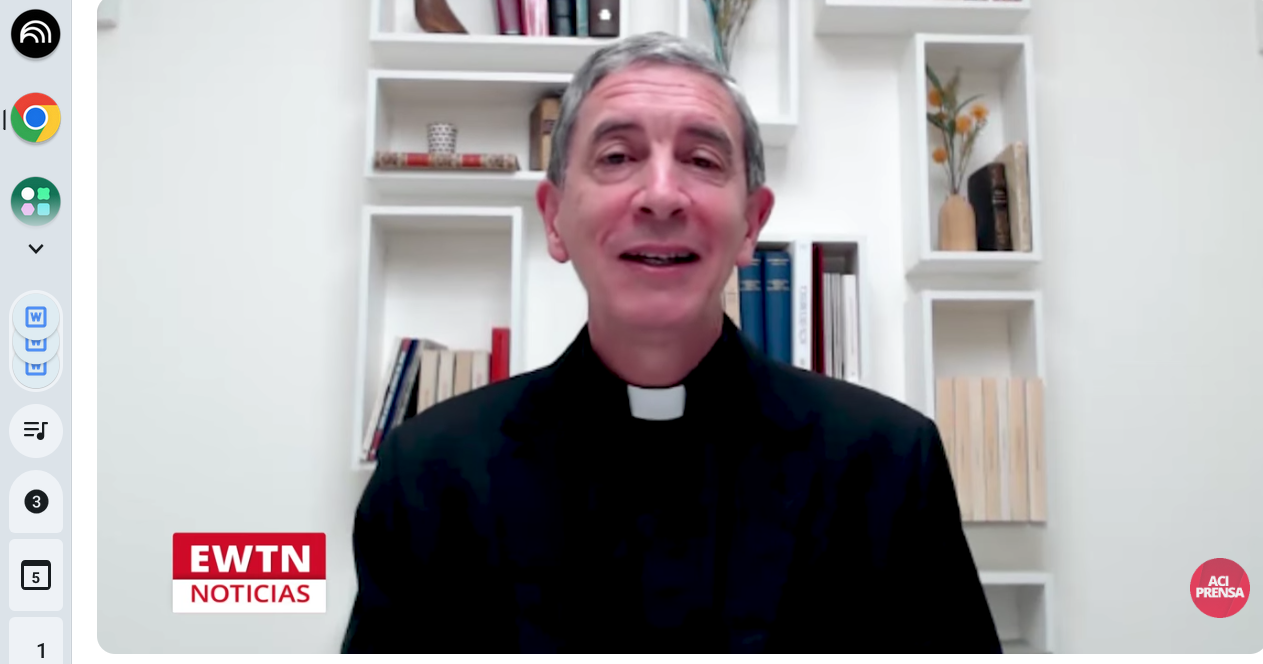
Psychological distress significantly affects priests, who may find themselves exposed to situations involving stress, anxiety, and emotional burnout due to the nature of their mission, said Father Wenceslao Vial, a priest and physician.
His remarks in an interview with ACI Prensa, the Spanish-language sister service of EWTN News, come against a backdrop of growing concerns about mental health issues within the clergy. In April, Filipino Cardinal José Advíncula warned that “almost 1 in 5 priests in the Philippines suffers from psychological distress” and urged that mental health be prioritized in order to sustain pastoral ministry.
Vial, a professor of psychology and spiritual life in the theology department of the Pontifical University of the Holy Cross in Rome, emphasized that this problem should come as no surprise, as it is part of a broader reality.
“In many countries and not just among priests, people suffer from psychological distress,” he said, noting that “nearly 30% of the adult population suffers from some form of psychological pathology” and that anxiety “affects roughly 25% of the general population.”
Warning signs: When to be concerned
Vial stressed the importance of identifying warning signs. According to the specialist, the first sign of a mental health issue is often “a continuously and excessively negative emotional state: fear, sadness, distress, anger, and persistent negative thoughts.”
He further warned that these signs must be taken seriously when they persist over time: “When you observe a person who is overly anxious, overly insecure, or overly sad for a period that has already lasted, for instance, a couple of weeks, that’s a warning sign that requires attention.”
Otherwise, he cautioned, the situation may get worse: “If not addressed, the alarm itself turns into a fire. The person ends up getting burned.”
Regarding treatment, Vial emphasized the importance of a proper diagnosis: “The first step is to make a diagnosis … to give a name to the difficulties.” He explained that it is not enough to treat the symptoms; rather, it is necessary to get to the root causes.
Likewise, he issued a clear call to seek out specialists: “You shouldn’t be afraid of health professionals — psychologists, psychiatrists, and doctors.”
Burnout: A common risk among priests
Among the most common problems he sees in priests is burnout, or what he calls the “disillusioned Good Samaritan syndrome,” which he described as “a state of exhaustion” linked to constantly serving others.
“It occurs in people who work by serving others, by giving of themselves to others,” he explained, noting that it affects not only priests but also doctors, teachers, and mothers.
A particularly relevant aspect is its root cause: “Often, it is not brought about by overwork but rather by service work that has lost its sense of purpose.”
Shared responsibility in the Church
Vial emphasized that caring for mental health is not solely an individual responsibility. “When problems arise in a diocese, the bishop must take the time to see what is happening,” he said, noting that both personal and institutional factors are typically involved.
Among these, he cited “excessive perfectionism,” “insecurity,” and “unhealed wounds” but also situations such as “leaving the priest excessively isolated” or “burdening him with too many responsibilities without providing support.”
“That is why it is a collaborative effort,” he emphasized.
Vial highlighted the importance of the support provided by the laity. “All of us in the Church must pray for our priests … and look out for our pastors,” he said. They are “the ones entrusted with leading us to heaven and bringing heaven down to earth.”
This story was first published by ACI Prensa, the Spanish-language sister service of EWTN News. It has been translated and adapted by EWTN News English.