
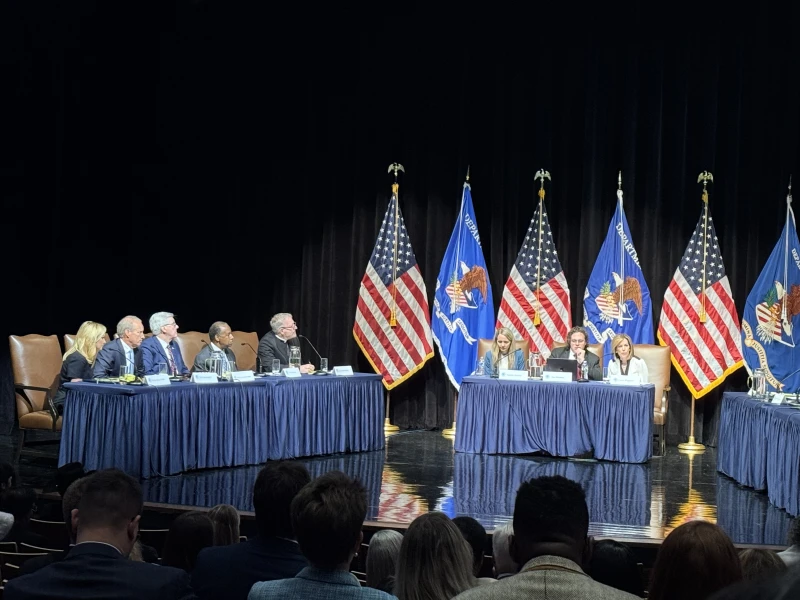
The Trump administration’s Religious Liberty Commission meets in Washington, D.C., on Monday, June 16, 2025 / Credit: Tessa Gervasini/CNA
CNA Staff, Dec 11, 2025 / 11:05 am (CNA).
The White House’s Religious Liberty Commission held its fourth hearing on Dec. 10, focusing on reports of the suppression of the right to religious freedom in the U.S. military.
The commission — on which sit the Reverend Franklin Graham, son of renowned evangelist Billy Graham; Ryan Anderson, head of the Ethics and Public Policy Center; and Bishop Robert Barron of the Diocese of Winona-Rochester, among others — heard testimony from expert witnesses who served in the various branches of the military, many as chaplains.
The commission, which met in Dallas, Texas, will present its findings from these hearings to President Donald Trump.
Retired Army chaplain and Major General Doug Carver spoke to the commission about the importance of the chaplaincy in the U.S. military. He recalled that in 1775, George Washington asked Congress for a religious leader to serve the needs of the military because the president recognized the crucial role religious faith played in the founding of the new nation, and especially to men who were giving their lives to protect it.
Historian and activist David Barton gave a brief timeline of the history of religious freedom in the U.S. military, emphasizing that along with Washington, many presidents have considered it invaluable since the country’s founding.
He argued that hostility against religious freedom started in earnest in 2009 under the Obama administration and continued under the Biden administration. There was no widespread suppression of religion in the military until this time, he said.
In 2010, troops were directed to “scratch off and paint over” Bible verses that had been inscribed for decades on scopes and gun sights, he said. The Air Force in California stopped a decades-old practice of teaching just war theory to members in 2011, he said, because it was taught by chaplains and based on biblical principles and the teachings of St. Augustine.
In 2012, the Air Force required the removal of the word “God” from the patch of the Rapid Capabilities office.
Both Democratic administrations tried to outsource military chaplains so they would no longer be embedded with the servicemembers, Barton said. In addition, military chaplains were pushed out of their teaching positions and troops began to be educated in “an ardently secular manor with no tolerance for any religious expression.”
“Fear and timidity” among the chaplains has become the norm as a result of the hostility against religion, according to Barton, who called for educational reform for servicemembers that emphasizes the constitutionality of religious freedom and the important role religion has played since the nation’s founding.
Carver, who served as a chaplain for more than three decades, criticized the state of faith in the military and in the culture at large. When he entered the army in 1973, he said, chaplains taught character guidance classes and even gave soldiers “a duty day with God,” where one day a month they could spend a day in spiritual reflection.
Those practices have long since ended, he said. Now, chaplains are called spiritual readiness coaches, values facilitators, and morale officers, Carver said.
“There is nothing wrong with chaplains taking on other duties,” he said, noting they are trained in handling crisis and trauma situations and serve as support for those struggling in family life. “But their primary role is as religious leaders, first and foremost.”
“The role of chaplain has been diminished,” he said.
“We are losing ground in the area of religious liberty. There’s a degradation of the Supreme Being having any input into our lives,” he said. “I am not sure how we can change direction without serious repentance.”
Marine veteran Mike Berry, now the executive director of external affairs and senior counsel at First Liberty Institute, a religious freedom law firm, also testified at the hearing.
Berry, like thousands of others, refused a mandatory COVID-19 vaccine on religious freedom grounds. He was placed on inactive status without being informed by his superiors, he said, and only found out when his family was told they were no longer eligible for Tricare, the military’s health insurance program.
He said during the hearing that religious liberty “isn’t merely an esoteric concept or a punchline. It’s a matter of national security.”
Since the military made the vaccine mandatory, more than 19,000 troops have either resigned or were pushed out, Berry said.
“Religious conviction is the source of America’s moral strength,” he said. “Highly religious young Americans are way more likely to join the military than nonreligious people.”
He warned that if religious freedom is not respected, young Americans will not enlist and the military “will become soft and weak.”
Berry made three recommendations that he hopes the commission will present to the president.
First, echoing Barton, Berry said that education and training must improve. Berry told the commission he received only one hour of training on the constitutional foundations of religious liberty as a new Marine. He also called for the elimination of “misguided” educational materials.
“America is not evil, racist, imperialist, or fascist. Anything implying that, and any content hostile to religious liberty” should be removed, he said.
Finally, Berry said religious liberty should be reaffirmed in national security strategy. Such liberty is a “first freedom” and should be a strategic priority.
Kelly Shackelford, First Liberty Institute CEO and chief counsel, who also sits on the commission, said in a press release after the hearing: “The testimonies at today’s meeting highlight the importance of ensuring that the religious liberty of our servicemembers, chaplains, and veterans are upheld both now and into the future.”
“These men and women are risking their very lives for our freedoms. To stand for theirs is the very least we can do.”
Trump established the Religious Liberty Commission, which is housed under the Department of Justice, through executive order on May 1, and appointed Texas Lt. Gov. Dan Patrick as chairman and Dr. Ben Carson, former secretary of the Department of Housing and Urban Development, as vice chair.
San Francisco Archbishop Salvatore J. Cordileone serves on the commission’s advisory board, along with Bishop Thomas Paprocki, Bishop Kevin Rhoades, and Father Thomas Ferguson.