

As the Basilica of St. Peter approaches the 400th anniversary of its consecration, the Vatican has announced a slate of liturgical and cultural initiatives — including opening parts of the basilica complex that have never been accessible to the public and rolling out a new digital entry system designed to better manage crowds.
St. Peter’s Basilica was consecrated on Nov. 18, 1626, by Pope Urban VIII. Vatican officials presented the anniversary program on Monday, highlighting plans intended to ease visitor pressure inside the basilica while improving security and preserving an atmosphere of prayer.
“We want to lighten the weight of the crowds in the basilica and foster deeper spiritual recollection,” said Cardinal Mauro Gambetti, archpriest of St. Peter’s Basilica, “while at the same time offering new spaces to get to know St. Peter better through themed itineraries.”
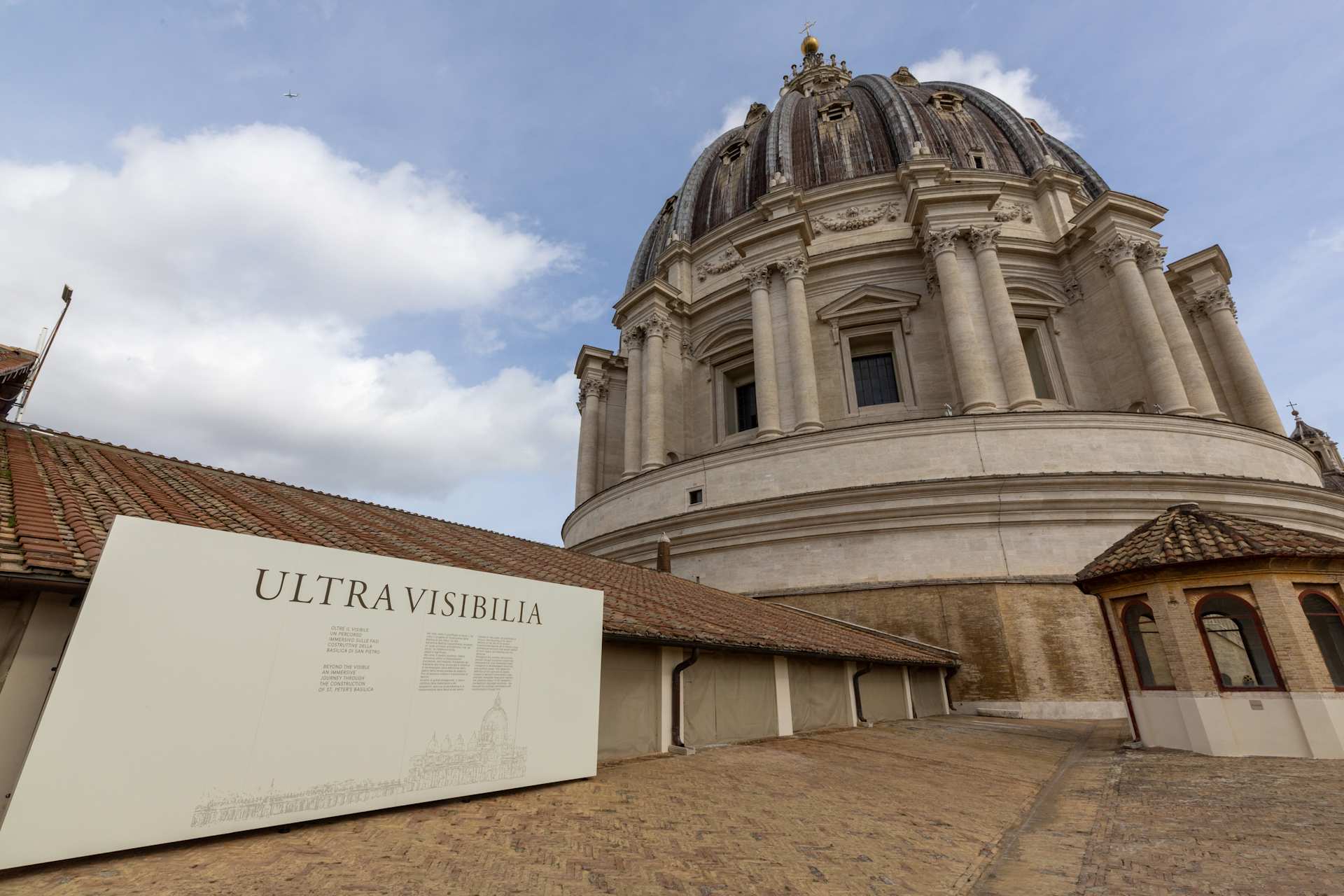
Among the most significant measures is the opening of the entire terrace of the basilica to visitors; currently, only about one-third is accessible. The newly opened terrace areas will feature a permanent exhibition on the history, construction, and ongoing maintenance of St. Peter’s.
Gambetti also said the restoration area currently located on the terrace will be reconfigured and expanded. The space will double and continue to be managed by the Fabric of St. Peter, he said, totaling about 100 square meters (roughly 1,075 square feet) and moving to the opposite side from its current location.
The Vatican also foresees the future opening of the large galleries of the Gregorian and Clementine domes, with educational proposals designed especially for children and young people.
To improve crowd management, officials announced a new digital access system — SmartPass — integrated into the basilica’s official website, along with a network of sensors to monitor visitor presence in real time and enhance security.
Gambetti described the initiative as a new “ecosystem” meant to safeguard the basilica’s sacred character while welcoming the millions of pilgrims and tourists who continue to come to the heart of Christianity.
A look ‘beyond the visible’
The cardinal stressed that the anniversary is not being treated merely as a historical commemoration but as an opportunity to renew the basilica’s spiritual meaning.
Built over the remains of the original Constantinian basilica, the current church stands as “the living memory of our faith in Jesus Christ, supported by Peter’s profession of faith,” Gambetti said, calling it “at the same time a door open to all who seek God.” He also recalled the transition from the earlier basilica to the present one, promoted by Pope Julius II during the Renaissance.
Gambetti pointed as well to the collaboration of the Italian energy company Eni, which is supporting conservation and “enhancement” projects tied to the anniversary.
Program of events
The spiritual program begins Feb. 20 with the inauguration of a new permanent Stations of the Cross inside the basilica, created by Swiss artist Manuel Durr, winner of an international competition launched in 2023.
On Saturday afternoons, the basilica will also host brief 30-minute “spiritual elevations” featuring prayer and polyphonic chant for those present.
Three “solemn pastoral lectures” — historical-cultural, theological-liturgical, and pastoral-spiritual — are planned for March 24, May 26, and Oct. 13 on the meaning of the basilica’s dedication. A spiritual meditation on St. Peter in light of the Gospel will be given by the preacher of the Papal Household, Father Roberto Pasolini, OFM Cap.
Additional initiatives include the urban itinerary “Quo Vadis,” tracing the footsteps of Sts. Peter and Paul through Rome, and the theatrical production “Pietro e Paolo a Roma” by Michele Aginestra, planned around the June 29 feast of the apostles.
The celebrations are set to culminate Nov. 18 with a solemn Mass to be celebrated by Pope Leo XIV on the exact 400th anniversary of the basilica’s consecration.
Eni’s technical work
During the presentation, Eni executive Claudio Granata said the company’s technical work for St. Peter’s has involved an 18-month process, much of it devoted to study and planning. He recalled Eni’s earlier restoration of the basilica façade beginning in 1999 — the first deep cleaning since architect Carlo Maderno completed it in 1612.
This time, Granata said, the scale is larger: Measurements were carried out across approximately 80,000 square meters, covering the entire basilica, including outer areas. The analysis includes visible surfaces — such as the façade, columns, and roofs — as well as “invisible” elements like the foundations, resulting in a permanent monitoring system and a comprehensive digital model.
Eni research and development director Annalisa Muccioli said the project was guided by respect for the basilica’s historical, artistic, and spiritual character. The effort included 4,500 work hours across day and night shifts, as well as extensive historical study and technical documentation. Using techniques intended to “see without altering,” she said the team employed methods such as geophysical investigations, laser scanning, and advanced photogrammetry.
Muccioli described the result as a dynamic model integrating architectural geometry, subsurface geology, and real-time data — a tool meant to support the Fabric of St. Peter in future conservation and planning.
This story was first published by ACI Prensa, the Spanish-language sister service of EWTN News. It has been translated and adapted by EWTN News English.