
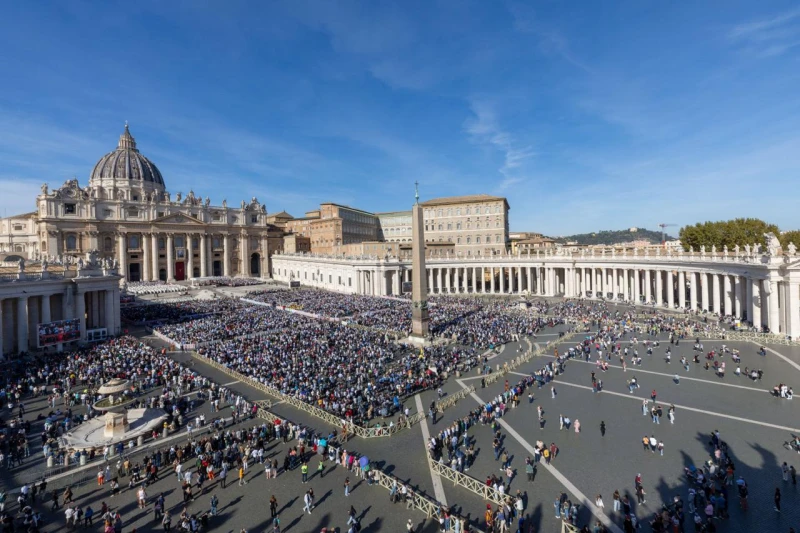
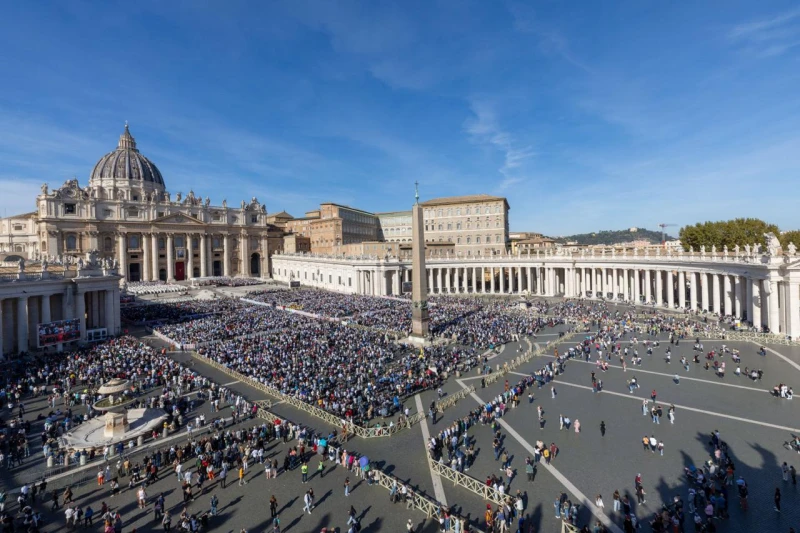
St. Peter’s Square during the declaration of St. John Henry Newman a doctor of the Church in November 2025. / Credit: Daniel Ibañez/EWTN News
Vatican City, Dec 1, 2025 / 16:51 pm (CNA).
The Holy See closed the 2024 fiscal year with a surplus of 1.6 million euros ($1.86 million), according to the 2024 Consolidated Financial Statement published Nov. 26 by the Vatican Secretariat for the Economy. This result represents a substantial change compared with the deficit of 51.2 million euros ($59.5 million) recorded in 2023, according to the Vatican.
The last public report from the Holy See was from 2020 — published in 2021 — and showed a deficit of 66.3 million euros ($77 million).
The current report indicates that the financial improvement is based on a reduction in the operating deficit, which decreased by almost 50%, from 83 million to 44 million euros, ($96.4 to $51.1 million) driven by a 79-million-euro ($91.8 million) increase in revenue, mainly from donations and hospital management, and by strict cost control that partially offset inflation and rising personnel costs.
The report also highlights the performance of financial management with positive results of 46 million euros ($53.4 million), higher than the previous year thanks to capital gains obtained from the sale of historical investments and the start of operations of the Investment Committee.
Surplus excluding hospitals
Excluding hospital entities, the Holy See recorded a surplus of 18.7 million euros ($21.7 million), although the secretariat warns that this figure reflects extraordinary accounting effects and a one-time increase in donations, so its sustainability will depend on future fiscal years.
The Holy See’s balance sheet reveals a total allocation of 393.29 million euros ($457 million) destined for the apostolic mission and the pontifical funds, not including the financing of hospitals. This budget reflects the priority of supporting the Church’s core activities worldwide and shows how resources are distributed to guarantee the continuity of the apostolic mission.
Approximately 83% of the funds are concentrated in five strategic areas that underpin the pastoral and social work of the Holy See. The most significant allocation, amounting to 146.4 million euros ($170.1 million) — equivalent to 37% of the total — is dedicated to supporting local Churches in difficult situations and for evangelization, recognizing the importance of strengthening the most vulnerable communities and supporting the spread of the faith in territories where the mission faces greater challenges.
Worship and evangelization constitute the second most significant category, representing 14% of the resources. This allocation supports liturgical activities, religious formation, and initiatives for spreading Church teachings worldwide. A further 12% is specifically dedicated to communicating the pope’s message, ensuring that his teachings, exhortations, and statements effectively reach the faithful and the international community.
Ten percent of the budget is allocated to charitable services
Likewise, 10% of the budget is dedicated to maintaining the international presence of the Holy See through the apostolic nunciatures, which play an essential diplomatic and pastoral role in relations with states and local Churches. Another 10% is allocated to charitable services, reinforcing humanitarian and assistance initiatives that respond to the most urgent needs of the poor and marginalized.
The remaining 17% finances activities such as the organization of ecclesial life, management of historical heritage, and support for academic institutions. The secretariat emphasized that these allocations reflect consistency between the Church’s pastoral mission and its financial management.
The report concludes that, although the result is encouraging, the full financial sustainability of the Holy See will continue to depend on its performance in the coming fiscal years, marking 2024 as a year of economic recovery after years of deficits.
Maximino Caballero Ledo, prefect of the Secretariat for the Economy, gave a comprehensive explanation of the results in an interview with Vatican media, highlighting both the achievements and the need for prudence and continuity in management.
“The data reflect remarkable progress in consolidating the economic situation of the Holy See,” Caballero said. “It is not only about maintaining a balanced budget but also about strengthening our ability to make the best use of every contribution received, making the service to the mission of the universal Church more solid and sustainable.”
The financial document presented by the Vatican shows that the structural operating deficit was reduced by almost half, from 83.5 million euros to 44.4 million euros ($97 million to $51.6 million). This is mainly due to an increase in revenue, which amounted to almost 79 million euros ($91.8 million) compared with the previous year, driven by greater donor participation, positive results from hospital activities, and progress in real estate and commercial management.
Caballero emphasized that these “favorable dynamics,” combined with prudent spending control and a constant effort to improve operational efficiency, offer a positive outlook for the Vatican’s finances. However, he recalled that “the deficit of 44.4 million euros [$51.6 million] indicates that there is still a long way to go. Financial sustainability is not only a possible objective but a necessary condition to guarantee the continuity of our apostolic mission.”
Growth in donations and the trust of the faithful
The prefect noted that contributions from the faithful experienced a rebound in 2024 after years of slowdown. “This increase represents an encouraging sign of renewed participation by the faithful and local Churches in the mission of the Holy See. However, these dynamics are variable and always require prudence and realism in their interpretation,” he emphasized.
The analysis of expenditures confirms, according to Caballero, that most resources continue to be allocated directly to apostolic activities, “reflecting the consistency between the priorities of the mission and the financial decisions that make it possible. This allows for the strengthening of pastoral initiatives and support for the most vulnerable communities, consolidating a balanced and responsible management of resources.”
Financial management and future prospects
The 2024 balance sheet also shows positive results of 46 million euros ($53.4 million) from financial activities, including extraordinary transactions related to the restructuring of the investment portfolio in accordance with the new policy approved by the Investment Committee. Caballero warned that “these capital gains are not repeatable with the same intensity in future years and reflect the natural volatility of financial activity.”
Therefore, he emphasized that “along with prudence in spending, it is essential to continue working on the revenue side: donations, fundraising, asset valuation, and consistent investment management. The goal is not to pit these dimensions against each other but to consolidate progress and gradually strengthen a more stable economic foundation.”
Toward full financial sustainability
The prefect concluded by highlighting that the 2024 fiscal year closed with a small surplus of 1.6 million euros ($1.86 million), an encouraging sign that, according to him, “demonstrates that the direction taken is positive. Now we must consolidate this progress, aware that some of the results come from nonrecurring elements. Financial sustainability is essential to ensure the continuity of the Holy See’s mission, which by its nature requires a stable economic foundation.”
Caballero emphasized that “it is not simply a matter of balancing the budget but of strengthening our ability to optimally utilize every contribution received, making the Holy See’s service to the entire universal Church more solid and sustainable.”
This story was first published by ACI Prensa, CNA’s Spanish-language news partner. It has been translated and adapted by CNA.