








The bishops of the United States voted in favor of a revised version of the Charter for the Protection of Children and Young People.
The document, also known as “the Dallas Charter,” is a set of procedures originally established in 2002 to address allegations of sexual abuse of minors by Catholic clergy.
The bishops voted on the revised document at the United States Conference of Catholic Bishops’ (USCCB) spring plenary session in Orlando, Florida, on June 11.
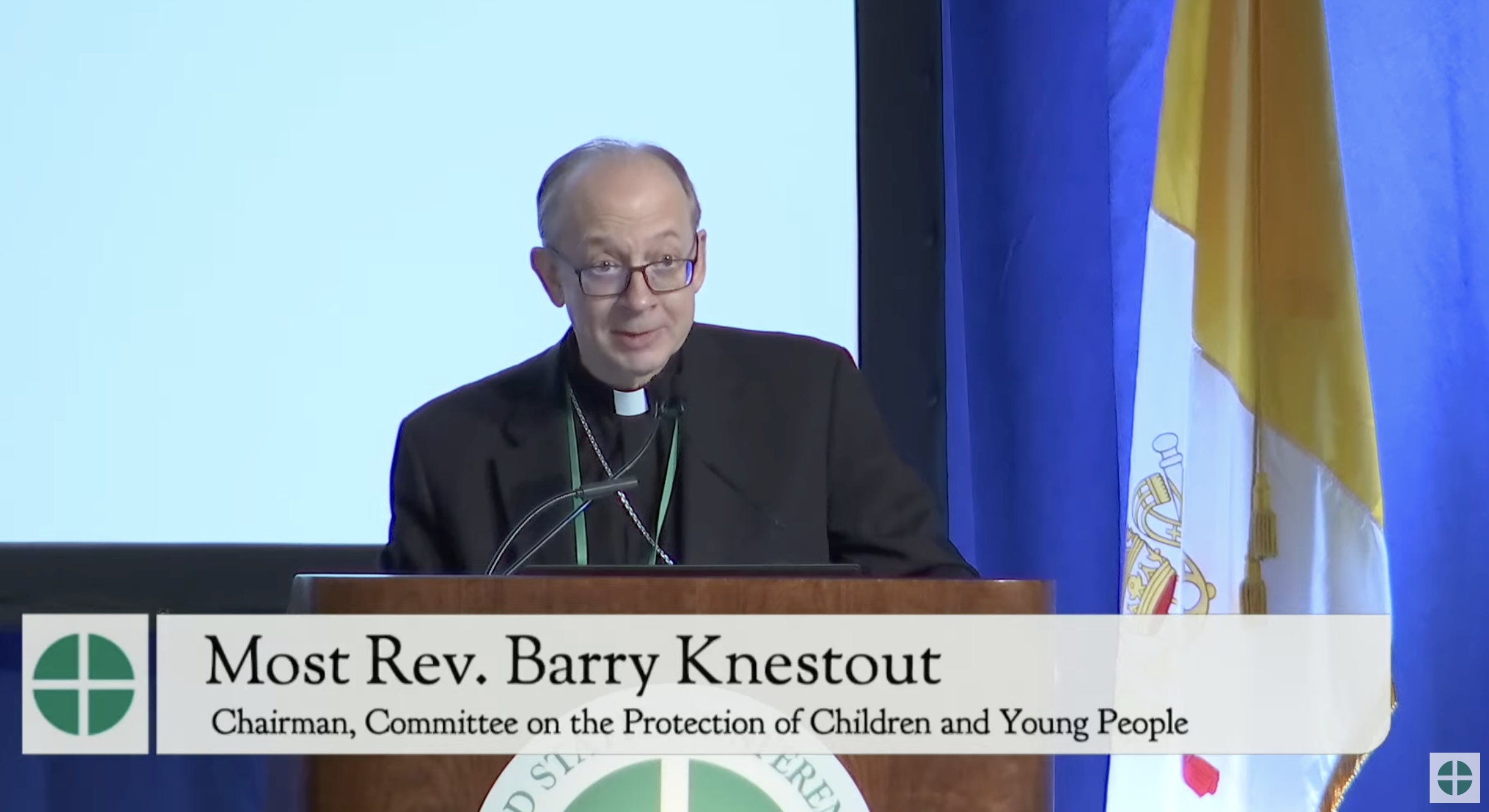
The revised charter offers changes and additions but maintains the focus of the original document “to address with transparency and accountability accusations of abuse committed by clergy,” said Bishop Barry Knestout of Richmond, Virginia, chair of the Committee on the Protection of Children and Young People, at the meeting.
The revision process began in 2021 and was done in collaboration with USCCB Committees on the Protection of Children and Young People; Canonical Affairs and Church Governance; Clergy, Consecrated Life, and Vocations; the Office of the General Counsel; and the National Review Board.
The new document offers a glossary “in response to repeated requests from dioceses on having more consistent definitions of various terms,” Knestout said.
“Among the influences drawn from the revisions of Book VI of the Code of Canon Law is the integration of the right of an accused to the presumption of innocence,” and “among the Vos Estis Lux Mundi general provisions is the identification of mandatory Church reporters to complement mandatory reporting to civil authorities,” he said.
The revised version also includes a “clear allowance for electronic letters of suitability” and “an added reference to the protection of information under the seal of the sacrament of penance,” Knestout said.
To ensure the charter focuses on abuse of minors, the Committee on Clergy, Consecrated Life, and Vocations will develop a separate document from the charter that will focus on standards of behavior for both clergy and laity with adults, including vulnerable adults.
Vote invites debate among bishops
Prior to voting, the bishops discussed and debated the topic. Some of the bishops inquired about the language within the document and offered proposed changes.
During the discussion, Archbishop Shawn McKnight of Kansas City, Kansas, proposed the bishops “postpone [the] vote until the next meeting,” which will be held in November. Bishop Earl Fernandes of Columbus, Ohio, seconded the motion as the bishops will not “lose very much by delaying” and to ensure his presbyteral council is “sufficiently consulted.”
In response to the bishops in favor of the postponement, Knestout said that “there has been quite a bit of consultation already.” He added: “I am not sure whatʼs gained through the additional time, other than … an opportunity for some dioceses and presbyterates to look at this again.”
Ultimately the majority voted not to postpone the vote. The bishops then approved the revised charter, with 176 voting yes, 22 voting no, and six abstaining.
Bishops react to approval of charter
“Iʼm coming towards the conclusion of my own term as the chair. I inherited the [charter] process and I wanted to make sure it was concluded,” Knestout told EWTN News following the vote.
“This was … our best effort to make sure it was adapted to some of the developments and circumstances of the present,” he said. “So it can function as the guide for our ongoing work in caring for and making sure that we are providing safeguarding for children and young people within our diocese and do it in a good way that is respectful of the role of priests.”
As the bishops revised the document, it was “necessary for us to do two things as bishops,” Knestout said.
“One is to express our love for, our care for those who are victim survivors, and for all those whoʼve been injured or wounded because of the abuse issue or the crisis, and to assure them that … with both transparency and accountability, [we] will address the issue and continue to do so in a vigilant way.”
It was also to reflect updates “from the developments that have occurred with canon law over the last eight years to also express in a tangible way our concern for our priests and for their needs” and “to address issues of due process and presumed innocence.”
It “tries to do both in a way thatʼs balanced and thatʼs authentic but is consistent and addresses the issue of the crisis in a way that will bring trust and healing over time,” he said.
While the charter was under review, the Committee on Canonical Affairs and Church Governance “wanted to keep clarity … that the charter is for protection of children and young people,” Bishop Thomas Paprocki of Springfield, Illinois, chair of the Committee on Canonical Affairs and Church Governance, told EWTN News.
“I think it has worked well over the last 25 years” and “I think these amendments that we had and the changes will be for the better,” he said.
“There were voices, and continue to be voices, that wanted to expand that to include other areas of misconduct, misconduct by bishops, or misconduct by priests with adults,” but there “are other avenues … for doing that,” Paprocki said.
“By not including vulnerable adults in the charter does not say that we donʼt think itʼs important,” but “it should be an entirely separate process, and in my experience it has been good to have that as a separate process.”
“I would also point out that there are some things already in existence,” he said. He detailed Pope Francis’ 2016 moto proprio As a Loving Mother, which “provides for the removal of bishops for different kinds of misconduct,” and Vos Estis Lux Mundi.
In contrast, McKnight told “EWTN News In Depth” it is “a missed opportunity” that the revised charter does not address the abuse of adults, abuses of power, and episcopal misconduct or cover-ups.
McKnight explained that he has previously “made a full proposal” that the bishops “consider not revising the charter but to honor it as an historical document written for its time period.”
“My proposal is that we have an integrated statement of moral commitment, like the charter, that would honor it but be organically related to it” and “encompass these other things that are just as pressing of an issue for our ecclesial life,” he said.
The bishops voting to not postpone the vote was also “a missed opportunity for us to exercise a bit more the approach that our Holy Father, Pope Leo, is asking us to do as bishops,” he said.
While “there has been extensive consultation over several years by conference leadership, the bishops as a body have not been involved in that other than four years ago was the last time we were consulted,” McKnight said.
“So my feeling was that … we should have the opportunity to take and solicit feedback from our own clergy and our own laypeople, and to work more collaboratively and in a spirit of co-responsibility,” he said.
Next steps
Going forward, “the administrative committee has asked the Committee for Clergy Consecrated Life and Vocations … [to] take up the next step of looking at issues of sexual misconduct with adults and with vulnerable adults,” Archbishop Ronald Hicks of New York, chair of the Committee for Clergy, Consecrated Life, and Vocations, told EWTN News.
“Weʼve accepted that as the committee, and we are going to start the work on producing such a document,” he said.
“As we do so … we are going to collaborate with all of the other agencies and those who are involved with sexual misconduct on how we respond as the USCCB within the Church,” Hicks said.
Having separate documents addressing different areas of abuse “is making sure that issues stay in their lane properly,” Hicks said.
The charter looks “at issues of children, minors, preventing abuse, protecting children, and also the accompaniment of victim survivors,” he said. “Then thereʼs opportunities for continued conversation of ‘What does abuse and sexual misconduct look like with adults or vulnerable adults?’”
“Let another document address that so that we are properly making sure we attend to the original outset of what the charter was meant for, which is the protection of children, the prevention of abuse, and the accompaniment of victim survivors,” Hicks said.