
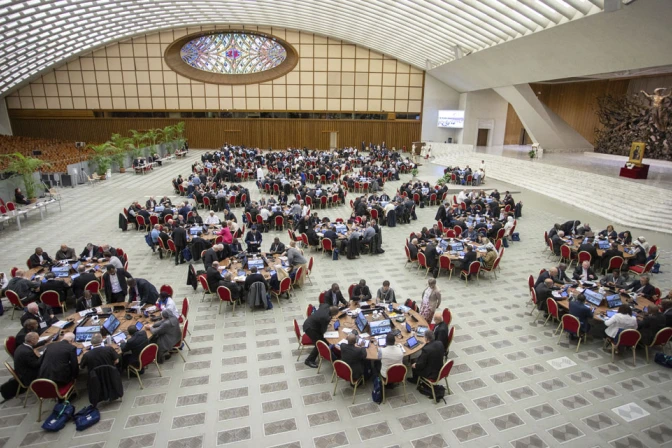
A final report from the Synod on Synodality study group on “mission in the digital environment” proposes the possible creation of a dedicated Vatican body to accompany and oversee the theological, pastoral, and canonical challenges that arise online.
The digital mission group is one of 10 study groups established by Pope Francis in 2024 at the conclusion of the first session of the Synod on Synodality, tasked with further examining issues seen as important to the Church’s mission through a synodal lens.
Among its recommendations, the report suggests forming a “Pontifical Commission for Digital Culture and New Technologies” — or an equivalent office or department — that would monitor emerging questions in the digital world; prepare documents, guidelines, and practical handbooks; develop tailored formation strategies for bishops, priests, religious, and laypeople; and support bishops’ conferences as they incorporate digital mission into pastoral planning.
The report emphasizes that these are proposals still subject to further study and discernment, not decisions already taken.
Ethical risks and polarization
The group also highlights ethical risks associated with digital platforms. The report says many participants in an international consultation pointed to the misuse of online platforms for polarization, manipulation, or the spread of false information as a significant challenge for ecclesial life and evangelization.
It specifically urges bishops’ conferences and diocesan digital teams to recognize ethical risks and the potential for polarization — a dynamic the report says often appears to be embedded in social media platforms themselves.
Abuse, doctrinal drift, and algorithmic pressures
The report cautions that those engaged in digital evangelization should be alert to possible abuses of authority, doctrinal drift, sensationalism, and manipulation. It notes that online environments can intensify ideological postures, oversimplify complex debates, and encourage confrontations that weaken ecclesial communion.
It also argues that major platforms “are not neutral,” because algorithm-driven systems can hinder the spread of positive messages while amplifying controversial or divisive content.
Rethinking jurisdiction in a digital culture
A central question raised by the report is how the Church should live its mission in a culture increasingly shaped by digital life. Drawing on a broad consultation involving pastoral workers, experts, and Church realities from across continents, the group gathered experiences, analyzed challenges, and proposed practical recommendations.
One key theme is the need to integrate digital mission into the Church’s ordinary structures rather than treating it as a marginal or parallel activity. The report also calls for deeper reflection on territorial jurisdiction in light of online communities and for stronger formation of pastors and pastoral workers in digital culture.
Possible canonical adaptations
One of the report’s most significant areas of reflection concerns whether the traditional concept of ecclesial jurisdiction — typically tied to geographic territory — may require adaptation to address “supraterritorial” digital realities.
It encourages competent Vatican offices to study and discern possible canonical adaptations, suggesting that the Church’s engagement in digital culture could eventually require some form of non-territorial organization shaped by pastoral relationships rooted in accompaniment.
Formation and spiritual accompaniment
The report proposes differentiated formation strategies based on ecclesial roles, with comprehensive preparation grounded in theology, pastoral ministry, communication, and digital culture — including “training of trainers” models.
It also recommends strengthening spiritual accompaniment and formation for so-called “digital missionaries,” emphasizing discernment and mission, and developing stable structures for spiritual direction and pastoral support. The report adds that digital safety and well-being, along with media literacy, should be more structurally integrated into Catholic education and seminary formation.
The proposals, the report reiterates, are intended as open-ended orientations for further study and discernment, as the Church continues to ask what changes digital culture may require of pastoral approaches historically shaped by territorial boundaries.
This story was first published by ACI Prensa, the Spanish-language sister service of EWTN News. It has been translated and adapted by EWTN News English.