
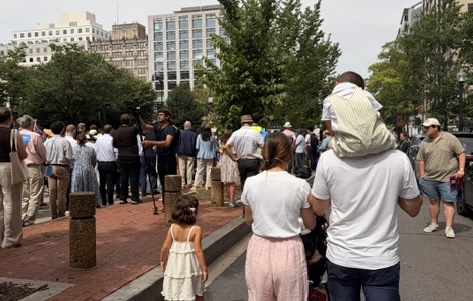
Along K Street in Washington, D.C., amid a humid morning on June 6, Catholics from across the area gathered to adore the Eucharist as it processed through the nationʼs capital.
Despite the heat and humidity, many parents and grandparents packed their little ones into strollers or baby carriers and brought them out to view the Eucharistic pilgrimage as it made its way through D.C. The local procession was a partnership between the Catholic Information Center and the National Eucharistic Pilgrimage.
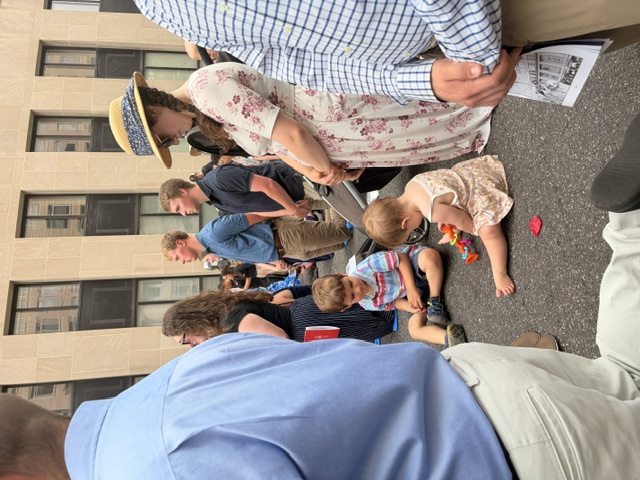
“I really like taking my kids to the Eucharistic processions for Corpus Christi,” Theresa Cambell said while pushing Augustine, three years old, and Rowena, nine months, in a stroller in the procession. “I think practical things really help them understand the significance of what is going on.”
Campbell, who lives in the Capitol Hill neighborhood, took her children to the Catholic Information Center procession last year. Though she wasn’t raised going to processions or adoration regularly with her family, Campbell said the tradition was important to her as she raises her own children so that they can better come to understand the Church.
A big part of this, she said, was her own active participation.
“Children have a very natural orientation towards liturgy, and I think that the reverence that everyone has in the tradition actually does most of the teaching,” Cambell said. “And then, you know, we do explain that it is the body and blood of Christ and that the procession is for Corpus Christi, and we try to tie that into the liturgical year.”
Maria and Pedro Estrada of Reston, Virginia, practice similar worship habits with their four children. The couple moved to the United States from Argentina six years ago and grew up attending similar events with their families.
Estrada said she and her husband take their children to adoration regularly and practice family prayer to get them interested in Jesus and the Church.
“At home, we pray a lot,” Estrada explained. “We pray the rosary in front of our kids, and they see us and they try to imitate us. They’re very interested in Jesus and His love for us, and we explain that all the things we have, and the way we are, is because of Jesus, and because He loves us. And it’s nice to Him that we, you know, give Him some of the love He gave us.”
Julie Enzler of Alexandria, Virginia, helped take her 15-month-old granddaughter through the procession while her daughter volunteered with the Catholic Information Center.
“What I appreciate about the procession through the city is the witness that we can give to the whole world of our Eucharistic Lord present in the midst of us, and to bring the power of his love to the streets,” Enzler said. “It’s something we try to do in person every day, hopefully, but just to make Him present in the lives of people who wouldn’t necessarily find Him.”
Enzler said that all her grandchildren are being raised in the Catholic Church and attending Corpus Christi processions, even though she herself did not growing up. This, she hopes, will help them to orient their lives toward God.
Enzler said she knows how valuable it is to bring Christ with you wherever you go, whether that be spiritually or in actuality.
“Because the Church is the body of Christ, we all need each other,” Enzler explained. “We all need the witness of new life in the body. And the children need the witness of adults doing things that might be uncomfortable.”
“For old people, it’s uncomfortable on your knees,” she continued. “And for other ages, maybe it’s uncomfortable to be seen practicing your faith or witnessing to your faith in the Eucharist, which is something that’s not obvious without faith.”
Enzler said that she feels the United States is poised to accept Christ at this moment, and that showing the next generation of Catholics what faithful adoration looks like can help spread this.
“I’m really grateful to the [Catholic Information Center] for offering this opportunity and for the word of hope that this event brings to the streets of Washington, D.C. at a time where the country seems particularly open to the practice of faith and the witness of faith,” she said.
“I know there’s a lot of prayers begging more and more graces, so I’m grateful,” she said. “There’s always the grace that we can count on, but we can’t see or quantify.”