
Many U.S. dioceses are expecting heavy increases in people joining the Catholic Church at Easter 2026, including some with record highs, a survey by the National Catholic Register, the sister partner of EWTN News, found.
“Something’s happening,” said John Helsey, director of communications for the Archdiocese of Oklahoma City, which is expecting a 57% increase in unbaptized people becoming Catholics at Easter — from 635 in 2025 to nearly 1,000 in 2026.
In most places, this year’s increases aren’t a one-off but follow significant increases in recent years.
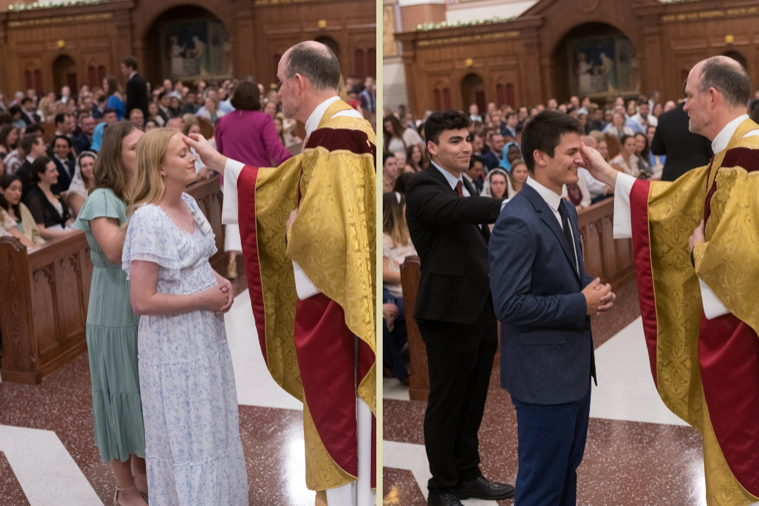
One example is the Archdiocese of Newark, New Jersey, which had record highs attending liturgies several weeks ago that were meant to welcome would-be converts who have been preparing to enter the Church in recent months and to formalize their status.
Newark is expecting a 30% jump in converts in 2026 (at 1,701) over 2025 (at 1,305). The 2026 figure is 60% higher than the 1,064 converts in 2019, the year before the COVID-19 pandemic.
In the Archdiocese of Mobile, Alabama, the number of converts in 2025 (447) was the highest since at least 2014, and the number in 2026 (603) is 35% higher than in 2025.
The Register recently contacted all 175 Latin-rite territorial dioceses in the United States, seeking numbers of people planning to join the Catholic Church at Easter 2026.
Seventy-one, or 40% of U.S. dioceses, responded. In some cases, the Register used published sources to supplement the data it used in its analysis. In all cases, the Register attempted to make apples-to-apples comparisons, with the caveat that 2026 numbers aren’t set yet.
Just five of the 71 dioceses expected a drop in converts this year, most of them slight. The remaining 66 are expecting increases — in many cases, significant ones.
This year’s expected increases in converts in the United States include regions where the Church has been growing rapidly in recent decades, such as Florida, where the Diocese of St. Petersburg is expecting an 84% jump, and Texas, where the Diocese of Austin is expecting a 53% jump.
But it also includes highly secularized New England, where the Archdiocese of Boston has 55% more catechumens (unbaptized) this year than last year. The Diocese of Manchester, New Hampshire, reported a 54% increase (including already-baptized and unbaptized); the Diocese of Providence has 76% more converts; and the Diocese of Norwich, Connecticut, is recording a 112% spike.
In Pennsylvania, the dioceses of Harrisburg (77%) and Altoona-Johnstown (84%) are seeing big increases. Across the country, the Diocese of Pueblo, Colorado, is expecting a 105% increase.
In the Archdiocese of Philadelphia, which is expecting a 60% increase in converts in 2026 over last year, a priest who oversees conversion programs said people seeking to join the Catholic Church tend to come to Mass and have an active prayer life before they ever attend formal sessions with catechists and that they tend to accept Church teachings earlier in the process than their predecessors did.
“I have noticed over the last several years that there is a greater commitment to conversion, a greater commitment to the Church, when they arrive,” said Father Dennis Gill, director of the Office for Divine Worship for the Archdiocese of Philadelphia and rector of the Cathedral Basilica of Sts. Peter and Paul.
Other factors
As for why it’s happening, diocesan officials offered various theories.
Immigration, particularly from the surge during the Biden administration, is a factor in some places. Some suggest the election in May 2025 of Pope Leo XIV, the first American pope, who describes Church teachings with a native accent unfiltered by translation, might also be a draw for some non-Catholics. Some diocesan officials shared a new emphasis on outreach to non-Catholics.
Bishop Frank Dewane, who leads the Diocese of Venice, Florida, which is expecting a 94% increase in converts, noted that some places outside the United States are also seeing big increases this year, including England and France.
He told the Register the Church is enjoying what he called “a golden age of Catholic resources,” including podcasts and other online sources that get information about the Church to people who would ordinarily never set foot in it and yet come to find Catholicism unexpectedly attractive.
“Our modern culture has not borne good fruits, and I think people see that. They recognize that. They know that,” Dewane said.
But ultimately, he and other Church officials the Register spoke with attributed the bountiful harvest to God.
“It’s the Holy Spirit,” Dewane emphasized. “Yes, we follow promptings, also. But I think it’s the work of the Holy Spirit right now in society and in the Church.”
This story was first published by the National Catholic Register, the sister partner of EWTN News, and has been adapted by EWTN News.