


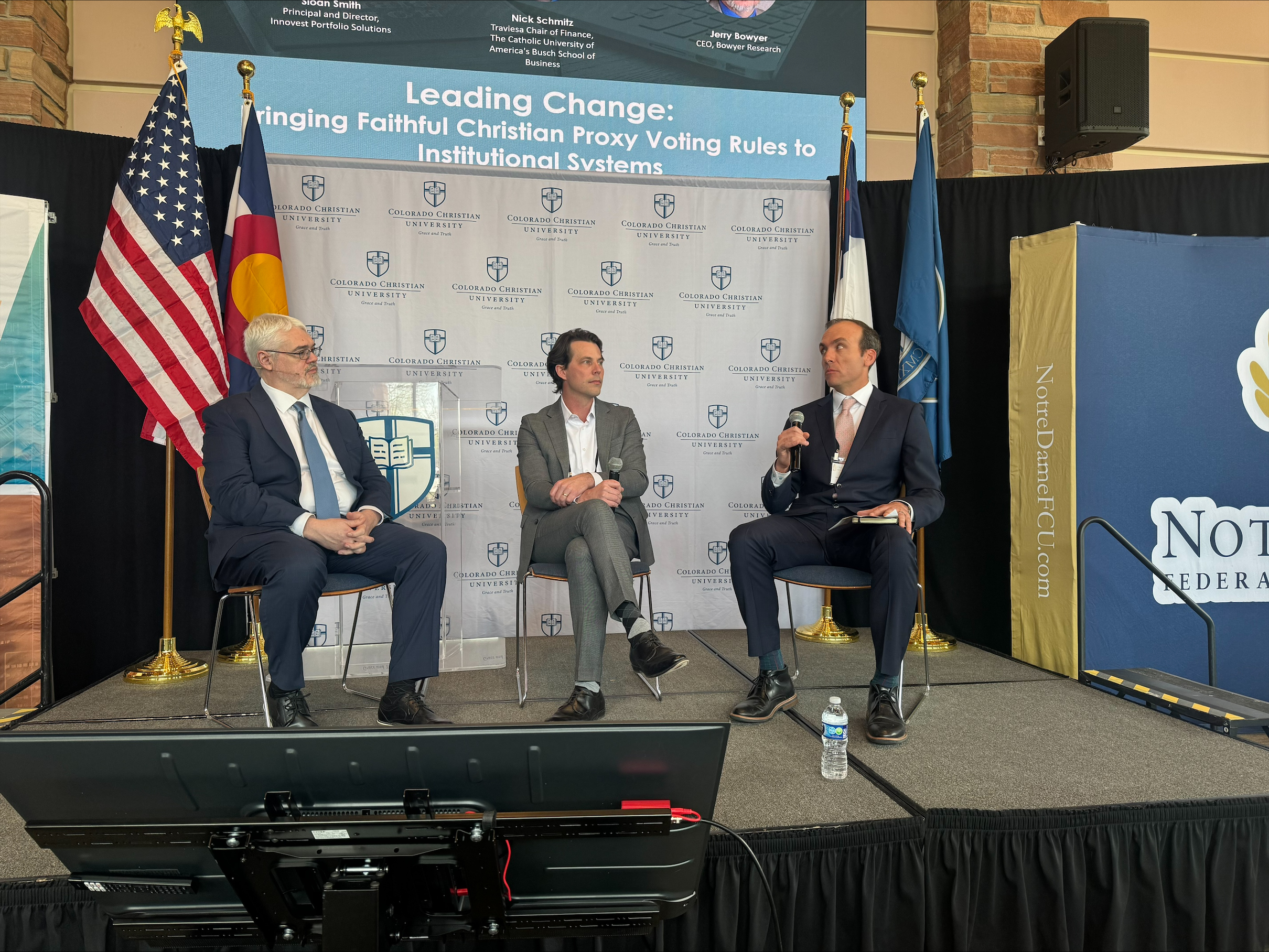
Remembering “the lordship of Christ is over everything,” Catholic and Protestant leaders are prioritizing ethical investing by making their voices heard as shareholders.
At the 2026 Christian Institutional Investors conference in Lakewood, Colorado, on April 8, speakers urged Christian businesses, schools, and apostolates to stand up for their beliefs as investors.
More than 150 attendees from across the country attended the conference, which was hosted by the faith-based investment consulting company Innovest Portfolio Solutions along with the Archdiocese of Denver, Catholic Benefits Association, The Catholic Foundation of Northern Colorado, AmPhil, Alliance Defending Freedom, and Colorado Christian University, where the event took place.
“This ecumenical gathering brings together Catholic and Protestant leaders to explore portfolio screening, values alignment with asset managers, and the importance of proxy voting and corporate engagement,” Innovest spokesperson Sarah Newman said.
“Our goal is for attendees to leave informed, inspired, and equipped to better understand how their portfolios are built and why the partners they choose truly matter to create returns they need for their Christian mission,” Newman told EWTN News.
Fighting for Christian values through proxy voting
In the fight to bring Christian values into investing, speakers emphasized the importance of proxy voting — a process where shareholders authorize someone else to vote on their behalf in shareholder meetings.
“As a shareholder, youʼre sort of a citizen of a company and are entitled to vote on these matters — but most people donʼt realize that their proxies are being delegated to an adviser and unintentionally support things that are opposed to their own values,” speaker Dustin DeVito said.
DeVito is a research director at the 1792 Exchange, a company working to bring “ideological balance back to public corporations.”
Nicholas Schmitz, the Traviesa chair of finance at The Catholic University of America’s Busch School of Business, noted that Christian investors “need a custom proxy option that actually represents Christian viewpoints” to have a cumulative, widespread impact across corporate America.
Custom proxy options enable institutions to vote according to their own guidelines rather than the default options.
“That would be a huge, huge uptake that would get long-term cultural change,” Schmitz said in a panel titled “Leading Change: Bringing Faithful Christian Proxy Voting Rules to Institutional Systems.”
In November, The Catholic University of America developed new proxy guidelines that leading companies representing shareholders accepted — giving a faith-based option in line with the Catholic Churchʼs teachings.
“Catholicism … I joke, weʼre the most organized religion in America, but the least organized in capital markets. We donʼt really have an excuse for not getting this right,” Schmitz said.
In his talk, “The Post-ESG Landscape: Where Corporate America Is Headed and How Faith-Aligned Capital Can Lead,” DeVito also encouraged Christian investors to stand up for their faith.

“As Christians, we want to be the ones boldly leading because the lordship of Christ is over everything,” DeVito said. “So if thereʼs any issue in which companies are engaging in something thatʼs biased and thatʼs harming Christians, we need to be willing to have the courage and put ourselves out there and engage on the issue.”
As an example, DeVito cited the debanking of Christians and conservatives. In 2025, President Donald Trump signed an executive order prohibiting banks and financial institutions from debanking clients based on their political or religious views after Christians and conservatives expressed concern about the controversial practice.
“Even just with a small amount of shares and the willingness to engage these companies and to talk through the research, we end up seeing incredible wins,” DeVito continued. “All it takes is just some people willing to fight.”
In his research at 1792, DeVito said he has seen a trend away from DEI (diversity, equity, and inclusion) initiatives and “ESG” (environmental, social, and governance) — politically-motivated standards that large companies subscribed to but that recently fell out of favor after criticism from conservatives.
DeVito pointed to the work of Robby Starbuck, an influencer known for raising awareness of DEI policies at companies like Tractor Supply, as well as the Trump administration as defining moments in the decline of DEI and ESG.
“For the first time in over 20 years, corporate America is headed back in the direction of depoliticizing and focusing on business,” DeVito said. “And this is good because the companies are supported for the value they bring in, the goods and services they provide, not for identifying and solving all the worldʼs problems.”