
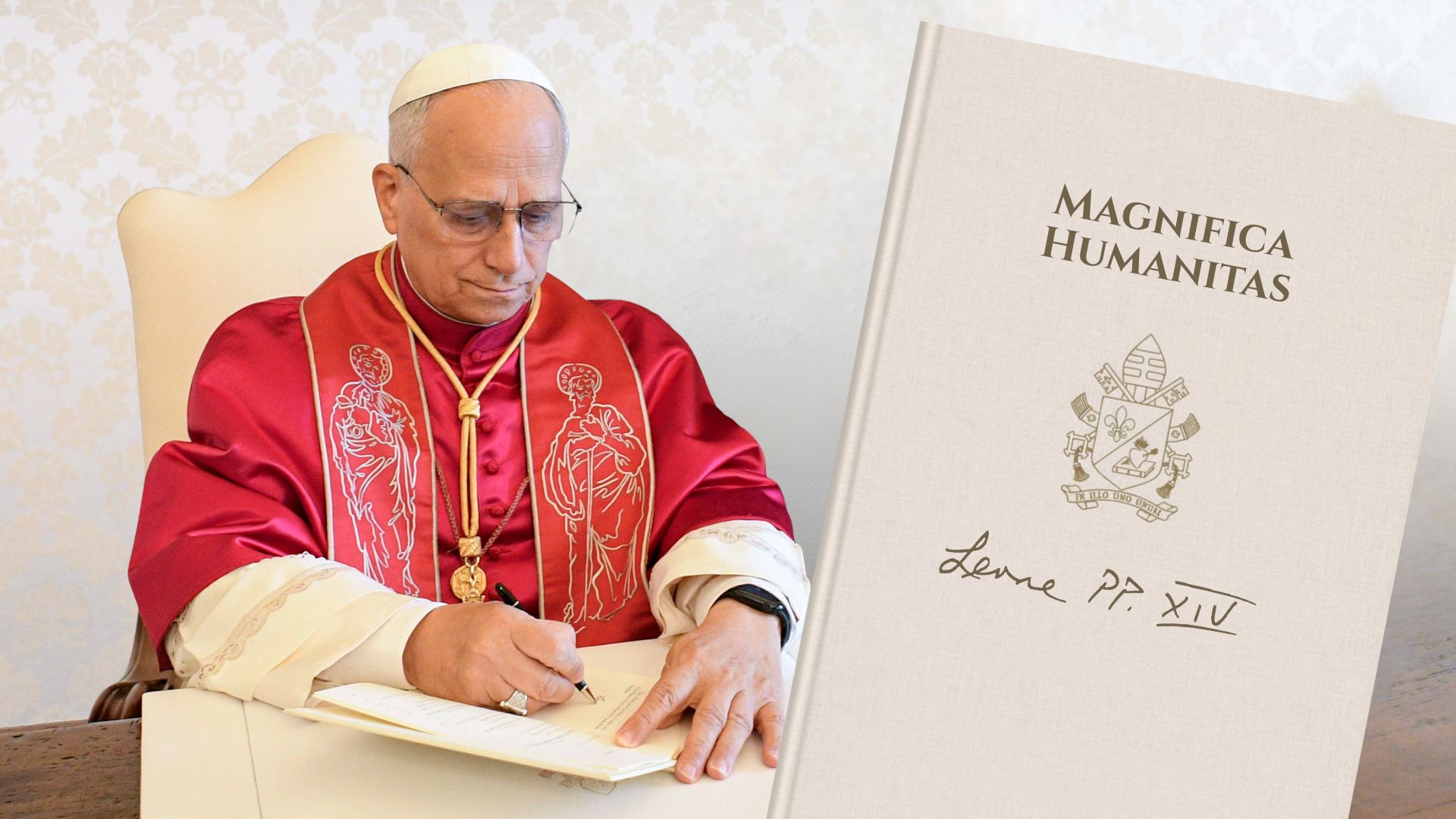
In his encyclical Magnifica Humanitas, published Monday, Pope Leo XIV calls on society and AI developers to implement “shared standards of social justice” in order for artificial intelligence to respect human dignity and serve the common good.
AI is not a morally neutral tool; It matters not only how it is used, but how it is designed, Leo writes in “Magnifica Humanitas: On Safeguarding the Human Person in the Time of Artificial Intelligence,” published May 25. Magnifica Humanitas means “Magnificent Humanity” in Latin.
He also warns that “a more moral AI is not enough if that morality is determined by a few … In fact, as with every major technological shift, AI tends to amplify the power of those who already possess economic resources, expertise and access to data.”
The first encyclical letter of Leo XIV covers a wide range of social issues, focusing heavily on the impacts of AI in the areas of education, the economy, unemployment, work, the development of young people, human trafficking and war.
He proposes the principles of Catholic Social Doctrine — the dignity of the person, the common good, the universal destination of goods, subsidiarity, solidarity and justice — as guidelines for decision-making and the “criteria for judging whether technologies truly serve humanity or are subjugating it.”
While rejecting dichotomous thinking that pits the opportunities of AI against its risks, or enthusiasm against fear, Leo offers a stark assessment of the technological paradigm the world finds itself in today and describes a path of progress that serves people “or a progress that subjects them to the mentality of power.”
“The risk extends beyond the misuse of certain technologies. More gravely, the pervasive technocratic paradigm in which we are immersed, and that is amplified by the digital revolution and AI, threatens to normalize an anti-human vision,” he writes.
Leo borrows the term, “technocratic paradigm,” from Pope Francis’ 2015 encyclical Laudato Si’, in which, Leo writes, Francis critiqued a paradigm “that seeks to reduce everything to an object to be dominated.”
In that anti-human vision, he continues, “the fullness of life is equated with having more, reducing weakness, eliminating uncertainty and exerting total control. When efficiency becomes the ultimate measure of value, human beings are tempted to see themselves as a project to be optimized rather than as persons called to relationship and communion.”
According to Pope Leo, the central question — safeguarding our humanity — is something everyone should have a role in answering.
He invokes one of his spiritual guides, St. Augustine of Hippo, quoting from “De Civitate Dei” (“The City of God”): “‘Two loves have built two cities: the earthly city, the love of self even to the contempt of God; the heavenly city, the love of God even to the contempt of self.’ As throughout history, these two loves continue to contend for dominance in our hearts today.”
From Catholic Social Doctrine to the fight for power
The encyclical’s 245 paragraphs are broken down into an introduction and five chapters, with the first two dedicated to an explanation of the development of the Church’s Social Doctrine from Pope Leo XIII to today, the main principles of that doctrine, and how they can be applied to the current technological age.
Chapter three introduces “the technocratic paradigm” of artificial intelligence and the imbalance of digital power.
Chapter four turns to the importance of safeguarding truth, democracy, work, education, and human freedom in the age of AI, while the fifth chapter is dedicated to an analysis of the normalization of war, the fight for power, and how everyone has a responsibility to help build a civilization of love through the cultivation of peace and justice.
Throughout the encyclical, Leo draws on the image of construction to ask how humanity will respond to the new technological age. Humanity, he says, must choose between building the Tower of Babel (Genesis 11:1-9) and building a city where God and humanity can dwell together, as Nehemiah gathered together people to rebuild the walls of Jerusalem after the Babylonian exile (Nehemiah 2-6).
“In light of these two images, the Holy Spirit challenges us today regarding our relationship with technology and the ongoing digital revolution,” he writes. “Technology has the power to heal, connect, educate and protect our common home; but it can also divide, exclude and generate new forms of injustice.”
Pope Leo XIV draws on quotations from prominent 19th and 20th-century thinkers, both Catholic and Jewish, including St. John Paul II, Victor Frankl, Hannah Arendt, J.R.R. Tolkien, Giorgio La Pira, and Fr. Romano Guardini, to argue that while technology is not a solution in itself to humanity’s problems, nor is it inherently evil.
“In practice, however, technology is never neutral, because it takes on the characteristics of those who devise it, finance it, regulate it and use it,” he writes.
The choice, he continues, is not between a “yes” or “no” to technology, but “between constructing Babel or rebuilding Jerusalem; between a power that claims to dominate the heavens and a people who work together in the presence of God to rebuild the walls of fraternal coexistence.”
Frequently cited sources for the encyclical letter include Pope Benedict XVI’s encyclical Caritas in Veritate and the Compendium of the Social Doctrine of the Church.
Writing that he does not wish to give a comprehensive overview of AI, the pope points readers to previous writings by the Church on AI, in particular, the 2025 note Antiqua et Nova by the Dicastery for the Doctrine of the Faith and the Dicastery for Culture and Education and Quo Vadis, Humanitas? published earlier this year by the International Theological Commission — both of which are cited often in the footnotes of Magnifica Humanitas.
Christian humanism and the technocratic paradigm
The pope writes about the mindsets of transhumanism and posthumanism and how they are the ideological vision underlying technology.
He proposes a Christian humanism, where human beings “are not confined by the boundaries of their own nature; rather, they are called to self-transcendence, not through an escape from reality or a contempt for their limitations, but through their fulfillment in love.”
In Magnifica Humanitas, the Holy Father also expresses concern about the “new monopolies of AI.”
“To speak of the common good means exposing this new form of epistemic, economic, and political asymmetry,” he writes.
The key question, he says, is that posed by Saint John Paul II: Does AI “make human life on earth ‘more human’ in every aspect of that life? Does it make it more worthy of man?’”
Leo writes that “a decisive test for the ethical discernment of AI and digital transformation” is in the fight against new forms of slavery, such as human trafficking. The pontiff goes on to “sincerely ask for pardon,” in the name of the Church, for the “immense suffering and humiliation endured by so many” before slavery was unequivocally condemned in the 19th century.
“This development offers a clear example of the Church’s growth in understanding the perennial truths of Revelation that she safeguards. Although there was not always consistency in practice,” he writes, “there has been a continuous affirmation throughout history of the dignity of every human being, created in the image of God, even if it took eighteen centuries for its full incompatibility with slavery to be explicitly recognized.”
The memory of past blindness and complicity regarding the injustice of slavery is “a call to vigilance,” the pope says. “What we have learned must be translated into discernment and responsibility in the present.”
‘A violent culture of power’
A large section of the pope’s letter is devoted to what he writes is, “a troubling revival of war as an instrument of international politics,” AI use in warfare, a crisis in multilateralism, and the erosion of ethical principles that used to limit war.
“Humanity is slipping into a violent culture of power,” he warns. “Today, more than ever, without prejudice to the right to self-defense in the strictest sense, it is important to reaffirm that the ‘just war’ theory which has all too often been used to justify any kind of war, is now outdated. Humanity possesses far more effective and capable tools for promoting human life and resolving conflicts, such as dialogue, diplomacy and forgiveness.”
“The modern Babel can be seen not only in the globalized technocratic paradigm, but also in the remote clash between opposing imperialisms, between powers that wish to preserve their supremacy, and those that aspire to seize that supremacy, resulting in a multiplicity of local conflicts. Moreover, there seems to be no limit to the race — driven by a dehumanizing ambition — to develop evermore powerful technologies or to secure control over them,” Pope Leo writes.
But the pontiff does not conclude on a negative note. He adds that, “despite this downward spiral, we can also glimpse a great part of humanity that is striving to remain human and working to build the holy city of coexistence and peace.”
Concluding the document, he expresses the hope that, “In the humble fidelity of daily life, even the era of AI can become a time in which the Holy Spirit brings about the civilization of love in our lives.”
“Indeed, the Lord continues to make all things new and offers every era the possibility of becoming part of salvation history in the light of the Incarnation.”