
Pope Leo XIV issued stark warnings against building “a new Tower of Babel” when developing artificial intelligence (AI) in his recently released encyclical Magnifica Humanitas, at a time when many people are growing concerned with the impact of the new technology and the rapid data center expansion that supports it.
His encyclical, the title of which means “magnificent humanity,” pleads for AI development that safeguards Earth’s natural resources, preserves the dignity of work, builds up human solidarity, and does not concentrate power in the hands of a few but rather ensures all people benefit from the innovation.
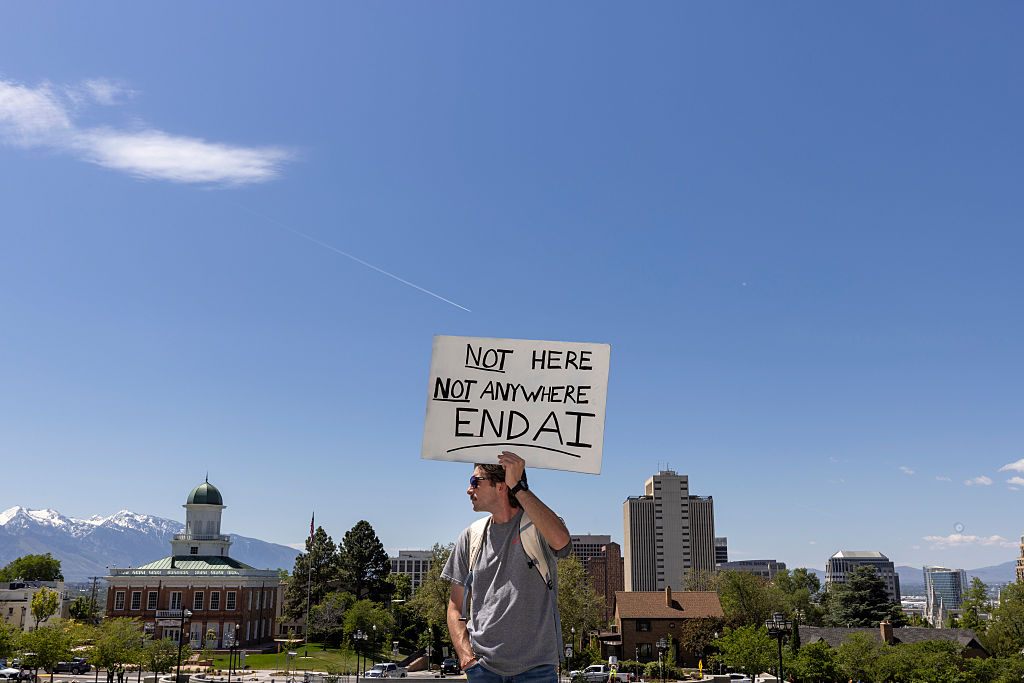
As American companies move fast to expand AI data centers — with over 4,000 operating and thousands more under construction — projects face local protests and critics cite environmental concerns, noise pollution, lack of long-term employment, and broader skepticism of AI’s impact on society.
Although a March Gallup poll of 1,000 Americans found 71% oppose local AI data centers and only 27% support them, Interior Secretary Doug Burgum promoted data center expansion on Fox Business on May 26, citing productivity benefits across many sectors of the economy.
The protests, he claimed, are “foreign-directed propaganda” campaigns from nations competing with the United States. He dismissed Leo’s guidance while laughing and said: “I didnʼt know that tech editorializing was part of the role of being pope.”
Yet AI skepticism is quite prominent among the American public. A June 2025 Pew survey of 5,000 people found 50% are more concerned than excited about AI, 38% are equally excited and concerned, and just 10% are more excited than concerned. An NBC poll of 1,000 people in March found that 57% believe the risks of AI outweigh the benefits and 34% said the opposite.
David Cloutier, a Notre Dame theology professor and academic director of the Business Ethics and Society Program, told EWTN News: “I think the resistance to data centers is rooted in a larger suspicion of the technology itself.”
“They are a really tempting symbolic target,” he said, adding that data centers “symbolize a future that is all computer and machine and no people.”
“I think people experience the arrival of this technology as something that they did not ask for and seems overwhelming to them,” Cloutier added.
Dignity of work and power concentration
Data centers often receive significant state and local tax incentives. At least 28 states offer tax incentives specific to data centers: Each waives certain sales tax, 14 offer energy subsidies, and 11 provide property tax reductions, according to the National Conference of State Legislatures.
In a small number of states with significant data center growth — such as Texas and Virginia — data centers are receiving more than $1 billion annually in tax incentives. Apart from temporary construction jobs, smaller data centers often employ fewer than 150 permanent workers, while larger ones may employ a few hundred.
Father Philip Larrey, a philosophy professor at Boston College, told EWTN News “it doesn’t make sense to me” to offer those incentives because “you don’t need many people to actually run these things.”
“What advantage is there for the local people to have a data center in their city?” he questioned. “Probably none.”
Cloutier noted the difference between incentives given to data centers and to factories, saying “the factory can only work if workers come to the factory,” but “data centers don’t employ people like factories do.”
“The question is a question about power and who controls these very important entities and whether they share the wealth that is generated by these entities,” he said, pointing to Leo’s concern about the centralization of power and dignity of work.
In the encyclical, Leo contrasted the Tower of Babel with the Book of Nehemiah, which details the construction of new walls for Jerusalem. The Holy Father said AI development should mirror the priorities outlined in that text: “Safeguarding humanity and the common good.”
Cloutier encouraged local government officials to question “Who’s truly being benefited by these developments?” and “Is this really benefiting my local community?” when considering projects.
“Listen to the community and ask questions of the company in ways that attempt to make the project more like Nehemiah building the wall,” he said.
The backlash to data centers also fuels concerns about AI replacing people in the workforce, with Cloutier noting “they’re enormous but empty of people.”
As the technology improves, Larrey expressed concern about the long-term impact on the labor force, saying it will be hard to convince a company to hire a person if it can achieve “the same result from an AI that you get from a human being and they cost almost nothing.” Yet, he urged employers to consider the human impact and encouraged employees to incorporate AI into their work if it can help prevent replacement.
“Just because you can replace a person with AI doesn’t mean that you should,” he said.
Judith McGill, marketing and content specialist for DataBank — a data center developer — and a practicing Catholic, told EWTN News that she believes critics’ objections about employment are misleading, because although the centers themselves do not employ “a lot of people,” the services benefit “all of the employees of our customers” who use AI.
She said governments would not offer incentives if investments were not “a net economic benefit to those communities.” Despite incentives, she said: “We pay taxes and, in fact, contribute to schools and roads.”
For example, McGill said DataBank aligns itself with the Organisation for Economic Co-operation and Development (OECD) guidelines for multinational enterprises, which prioritizes issues like labor rights and the environment.
“Our focus is on those organizations which are building technical skills for students entering the workforce and for teachers,” she said.
Environment and resources
In his encyclical, Leo warned of a “tendency to overlook the environmental impact” of AI and the “enormous amounts of energy and water” needed for data centers, which puts “heavy demands on natural resources” and influences carbon dioxide emissions.
A report from the Electric Power Research Institute found 4%-5% of national energy is consumed by data centers, but that will rise to somewhere between 9% and 17% by 2030, mostly because of AI. It could exceed 20% in seven states and be somewhere between 39% and 57% in Virginia. Many data centers use water to cool machines.
Cloutier said environmental concerns are “a very important point that is very easy to miss,” adding that “the amount of computer work that has to go on in order for the AI company to answer [a] question is very, very large.”
“The environmental impact is downstream from the way we use that technology,” he said, noting that if AI progresses to be “completely embedded in our lives,” it will exacerbate the concerns.
Larrey said water and energy are two concerns people have as data centers continue to be built: “They need huge data centers in order to run the servers that give us these large AI models that are only going to get larger and larger as time goes on.”
Larrey said innovation can ease concerns and cited OpenAI CEO Sam Altman’s investments in small nuclear reactors that could increase opportunities to employ clean energy. He referenced Nobel-Prize winning AlphaFold as well, developed by DeepMind, which significantly reduced the time and energy needed for AI protein structure prediction.
“You need massive data centers in order to keep up with the competition,” he said. “Now the companies have to come up with a way of making these more efficient and using less electricity. … It’s becoming a real problem for the companies because people are protesting, actually in the street.”
McGill, speaking for DataBank, said Leo’s environmental concerns and broader concerns are “well taken” and even though data center developers are not religious organizations, it “doesn’t absolve us from behaving responsibly.”
She said DataBank is experimenting with hydrogenated vegetable oil for power. The company also designs the data centers with a closed-loop water cooling system, which means the water is continuously recycled through the system rather than consuming additional water.
McGill added that “data centers pay for their power.” She acknowledged power consumption as a “legitimate concern” but criticized the narrative of the data center industry as “one big scary monster,” making them “the scapegoat” for higher consumption and rate hikes. She noted that inflation and foreign policy in the Middle East have a major effect on energy costs.
“What we are doing toward responsible behavior, toward human beings, and toward the environment is absolutely in line with the pope’s encyclical,” she said.
Amid growing protests and guidelines coming down from the Vatican, McGill said a parishioner at the parish she attends asked her how a Catholic could work for a data center company, but she said this incorrectly “implied there was a disconnection.”
“My conscience is clear,” she said. “This is an industry that is not just avoiding doing bad things but actively seeking out ways to do the right thing.”