
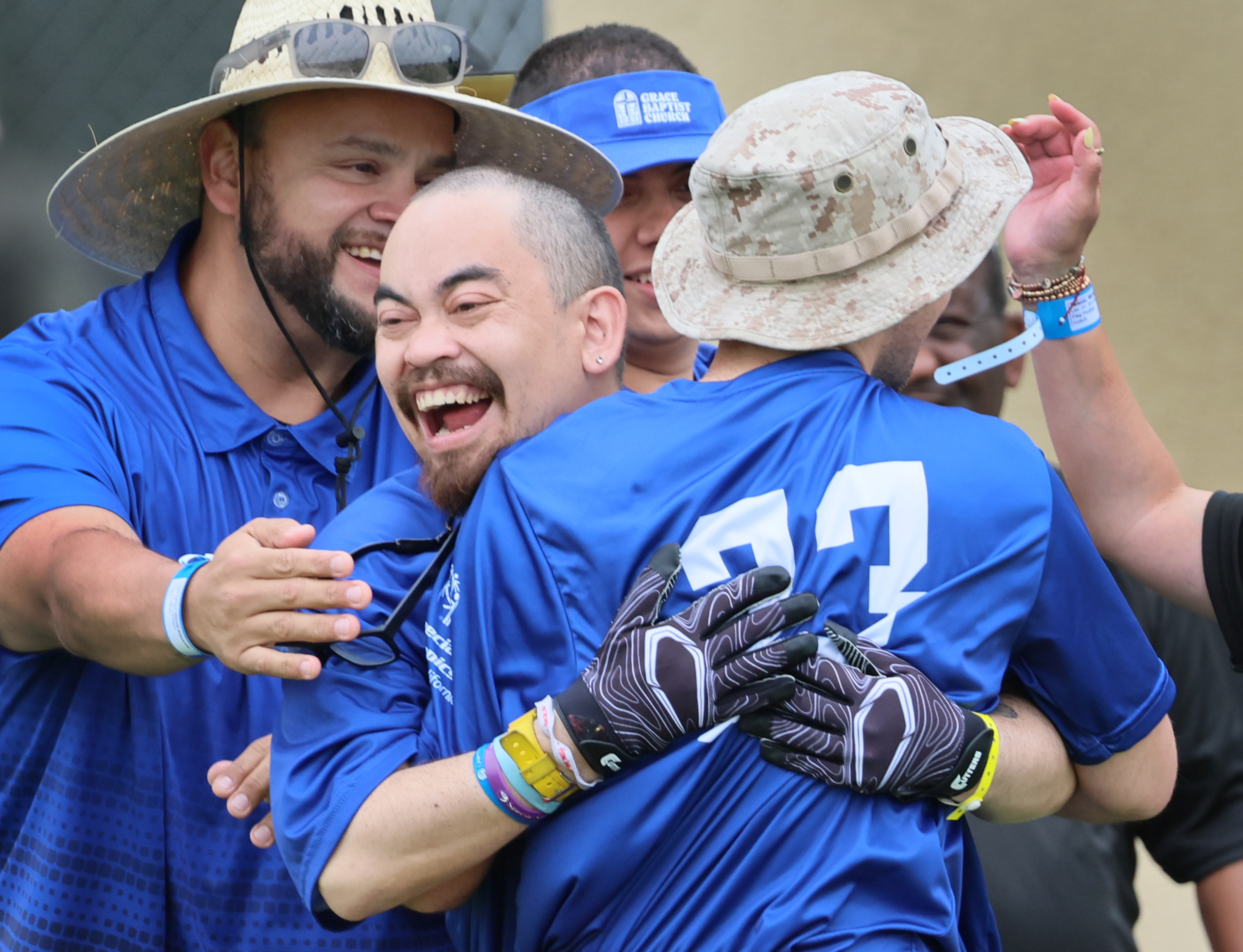
For decades, Special Olympics has provided sports training and athletic competition to help children and adults with intellectual disabilities develop physical fitness, demonstrate courage, and foster a sense of community among individuals both with and without disabilities.
March 21 marks World Down Syndrome Day, a global awareness day to advocate for the legal rights of people with Down syndrome and promote greater inclusion for people with the genetic condition, which can cause intellectual disabilities, developmental delays, distinct physical characteristics, and increased risks of certain health problems.
The day helps to draw attention to the nearly half a million Americans with Down syndrome and the 3,000 to 5,000 children who are born with the chromosome disorder every year.
To promote community among people with Down syndrome and other challenges, Special Olympics works to create opportunities to develop physical fitness, demonstrate courage, and experience joy.
Here are five facts you may not know about the global organization:
1. Special Olympics is active on every continent.
Special Olympics is the world’s largest sports organization for children and adults with intellectual disabilities with nearly 5 million Special Olympics athletes.
It has programs operating across the globe every day and holds the Special Olympics World Games every two years alternating between summer and winter. Anyone over the age of 8 with intellectual disabilities is eligible to compete.
Programs and training are present in all 50 U.S. states, the District of Columbia, and Puerto Rico. As of 2024, it was active in 177 countries spanning each continent.
From weight lifting to speed skating, the programs and games offer a diverse range of athletics with more more than 30 Olympic-style sports available. Soccer, basketball, and bocce are some of the most popular.
In 2022 alone, there were 46,000 Special Olympics sports competitions, averaging to 126 per day. About 16,000 of the competitions were Unified, meaning people with and without intellectual disabilities competed on the same teams.
2. The organization operates in tens of thousands of schools.
Special Olympics Unified Champion Schools program is active in nearly 11,000 schools in the U.S. It has trained youth leaders and educators to create more inclusive education systems by including students in all aspects of school life.
The program is aimed at promoting social inclusion through implemented activities in K–12 schools and across college campuses. Through the programming, young people with and without disabilities come together on sports teams, create student clubs, and foster youth leadership. As many as 19.5 million young people are taking part in the experiences.
3. The movement all started in a backyard.
The Special Olympics movement began in 1962 when its founder, Eunice Kennedy Shriver, hosted a summer camp in her backyard for kids with disabilities at her Maryland farm.
“Camp Shriver” was motivated by the unfair treatment of children with disabilities including Shriver’s sister, Rosemary Kennedy, who had an intellectual disability and loved sports.
Shriver reached out to schools and clinics in her area to find special-needs children who might be interested in her camp. She then recruited high school and college students to act as counselors, ending up with 34 children and 26 counselors.
The children swam, played soccer, shot baskets, and rode horses. Not only did the camp prove the kids could play sports, but it also helped the young counselors see the participants in another light — as children who merely wanted to have fun and compete, just like any other kid.
Shriver passed away in 2009, but her son Timothy Shriver has carried on her legacy and led Special Olympics for three decades. For his work as an outspoken advocate for people with disabilities, he received the University of Notre Dame’s 2026 Laetare Medal.
4. Multiple Special Olympics athletes have set world records.
Special Olympics is not only creating unity and confidence but also has built up record-breaking athletes.
Chris Nikic set a Guinness World Record by becoming the first person with Down syndrome to complete a full IRONMAN in November 2020. The Special Olympics Florida athlete has also competed in golf, track and field, swimming, basketball, and triathlons.
In 2024, Lloyd Martin, an athlete with Down syndrome, ran the TCS London Marathon in a little under seven hours at the age of 19. He set a new Guinness World Record for the youngest known person with Down syndrome to complete a marathon.
Other athletes including cyclists Tom Kelsall and Hannah Kemp have set Guinness World Records titles for their accomplishments completing in the Ford RideLondon-Essex100, a 100-mile race in the U.K.
5. The organization goes beyond sports.
While athletics is at the forefront of Special Olympics, it also provides other opportunities and care. The organization offers year-round health support and advocates for better access to social services and health care for people with disabilities.
Since 1997, Special Olympics athletes have had access to free health screenings through the Special Olympics Healthy Athletes program, which works to close the gap in health care access between those with disabilities and the rest of the population.
Special Olympics Healthy Athletes has conducted more than 2 million screenings and has also trained 300,000 health care professionals.
Organization representatives also make an annual visit to Capitol Hill to meet with members of Congress to advocate for the needs of Americans with intellectual disabilities.